
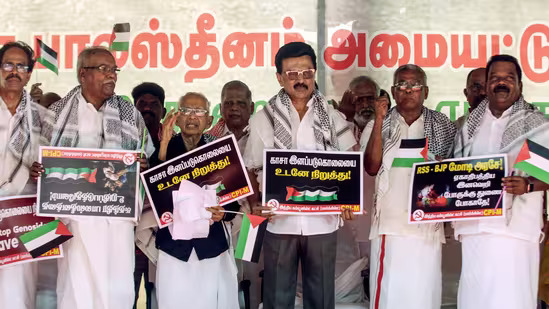
In what political analysts describe as the “height of Muslim appeasement,” Tamil Nadu Chief Minister M. K. Stalin has announced that his government will move a resolution in the Assembly condemning Israel and calling for a ceasefire in Gaza. This comes even as the state grapples with mounting law-and-order crises, corruption scandals, and a string of tragedies from the Kallakurichi hooch deaths to the Karur stampede.
While Israeli Prime Minister Benjamin Netanyahu held discussions with Prime Minister Narendra Modi on strengthening bilateral ties and security cooperation, the Dravidian government in Chennai is busy taking a stance against a friendly democratic nation. Critics argue that Stalin’s latest move exposes not only a constitutional overreach but also a deliberate attempt to divert public attention from Tamil Nadu’s deepening administrative failures. External affairs fall under the Union List, meaning states have no constitutional authority to take independent diplomatic positions. Yet, Stalin has chosen to wade into foreign policy to appease a specific vote bank, prioritising global posturing over governance at home.
Stalin’s Resolution: Politics Disguised as Morality
The controversy began when Stalin, during a protest organised by CPI(M) on October 8 in Chennai, declared his intention to move an Assembly resolution on October 14 demanding a ceasefire in Gaza. Standing alongside leftist leaders, Stalin accused Israel of committing “mass killings” and claimed that over 26,000 Palestinian children had lost their parents. “The resolution will reflect the sentiments of the people of Tamil Nadu,” he said. However, critics point out that Tamil Nadu’s people have more urgent issues unemployment, women’s safety, drug trafficking, and a deteriorating law-and-order situation.
Former BJP state president K. Annamalai was quick to hit back, saying Stalin should focus on real issues rather than indulging in international grandstanding. “People who don’t even know the route to Kallakurichi, where 68 people died after consuming illicit liquor, are now worried about Gaza,” Annamalai remarked. He also pointed out that the DMK government had failed to arrest those responsible for mixing human faeces in a water tank supplying water to Dalit households in Vengaivayal. “You showed no concern for the victims of Kallakurichi but are now shedding tears for Hamas terrorists,” he said, adding that this was “the height of comedy.”
Violation of Oath and Constitution
Legal experts and political commentators have described Stalin’s move as a violation of his constitutional oath. Matters related to foreign policy, international relations, and diplomacy lie exclusively within the jurisdiction of the Union Government. States do not have ambassadors, nor do they engage in foreign negotiations. By proposing a resolution on Israel a sovereign and friendly nation Stalin is not only exceeding his constitutional limits but also embarrassing India on the international stage.
Observers note that while Tamil Nadu is quick to permit pro-Palestine protests, it often clamps down on gatherings by BJP, RSS, or Hindu Munnani. This is not about humanitarian concern; it’s about selective politics. For Stalin, Muslim appeasement has become a political tool. He projects himself as the champion of human rights abroad while silencing dissenters at home.
Indeed, under Stalin’s government, journalists, activists, and opposition figures face routine harassment through police cases. Yet, the same administration is lecturing Israel on human rights a contradiction that even neutral observers find hard to ignore.
Hypocrisy and Selective Outrage
The selective outrage of Tamil Nadu’s ruling establishment has raised serious questions. While Stalin sheds tears for Gaza, he remains silent on the atrocities against Hindus in Pakistan, the persecution of minorities in Afghanistan, and the human rights violations in China’s Xinjiang province. “Why is there no resolution against the Pakistan’s genocide of Baloch people, or China’s oppression of Uyghurs?”
Analysts also pointed out that several countries, including the United States and European Union members, have designated Hamas as a terrorist organisation. Yet, Stalin’s speech made no distinction between the Palestinian people and Hamas terrorists. He demands the release of all prisoners, without realising that many of them are hardened terrorists responsible for killing civilians
The DMK’s selective compassion extends even to its allies. In Kerala, Congress leader Jinto John attended a pro-Palestine solidarity event organised by the Students Islamic Organisation (SIO), the student wing of Jamaat-e-Islami Hind a group with a record of radical sympathies.
Tamil Nadu’s Internal Mess: Governance on the Brink
While Stalin plays global statesman, Tamil Nadu’s internal situation is worsening. The Karur stampede, the death of a temple guard named Ajith Kumar in police custody, and rampant drug trafficking have shaken public confidence. Law and order have deteriorated to the extent that lawyers are assaulted in broad daylight as seen recently when VCK cadres attacked an advocate near a court while their leader Thirumavalavan’s car stood nearby. No arrests have been made despite the High Court taking suo motu cognisance.
Corruption cases, deteriorating public infrastructure, and unchecked crime rates have become hallmarks of the DMK government. “People want justice, not foreign policy lectures,” Annamalai said. “Stalin should be answering questions about unemployment, women’s safety, and corruption, not about Gaza.”
The Dravidian government’s diversionary tactics are clear whenever domestic failures mount, it shifts focus to emotional international issues to retain its vote base. Political analysts see this resolution as part of that pattern a calculated move to appease Muslim voters while masking administrative incompetence.
A Government Lost in Grandstanding
Stalin’s anti-Israel resolution is more about politics than principle. It reflects a government that has lost touch with the priorities of its people, using global conflicts as tools for domestic appeasement. By intruding into matters beyond its constitutional jurisdiction, the DMK government is setting a dangerous precedent one that undermines the federal structure and India’s diplomatic credibility.
Instead of posturing against Israel a nation that shares robust strategic ties with India Stalin should focus on rebuilding governance, restoring law and order, and addressing the real sufferings of Tamil Nadu’s people. The Chief Minister’s oath binds him to serve the people of his state, not to issue moral sermons on global conflicts. His resolution against Israel might win applause from his ideological allies, but for the common man in Tamil Nadu, it only deepens the sense that this government has forgotten its own citizens.