




















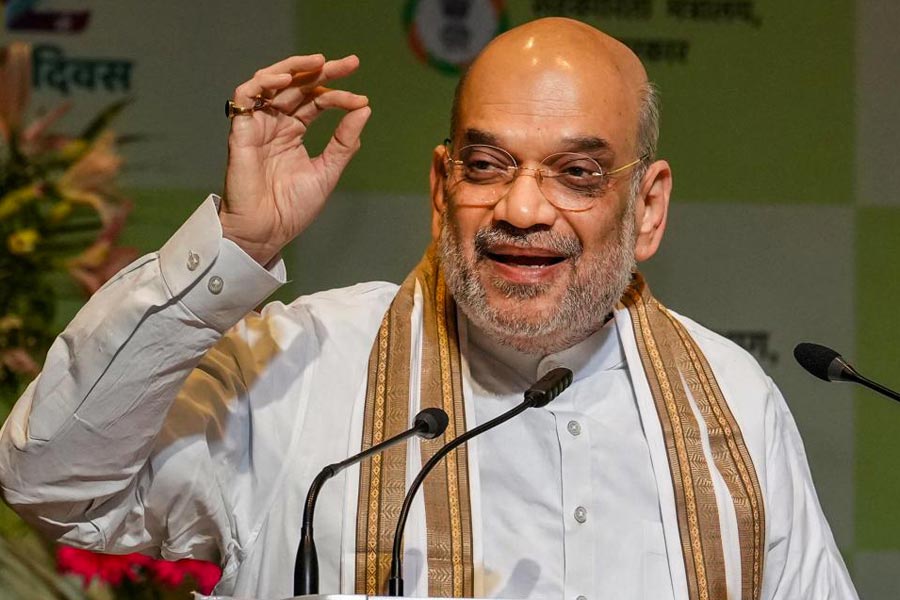
In a sharp and data-backed address that stirred the national debate on demographic change, Union Home Minister Amit Shah has sounded an urgent alarm over the issue of illegal infiltration and its long-term impact on India’s population balance, democracy, and cultural identity. Delivering the ‘Narendra Mohan Smriti Lecture’ and ‘Sahitya Srishti Samman’ ceremony organised by Dainik Jagran, Shah declared that unless every Indian recognises the link between infiltration, demographic change, and democracy, India’s sovereignty and cultural fabric could face serious threats.
He underlined that India’s changing religious demography, reflected across post-Independence censuses, was not just a matter of numbers but a question of national security and civilizational continuity. “India is not a Dharamshala,” Shah said emphatically. “We must protect our borders, our democracy, and our cultural identity from illegal infiltration.”
Census Data Reveals Stark Demographic Shift
Amit Shah backed his argument with data spanning six decades, demonstrating how the Hindu population has steadily declined while the Muslim population has risen — a trend he attributed primarily to infiltration from Pakistan and Bangladesh rather than differences in fertility rates.
Below is the comparative data Shah cited during his address:
| Census Year | Hindu Population (%) | Muslim Population (%) | Remarks |
|---|---|---|---|
| 1951 | 84.0% | 9.8% | First post-Independence census |
| 1971 | 82.0% | 11.0% | Infiltration begins to rise |
| 1991 | 81.0% | 12.12% | Continued demographic shift |
| 2011 | 79.0% | 14.2% | Sharpest increase observed |
Amit Shah pointed out that while the Hindu population has fallen by around 4.5%, the Muslim share has risen by nearly 25% between 1951 and 2011. “This is not a natural demographic trend,” he said. “The rise is primarily driven by decades of infiltration that successive governments ignored.”
He also highlighted that between 2001 and 2011, the growth rate of the Muslim population was 24.6%, which, according to him, cannot be explained merely through fertility differences. At the current rate, Shah warned, the imbalance could reach alarming levels by 2050 if unchecked.
‘Infiltration Is Not Political, It’s a National Issue’
Shah made it clear that the Narendra Modi government views infiltration as a national issue, not a political one. “When infiltrators enter and settle illegally, they alter the demography of border districts, manipulate voter lists, and affect the social structure,” he said.
He explained that infiltrators are often sheltered by political parties that view them as potential vote banks rather than security threats. “When the basis of voting is not the nation’s interest, democracy can never succeed,” Shah asserted.
The Home Minister reaffirmed the Modi government’s firm approach, encapsulated in the ‘Detect, Delete, and Deport’ policy identifying infiltrators, removing them from official records, and deporting them to their countries of origin.
Shah also questioned why states like Gujarat and Rajasthan, which share international borders, do not face the same infiltration challenges as West Bengal and Assam, where demographic changes have been most visible. “If someone crosses the border illegally and the district administration fails to act, infiltration continues unchecked. We must have local accountability,” he emphasized.
Congress Blamed for Breaking Promises Under the Nehru-Liaquat Pact
Turning the spotlight on historical failures, Amit Shah squarely blamed the Congress party for both the Partition of India and the subsequent demographic imbalance. “Dividing this country in the name of religion was a monumental mistake. By doing so, they fulfilled the British conspiracy and cut off the arms of Bharat Mata,” Shah said.
He accused Pandit Jawaharlal Nehru of betraying Hindu refugees by breaking promises made under the Nehru-Liaquat Pact of 1950, which assured protection for minorities in both India and Pakistan. “Nehru promised citizenship to refugees but went back on his word,” Shah said. “When Modi Ji’s government came with a full majority, we fulfilled that promise through the Citizenship Amendment Act (CAA).”
He reiterated that the CAA is not aimed at taking away anyone’s citizenship but rather at granting citizenship to persecuted minorities Hindus, Sikhs, Buddhists, Jains, Parsis, and Christians who fled Pakistan, Bangladesh, or Afghanistan due to religious persecution.
‘Refugees Are Not Infiltrators’: Clarifying CAA and Its Purpose
Amit Shah drew a clear line between refugees and infiltrators, a distinction he said had been blurred deliberately by opposition parties for political gain. “A refugee comes to India to save their religion, an infiltrator comes illegally for economic or other reasons,” Shah explained.
He further clarified that CAA does not target any Indian Muslim. “There is no provision in the CAA to take away anyone’s citizenship Hindu, Muslim, Sikh, or Christian. Its sole purpose is to protect refugees who were promised safety in India after Partition but were denied it for decades,” he said.
Shah also said that while the BJP government has fulfilled its promise to refugees, it remains equally determined to seal India’s borders, enhance citizen verification systems, and support the Election Commission’s Special Intensive Revision (SIR) of electoral rolls to prevent illegal entrants from gaining voting rights.
“The Constitution entrusts the Election Commission with ensuring free and fair elections,” Shah reminded. “That is only possible when the voter list contains only Indian citizens. Allowing infiltrators to influence democratic outcomes is an insult to the Constitution itself.”
A Call for National Vigilance
The Union Home Minister concluded his address by urging citizens to view infiltration and demographic shifts as existential issues rather than electoral ones. “Demographic change, infiltration, and democracy are deeply connected. If infiltration is not stopped, India will turn into a Dharamshala — a shelter without control,” he warned.
Shah’s message was not merely political; it was civilizational. He called upon citizens, bureaucrats, and state administrations to unite against infiltration and protect India’s borders from demographic dilution. “Protecting the nation’s cultural and demographic identity is as important as protecting its physical borders,” he said.
In essence, Amit Shah’s address was a wake-up call an appeal to awaken public awareness about the invisible but steady demographic transformation driven by infiltration, and to act before the balance shifts irreversibly. His reminder was clear: “Without national security and demographic stability, democracy cannot survive.”