
















Durga Puja is not merely a religious celebration in Bengal; it is a cultural phenomenon that combines devotion, community spirit, art, and politics into one of the grandest carnivals of the Indian subcontinent. Its history spans centuries, carrying traces of tribal worshi, Vaishnavite influence, zamindari extravagance, nationalist fervour, and modern-day political assertion. What makes Bengal’s Durga Puja truly unique is its ability to constantly adapt to social changes while retaining its spiritual core.
The Festival as a Carnival of Community and Art
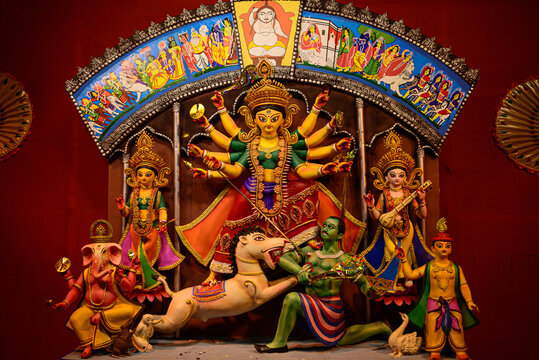
Durga Puja in Bengal is celebrated less like a private religious ritual and more like a community carnival. Its carnival-like atmosphere includes music, food, theatre, dance, and especially the spectacular artistry of pandals and idols. What distinguishes it from other festivals is the powerful element of public art that merges aesthetics with social commentary.
This creative streak has deep historical roots. In the 18th and 19th centuries, Bengal’s zamindars would compete to showcase the grandest Durga Pujas, using wealth and artistry as a measure of prestige. That legacy survives in today’s elaborate pandals, where local clubs and organisers compete with breathtaking installations that often blend tradition with innovation. In modern times, pandal artistry has also become a space for social messaging, with themes ranging from climate change to migrant struggles, proving that the festival remains deeply relevant to contemporary concerns.
From Tribal Worship to Brahmanical Integration
Durga’s journey in Bengal reflects the assimilation of local tribal deities into the mainstream Hindu pantheon. Before Durga worship gained prominence, Bengal’s religious life centred on local goddesses like Sheetala, the deity of smallpox, and Manasa Devi, the goddess of snakes. After 13th and 14th centuries, these local traditions were not discarded but integrated. It was during this period that Durga emerged as a fierce goddess in Bengal’s spiritual imagination.
By the 15th and 16th centuries, the rise of Vaishnavism in Bengal softened Durga’s image. She was increasingly seen as a mother and wife consort of Shiva and mother to Kartik, Ganesha, Saraswati, and Lakshmi. In the Bengali tradition, Durga is revered not only as a warrior goddess but also as a beloved daughter who returns to her parental home every autumn. This dual identity explains why her annual visit is celebrated with such heartfelt fanfare, culminating in an emotional farewell ritual reminiscent of a daughter returning to her marital home after a festive stay.
A Tool of Social and Political Assertion
Durga Puja has never been divorced from politics. In the 18th century, as Bengal shifted from the nawabs to British colonial power, zamindars used lavish Durga Puja celebrations to display wealth and assert dominance. The festival was as much about showcasing influence as about devotion.
In the 19th and 20th centuries, the festival acquired nationalist undertones. Writers like Bankim Chandra Chattopadhyay portrayed Durga as the embodiment of Bharat Mata, inspiring anti-colonial fervour. The concept of Sharbojonin Puja (community Durga Puja) emerged during the freedom struggle as a unifying force cutting across caste and class divisions. This democratization of worship played a symbolic role in challenging social hierarchies and colonial rule alike.
Even today, Durga Puja retains political significance. Meanwhile, puja organizers continue to use the festival for social and political expression.
Durga Puja as a Living Tradition
What keeps Durga Puja alive in Bengal is its remarkable ability to evolve with time. From tribal shrines to zamindari mansions, from freedom movement symbolism to today’s global recognition by UNESCO as an intangible cultural heritage, the festival has transformed in response to changing times. It continues to be a spectacle of faith and art, a platform for collective expression, and a marker of Bengal’s cultural identity.
The blend of spirituality, community celebration, artistic innovation, and political expression ensures that Durga Puja is never static. Every generation reinvents it, making it a living tradition that binds past, present, and future in one unbroken flow of devotion and celebration.
The Eternal Spirit of Bengal’s Durga Puja
Durga Puja is Bengal’s heartbeat. Its origins in tribal traditions, evolution through Vaishnavite influence, and role in nationalist politics have all shaped it into a multidimensional cultural force. Today, it functions as both a platform for artistic brilliance and a mirror of social realities, while retaining its sacred identity. The festival’s ability to embody devotion, creativity, and assertion simultaneously explains why it remains central to Bengal’s cultural identity. Ultimately, Durga Puja is not just about worshipping a goddess—it is about celebrating resilience, unity, and the eternal spirit of a people.