








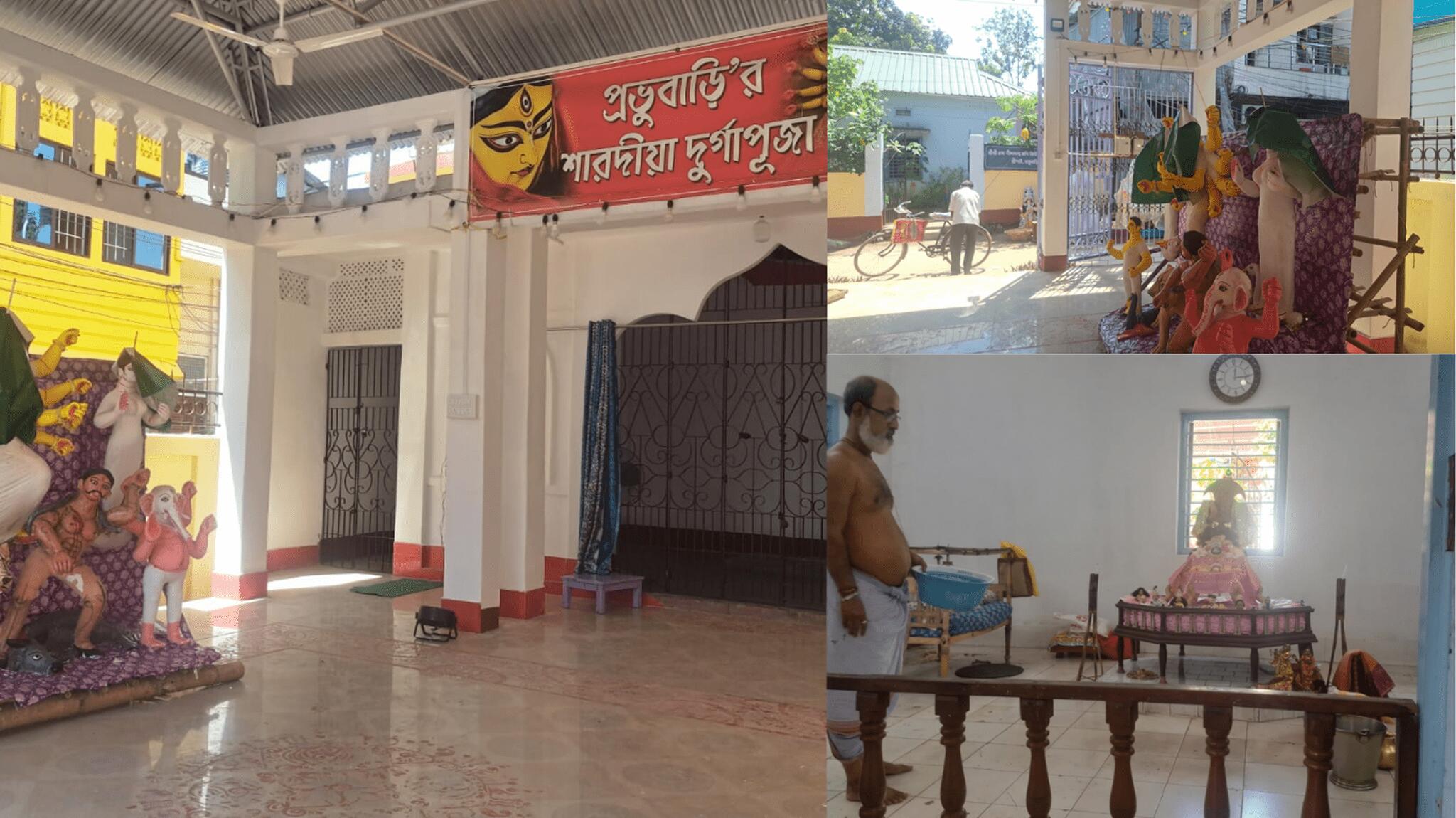
Started in the middle of the 19th century, the Durga Puja as per the Vaishnavite traditions in ‘Prabhu Bari’ is one of the oldest religious customs of Tripura which still bears the essence of erstwhile royal glory. It signifies how the kings of Tripura patronised Gaudiya Vaishnavism in its true form and spirit.
‘Prabhu Bari’ refers to the house of the spiritual mentor (Guru) of the Manikya dynasty that ruled Tripura until the Instrument of Accession was signed.
For the last 170 years or so, this Puja has assumed great spiritual and religious significance for the royal family. In fact, the idol of Goddess Durga worshipped here is immersed with full state honour along with the idol of Durga Bari, the temple of the royal family.
It has been a tradition that the idol of Prabhu Bari needs to be immersed first and then the idol of Durga Bari, after which the other idols of community Pujas and household Pujas proceed towards the place of immersion.
According to historical accounts, the Puja in Prabhu Bari was started during the time of Maharaja Ishan Chandra Manikya, the monarch who arranged permanent settlement for the whole family of his spiritual mentor Prabhu Pada Bipin Bihari Goswami at Agartala near the Laxmi Narayan Bari. Goswami was also made the Prime Minister in the royal court of the Maharaja as he felt that the spiritual guidance of the saintly figure was extremely necessary to ensure law and justice during his rule.
Bipin Bihari Goswami happens to be a Vaishnav saint from the lineage of Nityananda Mahaprabhu also widely known for his association with Chaitanya Mahaprabhu, the great spiritual leader who founded the Bhakti movement in Bengal. Prabhu Pada Bipin Bihari Goswami carried the bloodline of the great saint who, according to Vaishnavism, was an incarnation of Balaram.
Speaking on the issue, Madhanbanada Goswami, the descendant of the king’s spiritual mentor said, “Prabhu Bipin Bihari Goswami’s links with the Manikya Dynasty were established after a miraculous event which saved the life of the then prince of the kingdom. Prabhu reached Agartala as part of his religious expedition. He was resting under a tree in Laxmi Narayan Bari one fine morning when he saw a large crowd moving in one direction. When he asked one of the passers-by he was told that they were going to the royal palace. He was also made aware of the critical health condition of the prince. The prince was bedridden and, due to the critical health condition of his only child, the Maharaja was extremely anxious.”
He said, “Prabhu decided to visit the royal palace. He went there, spoke to the king and also physically examined the prince’s health. Prabhu told the Maharaja that he could help the prince recover from this state, but there was a condition. The Maharaja agreed to all conditions. For three days, Prabhu Bipin Bihari Goswami meditated inside a closed room in the Laxmi Narayan Bari. On the third day, he came out and went straight to the prince. The miracle really happened as the prince was cured. He could sit down on the bed on his own. After that incident, the prince Ishan Chandra Manikya was spiritually initiated by Prabhu Bipin Bihari Goswami which is popularly called the ‘Diksha Grahan’. Later, Ishan Chandra Manikya became the king and he offered his spiritual mentor the post of Prime Minister,” Goswami recalled.
Initially, Prabhu refused the post of Prime Minister, citing that his whole family was based in Bengal. The king insisted and arranged a settlement for the whole family of the spiritual mentor near Laxmi Narayan Bari. Along with his family, Prabhu also brought the revered Shaligram Shila which was consecrated at Radha Neelkanta Mani Jiu Debata Mandir. “Under the Maharaja’s instruction, an ivory throne almost following the same design of the royal throne was constructed for laying the revered Shila. But, it was found that the throne was lesser in height. Later another throne was prepared which was placed beneath the ivory throne to enhance the height. That Shila is still worshipped in this temple,” said Goswami.
Ever since this Durga Puja started, the royal family receives the idol of Prabhu Bari at the palace following religious rituals on the day of Dashami even before the idol of Durga Bari is brought to the palace compound. After the customary reception, both the idols proceed towards the place of immersion.
Maharaja Ishan Chandra Manikya was on the throne between 1849 and 1862. On being asked about the Puja, Goswami said, “This Puja is special in the sense that all the rituals performed here during the Puja are in accordance with the Matsya Puran, which is one of the eighteen major Puranas and one of the oldest and better preserved in the Puranic genre of Sanskrit literature in Hinduism. This Puran is not readily available everywhere. The whole process is strictly Vaishnavite.”
On the finances for the religious purposes, he said, “Since 2009, the Government of Tripura has taken over all the financial needs of the temple and different religious festivals organised here. Before that we used to arrange the Puja and other religious activities of the temple on our own. During the royal period, a portion of the King’s revenue collected from the Chakla Roshnabad (now in Bangladesh) used to be earmarked for our family.”
He said that ever since the government took over the charge of the temple, he had surrendered the token money he used to get as the principal sevait of the temple.
On being asked about the present head of the royal family, Goswami lamented that after Maharaja Kirit Bikram, the warmth of the relationship between the royal family and them gradually subsided.
“The present royal head sends someone on the day of Maha Navami to enquire about the Puja. Besides that, very little interaction takes place. Last time, I was invited to the ancestral ritual after the death of Maharaja Kirit Bikram,” he added.