
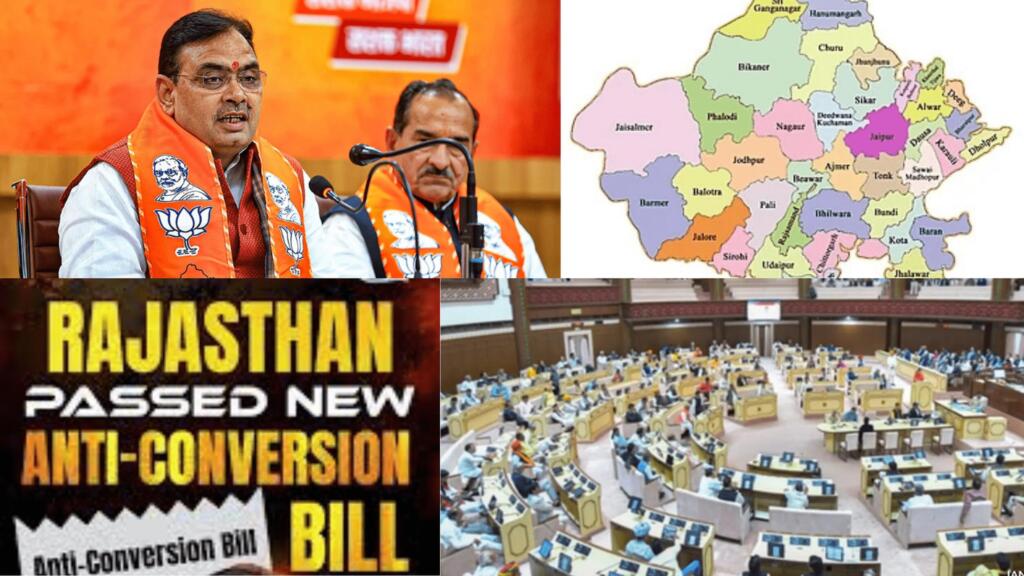
In a move hailed as a milestone in India’s fight against unlawful religious conversions, the Rajasthan Assembly has passed the Prohibition of Unlawful Religious Conversion Bill, 2025. The legislation has been described by the Bhajanlal Sharma-led government as a historic step to safeguard vulnerable communities, protect social harmony, and defend India’s cultural fabric from deceitful and foreign-funded conversion mafias. By introducing strict punishment, ranging from long prison terms to life imprisonment for mass conversions, the state has sent out a clear message: coercion, inducement, and fraud have no place in matters of faith.
Strongest Punishments Against Forced Conversions
The bill lays down the most stringent provisions in the country to date against fraudulent religious conversions. Individuals found guilty of conversion through deceit, fraud, inducement, or force will face seven to 14 years in prison along with a fine of up to ₹5 lakh. Conversions targeting women, minors, Scheduled Castes, Scheduled Tribes, and persons with disabilities will attract 10 to 20 years of imprisonment and a minimum fine of ₹10 lakh.
The law also takes a hard stance against organized or mass conversions. Any attempt to convert groups of people using fraudulent means will invite 20 years to life imprisonment with a minimum fine of ₹25 lakh. Furthermore, foreign or illegal funding used for conversion activities will result in rigorous imprisonment of 10 to 20 years and a fine of at least ₹20 lakh.
By introducing these unprecedented penalties, Rajasthan has placed itself at the forefront of India’s broader movement to end forced conversions.
Protection for the Vulnerable and Defending Identity
Minister of State for Home, Jawahar Singh Bedham, stressed that Article 25 of the Constitution guarantees freedom of religion but never supports forced or fraudulent conversions. He underlined how weaker sections, including SCs, STs, the poor, and women, are routinely targeted by conversion syndicates.
The bill also empowers authorities with preventive tools. Marriages conducted solely for conversion purposes can be annulled by family or competent courts, while properties used for forced conversions will be confiscated by the state. Additionally, the law makes it mandatory for individuals to inform the district magistrate prior to any voluntary religious conversion, ensuring transparency and accountability.
This is not just about legal enforcement—it is about preserving Rajasthan’s composite culture, where faith is respected but never exploited. The bill reinforces the idea that India’s social identity must not be diluted through coercion or manipulation.
Standing With Other States, Strengthening the National Framework
Rajasthan now joins the ranks of states like Uttar Pradesh, Uttarakhand, Karnataka, Haryana, and Himachal Pradesh, all of which have enacted anti-conversion laws to safeguard their societies. However, Rajasthan’s 2025 legislation has been recognized as one of the toughest and most comprehensive frameworks in the nation, filling in gaps left by its earlier 2008 law.
Past cases of forced conversions in districts such as Alwar and Banswara exposed the need for a stronger legal mechanism. By tightening provisions and expanding punishments, the government has acted to ensure that no vulnerable community is left unprotected.
Importantly, this is not just a Rajasthan-specific issue but part of a larger national effort to curb conversion mafias operating with foreign funding and political backing, threatening the country’s unity and harmony.
Congress Walkout Shows Political Divide
While the bill was passed by a voice vote, opposition Congress legislators abstained from participating in the debate and merely shouted against the bill’s strict provisions. Their walkout was seen as a refusal to engage with the very real and pressing problem of deceitful conversions.
For the BJP government, this legislation was not about political gain but about safeguarding Rajasthan’s identity and ensuring that generations to come inherit a society free from manipulative conversion practices. The contrast between the BJP’s decisive governance and Congress’s reluctance to act on such a sensitive issue was once again starkly visible in the Assembly.
A Bill That Reshapes Rajasthan’s Future
The passage of the Rajasthan Prohibition of Unlawful Religious Conversion Bill, 2025, is more than just a legal development—it is a cultural and social shield. By criminalizing fraudulent conversions with the harshest penalties in the country, the state has created a model for the rest of India. The bill strengthens constitutional values, upholds individual freedom of faith, and protects vulnerable communities from exploitation.
This historic legislation shows that while freedom of religion is sacred, deceitful conversions will not be tolerated. Rajasthan has taken a bold step, setting an example for the nation and reaffirming India’s commitment to preserving its dharmic fabric against divisive forces.