









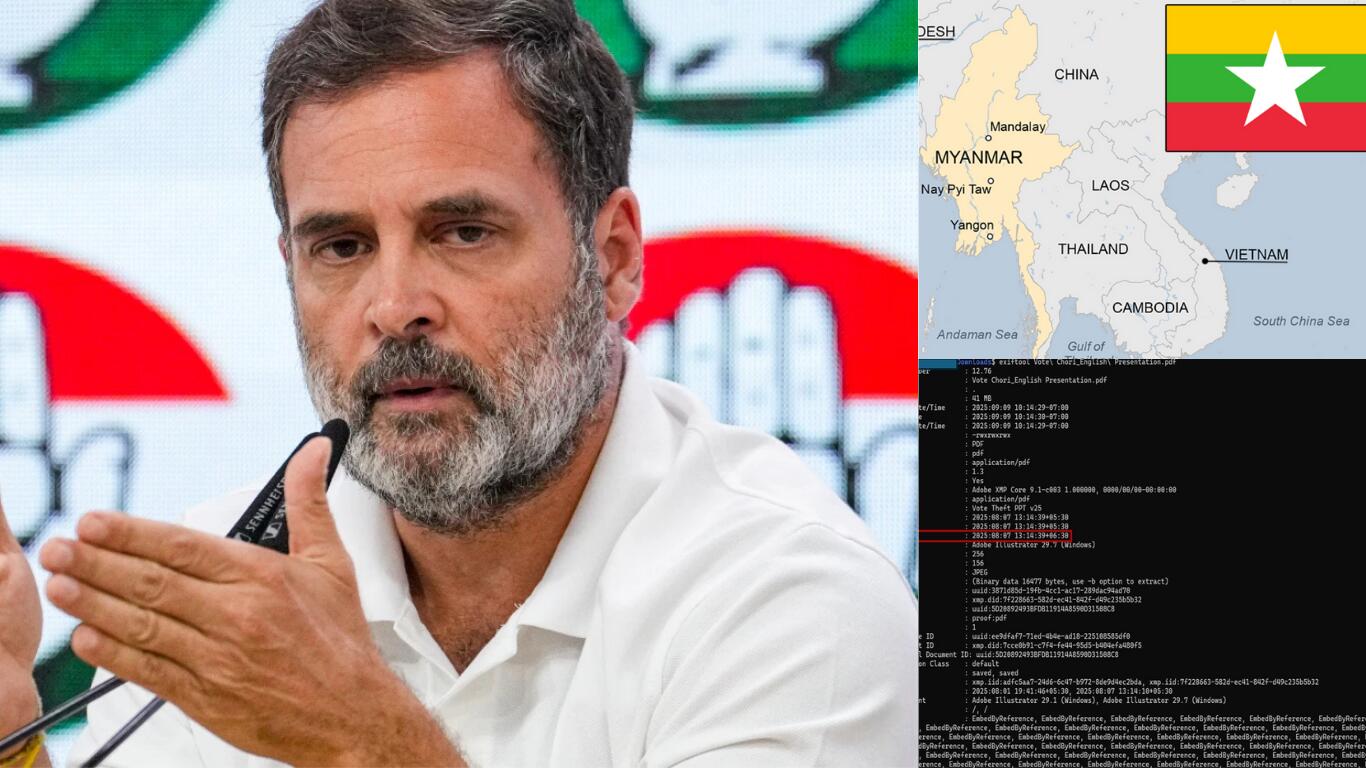
What is the real connection between Rahul Gandhi and Myanmar? This question has rocked India’s political landscape ever since metadata analysis of the Congress leader’s “vote chori” PowerPoint presentation revealed shocking details. The file was not prepared in India but in Myanmar a country that has witnessed coups, regime changes, and violent unrest. The fact that documents used to question India’s democratic process carry digital fingerprints of Myanmar has set off alarm bells across political and security circles. In a region where Sri Lanka, Bangladesh, and Nepal have already suffered political instability, the possibility of a foreign hand in India’s internal politics cannot be ignored. The revelations raise a larger issue: Is the Leader of Opposition merely an Indian politician, or is he acting as a messenger of foreign anti-India interests?
Metadata Doesn’t Lie: Myanmar Time Zone Stamps
The entire controversy began when X (formerly Twitter) user ‘khurpenchh’ conducted a metadata analysis of Rahul Gandhi’s vote chori PPT. The findings were explosive. All three versions of the Congress leader’s presentation were created in the Myanmar Standard Time (MMT) zone 6 hours 30 minutes ahead of UTC. In contrast, any file genuinely created in India would show the Indian Standard Time (IST) of UTC +5:30. The fact that Congress’ “smoking gun” evidence was stamped with MMT timezone meant it was either prepared in Myanmar or directly manipulated from there.
What makes this revelation more damning is the fact that VPNs or file transfers via Google Drive cannot alter PDF metadata. The time zone and system details remain embedded, and these are impossible to fake without deliberate tampering. Congress IT cell trolls attempted to cover up by claiming that Adobe software had a “timezone bug,” but experts quickly demolished this excuse. Adobe had fixed such bugs more than a decade ago, and Illustrator the very software used for Rahul Gandhi’s PPT never had such an issue. This suggests one thing: the document was indeed prepared in Myanmar.
Foreign Trips, Secret Meetings, and Familiar Patterns
The Myanmar connection is not an isolated incident. Rahul Gandhi’s frequent, unexplained foreign trips often raise suspicion. Sometimes it is Thailand, sometimes Vietnam, sometimes Malaysia and each time, these trips come to light only through leaked pictures or viral videos. When Punjab and Himachal Pradesh were reeling under devastating floods, Rahul Gandhi was reportedly vacationing in Malaysia. The timing of these “secret tours” often coincides with international campaigns to target India’s image.
During the farmers’ protests, India had witnessed a massive global disinformation campaign. From Canada to the UK, anti-India narratives were amplified by foreign lobbies, with NGOs and activists linked to billionaire George Soros also pushing the agenda. Now, with Rahul Gandhi’s Myanmar-linked PPT, the fear that similar toolkit-style operations are underway again gains further credibility. BJP spokesperson Shehzad Poonawalla rightly asked, “Are you being played around like a puppet at the hands of foreigners? Is your script to paint India as a democratic deficit being written in another country?”
These questions are important because Rahul Gandhi’s track record shows a disturbing consistency. From signing a secret Memorandum of Understanding (MoU) with the Chinese Communist Party in 2008 to repeatedly seeking international intervention against India in his speeches abroad, the Congress leader’s politics seems more aligned with external pressure groups than with the aspirations of Indian voters.
Congress and Foreign Hand: From Soros to Myanmar
The Myanmar revelations come at a time when foreign interference in India’s politics has already become a serious concern. Congress leaders have openly quoted Soros-funded reports in Parliament. Rahul Gandhi’s own ecosystem has been accused of using bot networks based in Kazakhstan, Indonesia, and Russia to amplify anti-BJP propaganda online. His “vote chori” narrative fits neatly into a larger design of delegitimizing India’s democratic institutions, similar to how Western-backed activists have delegitimized governments in Sri Lanka, Nepal, and Bangladesh before regime change attempts.
BJP national spokesperson RP Singh directly connected the dots, saying: “It is clear that foreign forces are influencing the Congress leadership. This revelation has made it clear that Rahul Gandhi and the Congress leaders are connected to Soros.” He further questioned whether Rahul Gandhi is the Leader of Opposition in India or merely a promoter of a foreign anti-India toolkit.
The Myanmar link also gains significance because the same country has been a hotbed of Rohingya infiltration into India. If the same Myanmar is now connected to Congress’ so-called evidence against India’s Election Commission, it paints a grim picture of deliberate attempts to destabilize India from across the border.
Is Rahul Gandhi Fighting Elections or Playing Puppeteer?
The controversy surrounding Rahul Gandhi’s Myanmar-linked PPT is not just about one document. It points to a deeper pattern of political behavior that prioritizes foreign validation over Indian democracy. From his MoU with the Chinese Communist Party, to mysterious foreign trips, to the use of documents traced to Myanmar Rahul Gandhi appears less like a domestic opposition leader and more like a participant in a global anti-India playbook.
As BJP leaders have emphasized, India today is governed by a leader who has earned respect globally for his conviction and delivery. Yet, the Opposition seems desperate to invite foreign interference instead of earning the trust of Indian voters. With Nepal’s youth themselves calling for “a leader like Modi,” the contrast becomes even sharper. While Modi strengthens India’s global image, Rahul Gandhi’s foreign entanglements weaken the credibility of his politics.
In the end, the big question remains: Is Rahul Gandhi truly representing India’s Opposition, or is he representing foreign interests who seek to destabilize India’s rise? For the voters, the answer may decide not just the future of Congress but also the integrity of Indian democracy itself.