
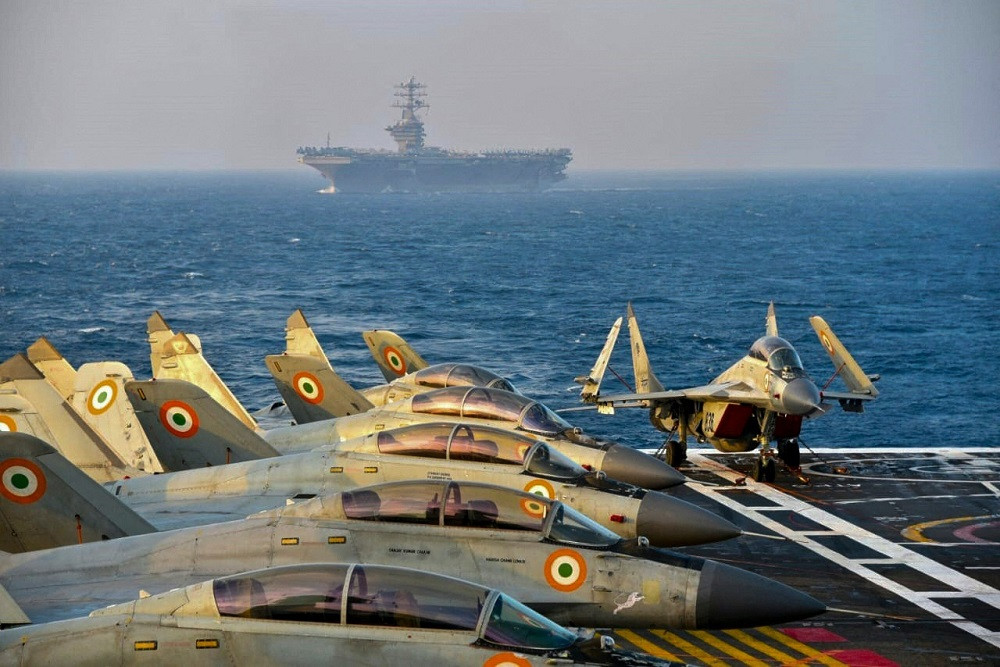
India is rising, and the world is watching closely. From September 2nd to 3rd, the Indian Air Force will carry out a high-intensity combat exercise over the Arabian Sea, right next to Pakistan’s backyard just 200 nautical miles from Karachi and barely 70 nautical miles from Pakistan-controlled airspace. A NOTAM has been issued, warning of missile firing during the drill. But the real question is this what exactly is being tested? Is this just routine training, or are we witnessing the next chapter in India’s defence power with the trials of our game-changing BrahMos Next Generation missile or the Astra Mk-III Gandiva?
India’s Arabian Sea Exercise: Power Projection Near Pakistan
The Indian Air Force (IAF) has declared a two-day exercise in the Arabian Sea, beginning at 11 AM on September 2 and concluding at 2 PM on September 3. What makes this exercise significant is not just its timing but also its location. The declared zone lies only 200 nautical miles from Pakistan’s Karachi coast and as close as 70 nautical miles from Pakistan-controlled airspace. In such a sensitive area, the message is clear: India is showcasing its strength and testing its readiness against any potential adversary.
To formalize this drill, the IAF issued a NOTAM or Notice to Air Missions alerting pilots and airlines that certain airspace will be restricted due to live firing and unusual military activity. While the Air Force described the event as a “routine training operation,” the exercise coordinates raise eyebrows, as they overlap with the potential range of India’s most advanced missile projects under development.
This has led many defence watchers to ask are we looking at routine manoeuvres, or could this be a trial run for India’s next-generation missile systems, the BrahMos-NG or the Astra Mk-III Gandiva?
Astra Mk-III Gandiva: India’s Beyond-Visual-Range Guardian
The Astra Mk-III, recently christened Gandiva after Arjuna’s divine bow from the Mahabharata, is India’s most ambitious beyond-visual-range (BVR) missile project. Developed by the Defence Research and Development Organisation (DRDO), this air-to-air missile is designed to give the IAF an edge over enemy fighters long before they can threaten Indian airspace.
The Gandiva boasts a maximum range of 340 kilometers when targeting aircraft at 20 kilometers altitude, and around 190 kilometers when engaging lower-flying targets. With a dual-fuel ducted ramjet engine, it sustains supersonic speeds of Mach 4.5, making it one of the fastest and longest-range air-to-air missiles in the world.
What sets Gandiva apart is its agility. It can target highly maneuverable fighters, even those making sharp turns, with an angle of attack of up to 20 degrees. Its ±10 km snap-up and snap-down capability allows it to strike both higher and lower flying aircraft. This makes it lethal against enemy fighters, bombers, refuelers, and AWACS surveillance planes.
The missile will be deployed on India’s frontline Sukhoi Su-30MKI jets and the indigenous Tejas Light Combat Aircraft. While Gandiva is still undergoing trials and is expected to be fully combat-ready around 2031, its development tests are ongoing. The Arabian Sea NOTAM zone matches its test profiles, suggesting that this exercise could involve Gandiva trials.
BrahMos-NG: The Next Generation Supersonic Strike
Alongside Gandiva, another strong contender for testing during this exercise is the BrahMos Next Generation missile, or BrahMos-NG. The original BrahMos, jointly developed with Russia, has already been inducted since 2005 and is regarded as one of the deadliest supersonic cruise missiles in the world. Capable of being launched from land, sea, sub-sea, and air, it boasts a range of over 400 kilometers and a speed of Mach 2.8.
The BrahMos-NG, however, represents a significant upgrade. It will retain a range of 290 kilometers but will be lighter, sleeker, and more compact just 1.33 tonnes compared to the current 2.65-tonne version. This reduced weight means a Su-30MKI will be able to carry up to four BrahMos-NG missiles, while the Tejas can carry two.
This advancement gives India unmatched strike capability. The BrahMos-NG will be quicker to launch, harder to intercept, and easier to integrate across different fighter platforms. It will also serve as a primary deterrent weapon, capable of precision strikes on enemy bases, radars, and strategic command centers deep inside hostile territory.
Former Air Chief Marshal V. R. Chaudhari described the BrahMos-NG as the IAF’s future “primary deterrent weapon.” Given the Arabian Sea’s history of being a preferred testing ground for BrahMos trials, there is strong speculation that this exercise may involve the BrahMos-NG.
Routine Exercise or Strategic Message?
While the IAF has described this drill as “routine,” the declared coordinates, the issued NOTAM, and the timing raise deeper questions. Both Gandiva and BrahMos-NG are currently in crucial phases of testing. The Astra Mk-III requires flight trials for its propulsion system and range validation. Meanwhile, the BrahMos-NG is being readied for full integration with fighter jets, and live firing exercises are essential.
It is entirely possible that the two-day drill is more than just training. Instead, it may be a carefully orchestrated exercise combining combat manoeuvres with live testing of one or both of these advanced missile systems. By conducting it so close to Pakistan’s airspace, India is not just testing hardware it is sending a powerful signal to adversaries.
India’s Message to the World
India’s Arabian Sea exercise is more than a routine drill it is a statement of intent. Whether it is the Gandiva, designed for air superiority, or the BrahMos-NG, built for deep strike precision, both systems symbolize India’s determination to dominate the skies and seas in any conflict scenario.
At a time when the region remains sensitive, India is proving that it will not hesitate to showcase its power. For our adversaries, the message is clear India is ready, armed with weapons that can strike first, strike deep, and strike decisively. For the Indian people, this exercise reaffirms our nation’s resolve to protect sovereignty, strengthen deterrence, and prepare for the battles of tomorrow.