
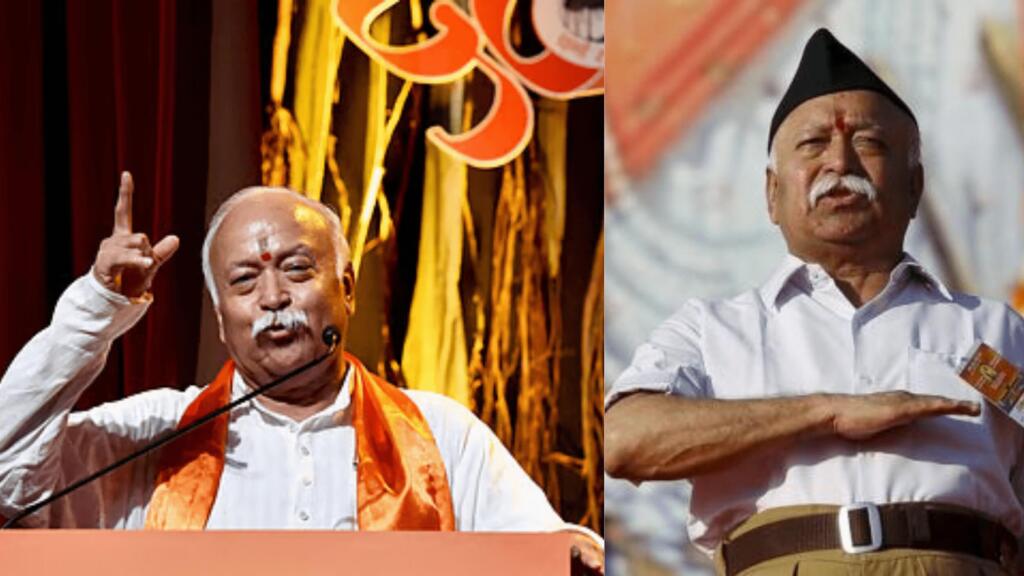
Shri Mohan Bhagwat, the sixth Sarsanghchalak of the Rashtriya Swayamsevak Sangh (RSS), turns 75 on September 11, 2025. Such a milestone invites reflection from scholars, political observers, and society at large. Bhagwat’s journey represents more than the rise of a dedicated swayamsevak within a cadre-based organisation; it is the story of a thought leader who has shaped discourses on national integration, Indian culture, and civilisational values.
In an era marked by globalisation, technological disruption, identity politics, and social realignments, Bhagwat’s leadership blends rooted tradition with reformist impulse. His interventions have often transcended the organisational boundaries of the RSS, engaging broader questions about India’s trajectory in the 21st century. His leadership is multidimensional—historical, ideological, social, and cultural and therefore demands critical attention from youth, academics, and policymakers alike.
Rise of a Pracharak
Mohan Madhukar Bhagwat was born on September 11, 1950, in Chandrapur, Maharashtra, into a family with close ties to the RSS. His father, Madhukar Rao Bhagwat, served as a pracharak, which deeply influenced his early exposure to the ethos of discipline, service, and cultural nationalism.
Though he studied veterinary sciences at Nagpur Veterinary College, Bhagwat abandoned his academic career during the Emergency of 1975 to dedicate himself fully to organisational work. This decision reflected a profound conviction in the RSS mission.
From the 1980s onwards, Bhagwat steadily rose through the ranks, serving as Akhil Bharatiya Sharirik Pramukh (head of physical training) and later as Akhil Bharatiya Pracharak Pramukh (head of full-time workers). On March 21, 2009, he was appointed the sixth Sarsanghchalak, succeeding K. S. Sudarshan.
Mohan Bhagwat inherited an organisation already established as one of India’s most influential socio-cultural forces. His leadership has balanced continuity and change. The continuity is evident in his emphasis on discipline (anushasan), volunteerism (seva), and cultural rootedness (sanskriti), principles defined by Dr. K. B. Hedgewar in 1925. The change is visible in his efforts to modernise outreach, embrace digital platforms, engage diverse communities, and address contemporary social issues.
Social Harmony and Equality
Mohan Bhagwat has repeatedly stressed upon the centrality of social harmony. Recently, his three day discourse to mark the centenary celebrations of RSS, “Vyakhyanmala: 100 Years of Sangh Journey, New Horizons”, at Vigyan Bhawan, New Delhi, organised between 26 to 28 August 2025, Bhagwat emphasised that the RSS is not merely a political force, but a cultural and social organisation whose primary mission is nation-building through the transformation of individuals. He underlined that the foremost value upheld by the Sangh is the cultivation of human character, which, in turn, shapes the collective behaviour of society. For the Sangh, social transformation is seen as a gradual but deeply rooted process, beginning with the personal discipline, moral strength, and selflessness of the swayamsevak. According to Bhagwat, the vision of the RSS is to create a society bound by harmony, shared values, and a sense of responsibility towards the nation.
In his Vijayadashami address of October 2024, he declared: “The first condition for a healthy and able society is social harmony and mutual goodwill among different sections of society… all sections should understand the needs of weaker sections which arise from the circumstances they face.” He has consistently emphasised the eradication of caste-based discrimination. At his 2014 Vijayadashami speech, he stated: “There is an urgent need to eradicate social discrimination in our society in a bigger and faster way. Citizens must come forward to abstain, forbid, and reject all practices that weaken the social fabric. Society must reject all forms of untouchability and inequality.” This vision of samajik samrasta (social harmony) positions Indian society as an organic unity. For the youth, who increasingly reject rigid identities and demand inclusivity, Bhagwat’s emphasis represents a reformist intervention. He has also supported inter-caste marriages as a means to foster equality, pointing out that a significant number of swayamsevaks themselves have embraced such unions. In the same 2014 address, he said that India to evolve a new development model, rooted in dharmic civilisational values yet adapted to modern needs. This demonstrates that the RSS is not against change but seeks transformation aligned with enduring principles.
At the Vyakhyanmala of 2025, Bhagwat also addressed the often-discussed relationship between the RSS and the BJP. While acknowledging that the BJP has emerged as the political wing inspired by the ideals of the Sangh, he clarified that the RSS does not function as a political party itself. Instead, it seeks to work in the social and cultural spheres, influencing political directions only indirectly by shaping the broader ethos of society. In his words, politics is one dimension of national life, but the Sangh’s responsibility extends to every aspect of human development education, culture, economy, and moral values. Thus, while the RSS and the BJP share ideological roots, their operational domains remain distinct.
The Debate on Hindutva
At the Vyakhyanmala of 2025, Bhagwat also reiterated the long-standing conviction of the Sangh that India is fundamentally a Hindu nation. He emphasised that the term “Hindu” should not be understood in a narrow, religious sense, but as a cultural identity encompassing the civilisational ethos of the land. The philosophy behind this idea, as outlined by him, is rooted in inclusivity, harmony, and the recognition of diversity within unity. For Bhagwat, the word “Hindustan” represents not only a geographical territory but also a civilisational space where pluralism, spiritual pursuit, and collective well-being have historically flourished.
By framing the identity of India as a Hindu nation, Mohan Bhagwat sought to highlight the cultural continuity and civilisational depth of the country. At the same time, he argued that this identity is not exclusionary but seeks to affirm the essential values of coexistence and mutual respect. For the Sangh, nationhood is a matter of shared values and cultural belonging rather than rigid political boundaries. Bhagwat’s commitment to Hindutva has drawn both support and criticism. While critics argue that it risks marginalising minorities, Bhagwat has clarified that Hindu Rashtra does not exclude any community. He insists it does not mean a theocracy but rather a civilisational identity grounded in pluralism and harmony.
Earlier in his 2016 Vijayadashami address at Nagpur, he explained: “Hindutva is the identity of this nation. It is not a word of conflict; it is a word of unity. It binds us in diversity and connects us to our eternal ethos.” For Bhagwat, Hindutva is not a sectarian identity but the cultural DNA of the Indian subcontinent, embracing diversity while affirming unity. For students of political science, this interpretation shifts the debate from narrow identity politics to civilisational belonging. Engaging critically with his ideas allows youth to explore Indian thought beyond Western binaries of liberal vs. conservative or secular vs. religious.
Rashtra Dharma and Globalisation
In an age of consumerism and hyper-individualism, Mohan Bhagwat reasserts Rashtra Dharma the principle that duties to the nation precede personal privileges. His call for selfless service, ethical governance, and national pride provides a moral compass for a generation facing rapid change. He has also addressed the challenges of globalisation. In his 2018 lecture at Vigyan Bhavan, “Future of Bharat: An RSS Perspective”, he argued: “Globalisation is inevitable. But Bharat must globalise from its own strength. We should not lose ourselves in imitation; instead, we must contribute to the world with our values of harmony and sustainability.” This vision emphasises aatmanirbhar bharta (self-reliance) and civilisational confidence as prerequisites for engaging with the world.
Appeal to the Youth
Mohan Bhagwat has consistently highlighted the central role of the younger generation. At the preparatory meeting for the RSS centenary celebrations (2024, Nagpur), he declared: “The future of Bharat rests on its youth. They must imbibe discipline, serve society selflessly, and carry forward our civilisation with confidence and compassion.” For students, this underscores that leadership is not limited to politics but extends to building character, vision, and social responsibility.
The Significance of 75
As the RSS moves into its centenary celebrations, Mohan Bhagwat’s articulation of its core values and vision underscores its long-term objective: to transform society from the ground up by shaping individuals, and thereby building a nation that remains rooted in its civilisational heritage while adapting to modern horizons. But it is not necessary to agree with every idea Mohan Bhagwat proposes. Yet dismissing them without understanding undermines critical inquiry. For students and research scholars, engaging with his ideas is essential for grasping one of the most influential ideological currents in modern India. A rational reading of Bhagwat requires contextual awareness and intellectual openness. By doing so, India’s youth can rise above dogma and embrace an informed, ethical nationalism—rooted in history, responsive to the present, and responsible for the future.
As Mohan Bhagwat turns 75, his leadership calls for critical engagement rather than passive acceptance or rejection. Whether one agrees with him or not, his reflections on national identity, social harmony, and cultural confidence have deeply influenced contemporary India. For scholars, he offers a case study in how traditional organisations adapt to modernity. For policymakers, he highlights civil society’s role in nation-building. For the youth, he provides both inspiration and challenge: to reflect on who they are, where they belong, and how they can serve society. In the end, Bhagwat’s message rests on a simple yet powerful truth: India’s strength lies not in imitation but in sharing its own civilisational wisdom with the world.