



















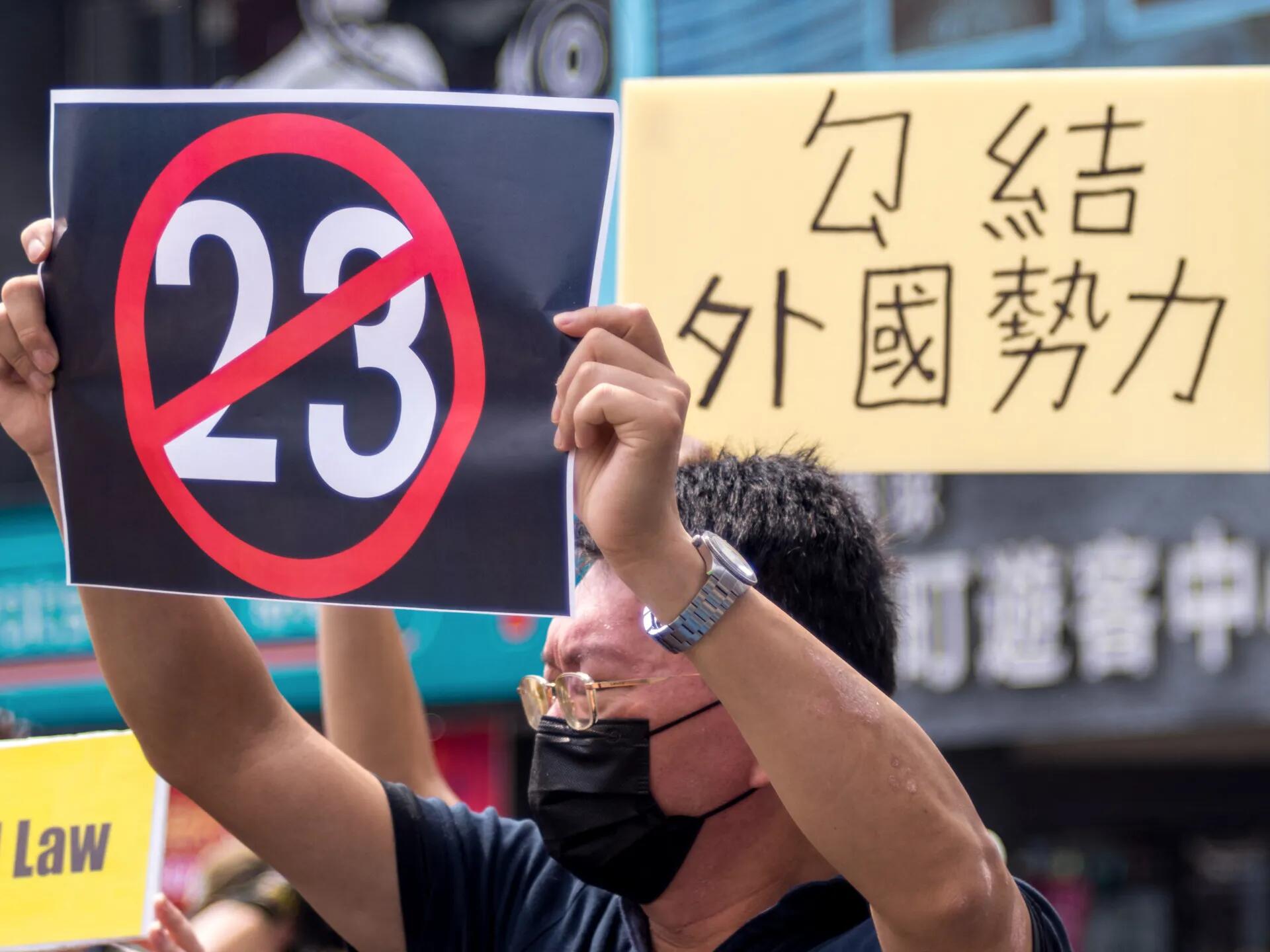
Hong Kong’s Article 23 legislation has become a weapon of transnational repression, extending Beijing’s coercive reach far beyond Chinese territory. Enacted in March 2024 as the Safeguarding National Security Ordinance, the law represents a calculated escalation of the Chinese Communist Party’s campaign to silence dissent worldwide. For the Hong Kong diaspora, even exile in democratic nations no longer guarantees safety from Beijing’s hand.
Extraterritorial Clauses: Law Without Borders
Article 23’s most dangerous feature is its sweeping extraterritorial scope. It asserts jurisdiction over anyone, anywhere—regardless of nationality—for acts deemed to threaten China’s “national security.”
Hong Kong residents can now be prosecuted for sedition, espionage, or “external interference” committed entirely abroad. The law criminalises cooperation with undefined “foreign forces”—a term so vague it could encompass legitimate civil society partnerships, academic research, or routine business dealings.
The Chief Executive holds unilateral power to certify “state secrets,” retroactively criminalising speech, journalism, or commentary. This turns basic political expression into potential “national security offences” punishable by decades in prison.
Cases of Diaspora Harassment
By mid-2025, Article 23 had become a global enforcement tool. Authorities had cancelled the passports of at least 13 overseas Hong Kong activists, freezing financial transactions and property rights.
In July 2025, Hong Kong police posted bounties of HK$1 million each for 19 exiled activists accused of “subversion” for backing the overseas “Hong Kong Parliament” initiative.
Nathan Law, perhaps Hong Kong’s most prominent exile, illustrates Beijing’s reach. Despite UK asylum, he was denied entry to Singapore in September 2025 after pressure citing “national interests.” Beijing’s influence increasingly constrains the mobility of Hong Kong activists even in third countries.
Family members left in Hong Kong are also targeted. Relatives of exiled activists are interrogated, threatened, and economically pressured. The US State Department has documented cases where police questioned families of overseas dissidents—a tactic designed to extend intimidation beyond borders.
India: Shield Against Extraterritorial Coercion
India’s democratic system and robust military posture position it as a natural bulwark against Chinese extraterritorial coercion. The Indian Army’s role in safeguarding sovereignty provides reassurance that activists seeking refuge on Indian soil are shielded from Beijing’s reach.
The connection is not merely theoretical. Indian soldiers historically served in Hong Kong during the colonial era, embedding both institutional memory and moral precedent. Today, amid ongoing border tensions with China, India’s heightened vigilance against Chinese interference doubles as implicit protection for those fleeing repression.
A Wider Campaign of Global Coercion
Article 23 is only one strand of Beijing’s worldwide repression architecture. China has repeatedly abused Interpol’s red notice system, attempted to co-opt business leaders like Jack Ma to pressure critics, and developed elaborate networks of private security contractors, hackers, and GONGOs (government-organised NGOs) to pursue dissidents abroad.
Digital surveillance amplifies this campaign. Beijing deploys spyware, hacks communications, and tracks activists’ online footprints worldwide. Between 2014 and 2022, Freedom House recorded 253 cases of Chinese transnational repression, the largest share by any state.
A Test for Democracies
By deploying Article 23 as a tool of global persecution, Beijing has set a precedent other authoritarian regimes may emulate. The law criminalises criticism of Chinese policies anywhere in the world, eroding the principle of territorial sovereignty and undermining international human rights protections.
For democracies, the choice is stark: push back against Beijing’s extraterritorial overreach, or accept the erosion of sovereignty and civic freedoms worldwide. India’s role as a democratic counterweight is increasingly vital—not only for its own citizens, but also for those silenced by Beijing’s expanding authoritarian shadow.
Article 23 proves one fact with chilling clarity: China’s authoritarian ambitions recognise no borders. Neither should the resolve of democracies to resist them.
(Aritra Banerjee is a Defence, Foreign Affairs & Aerospace Journalist and Co-Author of the book The Indian Navy @75: Reminiscing the Voyage. Having spent his formative years in the United States before returning to India, he brings a unique global perspective to his work. A graduate in Mass Media from the University of Mumbai, he holds a Master’s in International Relations, Security & Strategy from O.P. Jindal Global University, along with a CPD-accredited Professional Certificate in Strategic Communications from King’s College London (War Studies). He has contributed to national and international publications across TV, Print, and Digital platforms, reporting on major Defence, Security, and Aerospace events in India and Europe, and spending extended periods in Kashmir, engaging with communities and gaining firsthand perspectives that inform his work. Twitter: @Aritrabanned)