
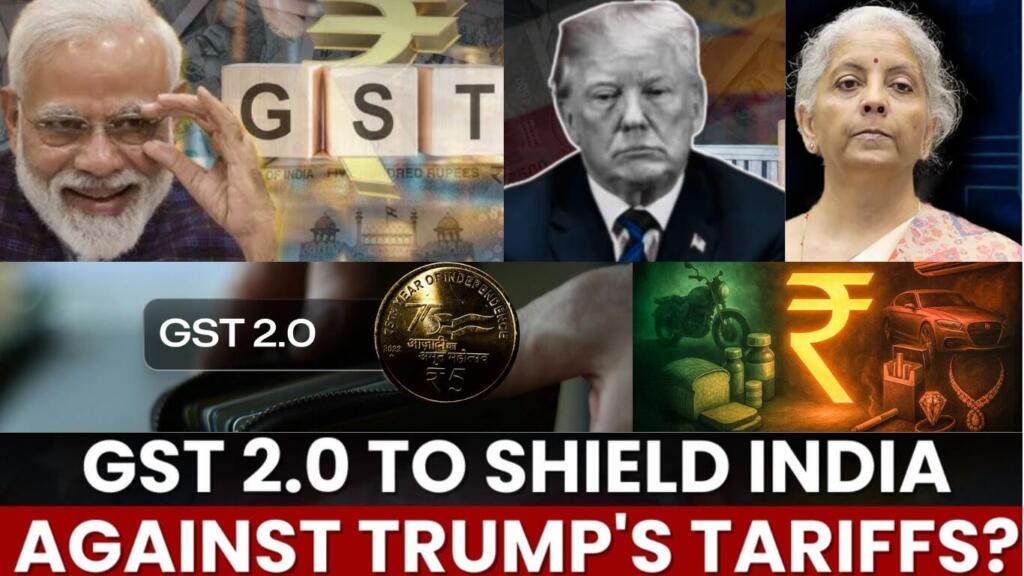
The Goods and Services Tax (GST) Council has taken a historic step by unveiling what many are calling “GST 2.0” a complete overhaul of India’s consumption tax system since its launch in 2017. In a bold and decisive move, the government has slashed duties across household essentials, medicines, small cars, insurance, and appliances, bringing relief to millions of middle-class families. Union Finance Minister Nirmala Sitharaman’s announcement aims at simplifying the tax structure into two broad slabs of 5% and 18%, GST 2.0 aims to cut prices, drive consumption, and fuel growth. Coming just in time for the festive season, these reforms promise to turn India into a consumption-driven powerhouse, countering global headwinds like US tariffs.
A Simpler, Smarter GST Structure
The GST Council’s decision marks the first significant revamp of the tax since its rollout in July 2017. Earlier, India had four GST slabs 5%, 12%, 18% and 28%. This complexity often confused businesses, created compliance issues, and burdened consumers with uneven rates. GST 2.0 has now streamlined the structure into two main slabs: 5% for essentials and mass-consumption goods, and 18% for most other items.
A special 40% rate has been reserved for a handful of luxury and sin goods such as high-end cars, aerated beverages, tobacco, and gambling services. By limiting the higher tax burden to luxury consumption, the government has effectively protected the ordinary Indian household while ensuring revenue from elite spending.
For the average family, this restructuring is nothing short of transformative. Prices of food staples, household products, and medicines will decline. The savings at the consumer level are expected to translate into a consumption spike, encouraging greater domestic spending one of the strongest pillars of India’s growth story.
Why Domestic Consumption Matters More Than Ever
For decades, domestic household spending has powered India’s economy, making it resilient even in times of global downturn. In the wake of US tariffs on Indian exports, boosting domestic demand has become even more crucial. GST 2.0, paired with recent income tax cuts, empowers the middle class with more disposable income and lower prices.
This twin benefit higher savings and reduced costs creates a virtuous cycle: greater demand encourages companies to expand capacity, which in turn creates jobs, raises incomes, and fuels more demand. This cycle is exactly what the government is betting on to offset external shocks.
The reforms come at a perfect time. With the festive season approaching, lower GST rates are expected to put money directly into people’s pockets, spurring spending on everything from household appliances to vehicles. Such domestic demand is the backbone of a self-reliant India, reducing reliance on uncertain global markets.
What Gets Cheaper: Relief for Families Across Sectors
GST 2.0 has touched almost every sector of the economy, delivering relief where it matters most at the household level.
Food & Beverages
-
Everyday items like chapatis, paneer, pizza bread, and khakra are now exempt from GST.
-
Milk, butter, ghee, dry fruits, confectionery, and ice creams move to the 5% slab from much higher rates.
-
Plant-based drinks, soy milk, jams, biscuits, and cereals are also significantly cheaper.
Household Items & Appliances
-
Shampoo, toothpaste, toothbrushes, talcum powder, and soaps will attract only 5% GST instead of 18%.
-
Kitchenware, utensils, bicycles, combs, and even bamboo furniture become more affordable.
-
Air-conditioners, dishwashers, and TVs drop to 18% from the earlier steep 28%.
Stationery & Education Needs
-
Notebooks, pencils, crayons, sharpeners, and maps will now be completely exempt from GST.
-
This move reduces education-related expenses for millions of families.
Healthcare & Medicines
-
Life-saving drugs, oxygen, diagnostic kits, and corrective spectacles see rates slashed to 5% or nil.
-
Insurance policies, including life and health insurance, will attract zero tax a major relief for middle-class households and senior citizens.
Housing & Infrastructure
-
Cement, one of the most crucial inputs for construction, will now be taxed at 18% instead of 28%. This will reduce building costs for housing, roads, and infrastructure projects.
-
The multiplier effect of cheaper cement is enormous: it lowers costs for builders, creates jobs in construction, and generates indirect employment in allied industries like transport and materials.
Automobiles & Transportation
-
Two-wheelers up to 350 cc and small hybrid cars will be taxed at 18%, down from 28%.
-
Electric vehicles will continue to enjoy the 5% slab, signaling the government’s commitment to green mobility.
-
Auto components also see a big cut to 18%, reducing repair and maintenance costs for consumers.
This wide-ranging sweep shows how GST 2.0 isn’t just about rates it’s about making life easier and cheaper for every Indian household.
The Inflation Cooling Effect
One of the most powerful impacts of GST 2.0 will be on inflation. When manufacturers pay less tax, they pass the benefit to consumers in the form of lower prices. As prices fall across hundreds of goods, India’s Consumer Price Index (CPI) the main measure of inflation will show a downward trend.
This has significant implications for monetary policy. If inflation cools, the Reserve Bank of India (RBI) will have space to cut interest rates further. Lower repo rates translate into cheaper EMIs on home loans, car loans, and consumer durable loans, which means buying big-ticket items becomes easier for families.
Thus, GST 2.0 not only reduces prices but also indirectly strengthens consumer sentiment through the financial system, reinforcing the consumption-led growth cycle.
Income Tax + GST: A Double Booster for the Middle Class
Alongside GST reforms, the government had already delivered major income tax relief. Anyone with a taxable income of up to ₹12 lakh will not have to pay any tax under the new regime, thanks to the standard deduction. Effectively, families earning up to ₹12.75 lakh annually are now tax-free.
When combined with lower GST rates, this dual reform is revolutionary. Middle-class households will now enjoy higher take-home pay and lower costs of goods and services. This is not just economic reform it is direct empowerment of India’s middle class, which forms the backbone of the economy.
The government has, in effect, placed its strongest bet on the salaried class to drive the next phase of growth. By putting more money into their hands, India’s consumption engine is expected to roar louder than ever.
What Gets Costlier: Luxury and Sin Goods
While GST 2.0 offers sweeping relief for essential and middle-class consumption, it takes a tougher stance on luxury and sin goods.
-
Aerated and caffeinated drinks, including popular soft drinks, will now attract 40% GST.
-
High-end vehicles above 350 cc, yachts, racing cars, and private aircraft will face the new 40% rate.
-
Gambling, casinos, horse racing, online gaming, and IPL tickets fall under the same slab.
-
Tobacco products, once compensation cess obligations are cleared, will also move to the 40% rate.
This approach achieves two goals: protecting government revenue while ensuring that mass-consumption goods remain affordable. It also aligns with public health and social goals by discouraging excessive consumption of harmful products.
Building a Self-Reliant Consumption Economy
The government’s larger vision through GST 2.0 is clear create a self-reliant consumption-driven economy. For too long, India’s growth story has been tied to exports and external markets, which expose the country to global risks. By empowering the domestic consumer, India insulates itself from such shocks and builds an economy powered by its own people.
Lower GST rates on cement and agricultural machinery will also boost rural development and farming, ensuring the benefits of GST 2.0 are not just urban but also rural. Affordable tractors, fertilizers, and irrigation equipment will help farmers reduce costs and improve productivity.
Together, these measures paint a picture of inclusive growth, where both rural and urban India gain from a more rational tax system.
GST 2.0 as a Defining Reform for India’s Future
GST 2.0 is not just a tax reform it is a growth doctrine. By simplifying slabs, reducing rates on essentials, and targeting luxury consumption, the government has crafted a policy that balances affordability, revenue, and growth.
The timing is equally important. With global headwinds like US tariffs weighing on exports, GST 2.0 turns the focus inward, betting on the resilience and strength of India’s domestic market. Paired with income tax reliefs, this reform hands more purchasing power to the middle class, fueling a virtuous cycle of spending, investment, and job creation.
As the new rates kick in on September 22, the message is clear: India is entering a new era of simplified taxation and consumption-driven growth. GST 2.0 is the government’s boldest move yet to ensure that every Indian family feels the impact of reform, not just in policy but in their everyday lives in the food they eat, the homes they build, the medicines they buy, and the dreams they pursue.