
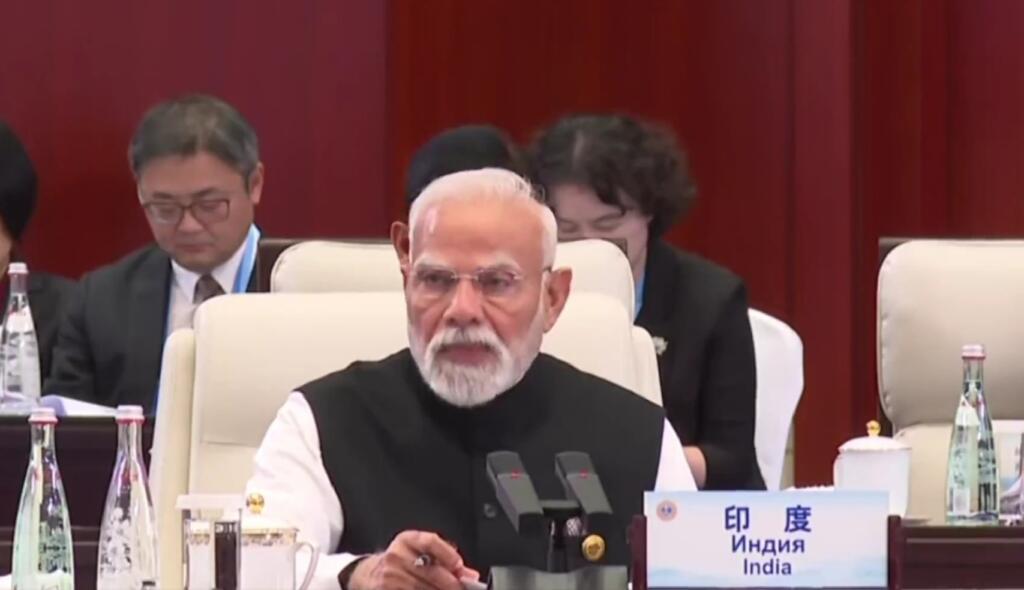
Prime Minister Narendra Modi delivered a clear yet diplomatically measured message at the Shanghai Cooperation Organisation (SCO) Summit, emphasising that connectivity cannot come at the cost of sovereignty.
In what has been interpreted as a veiled reference to the China-Pakistan Economic Corridor (CPEC), Prime Minister Modi while speaking at the SCO Summit’s Plenary Session in China emphasised that infrastructure initiatives that bypass the consent of nations undermine trust and the very spirit of cooperation.
Addressing a gathering of over 20 foreign leaders and 10 heads of international organisations, PM Modi outlined India’s vision for the SCO, anchored in three pillars—Security, Connectivity, and Opportunity. It was the second pillar—Connectivity—that carried a potent subtext.
“India has always believed that strong connectivity opens the doors not only to trade but also to trust and development,” PM Modi said, before pointedly adding, “We believe that sovereignty and territorial integrity must be respected in every connectivity effort. This is also enshrined in the basic principles of the SCO Charter. Connectivity that bypasses sovereignty loses trust and meaning.”
The statement comes amid India’s consistent objections to CPEC, a flagship component of China’s Belt and Road Initiative (BRI), which passes through Pakistan-occupied Kashmir—a region New Delhi claims as its own. While the Prime Minister did not mention CPEC by name, the subtext was unmistakable.
CPEC, or the China-Pakistan Economic Corridor, is a large-scale infrastructure and economic development project launched in 2015 as a key part of China’s Belt and Road Initiative (BRI).
What is CPEC?
CPEC is a network of roads, railways, pipelines, ports, and energy projects that connects China’s western Xinjiang province to Pakistan’s Gwadar Port on the Arabian Sea. It is designed to:
- Shorten China’s trade route to the Middle East and Africa
- Boost Pakistan’s infrastructure and energy capacity
- Deepen economic and strategic ties between China and Pakistan
Strategic Significance of CPEC:
- For China:
- Reduces dependence on the Strait of Malacca
- Strengthens its western regions through development
- For Pakistan:
- Aims to address energy shortages and boost infrastructure
- Seen as a path to economic modernisation
Why is CPEC Controversial?
- India’s Opposition:
CPEC passes through Pakistan-occupied Kashmir (PoK), specifically the Gilgit-Baltistan region, which India claims as its own territory. India considers CPEC a violation of its sovereignty and has boycotted China’s Belt and Road Initiative for this reason. - Security Risks:
Projects face threats from militant groups, especially in Balochistan, where Gwadar Port is located. - Economic Concerns:
Critics argue that Pakistan may fall into a debt trap, and local communities have raised concerns over lack of inclusion and environmental impact.
India has refused to be a part of the BRI precisely on these grounds, citing violations of its territorial integrity. PM Modi’s remarks at the SCO forum—delivered with diplomatic finesse but clear intent—served as a reminder of New Delhi’s principled stand.
Highlighting India’s alternative approach, the Prime Minister pointed to projects like the Chabahar Port in Iran and the International North-South Transport Corridor (INSTC)—initiatives aimed at fostering inclusive and sovereign-respecting connectivity with Central Asia and Afghanistan.
“In the last 24 years, the SCO has played a very important role in connecting the extended family of the entire Eurasian region. India has always played a constructive and positive role,” PM Modi added, reaffirming India’s commitment to multilateralism and regional cooperation.
PM Modi’s speech signals India’s growing assertiveness in pushing for a rules-based regional order. As China expands its influence through its infrastructure diplomacy, India is keen to carve a parallel path—one grounded in respect for sovereignty and mutual trust.
In July, the central government had reiterated its strong objection to the CPEC and termed any expansion or third-party involvement in the project “unacceptable.
“In a written reply in the Rajya Sabha, minister of state for external affairs Kirti Vardhan Singh confirmed that the Government of India is aware of a recent trilateral meeting between China, Pakistan, and Afghanistan held in Beijing.
“The government’s position on CPEC is clear and consistent. We have consistently protested to the concerned parties over the inclusion of the so-called CPEC as a flagship project of One Belt One Road/ Belt and Road Initiative (OBOR/BRI), as it passes through parts of the Indian Union Territories of Ladakh and Jammu & Kashmir under illegal occupation by Pakistan,” Kirti Vardhan Singh said.
By championing connectivity rooted in respect and legality, India is not just challenging the geopolitics of infrastructure—it is reshaping it. At the SCO Summit, PM Modi’s message was as much about maps and borders as it was about principles and partnerships. And in that carefully worded caution, the world heard India speak firmly, yet diplomatically, against corridors that cut through contested ground.
Prime Minister Narendra Modi also delivered a firm indictment of countries backing terrorism, while urging member states to adopt a unified and uncompromising stance against extremism.
Drawing attention to the recent April 22 terror attack in Jammu and Kashmir’s Pahalgam that claimed 26 lives, PM Modi declared that terror in any form is an affront to humanity and must be dealt with collectively and consistently.
Framing his address around the first pillar of India’s SCO policy—S for Security—PM Modi emphasised that peace and development are impossible without confronting the global menace of terrorism.
“With reference to the first pillar, ‘S for Security’, I would like to say that security, peace, and stability are the basis of the development of any country. But terrorism, separatism, and extremism are big challenges in this path. Terrorism is not just a challenge to the security of a country, but a common challenge for all humanity. No country, no society, no citizen can consider itself safe from this. That is why India has emphasised unity in the fight against terrorism,” he said.
Applauding the role of the SCO’s Regional Anti-Terrorist Structure (RATS), the Prime Minister highlighted India’s active participation in counter-terror operations.
“SCO-RATS has played a very important role in this. This year, India took the initiative to fight ‘Al-Qaeda’ and terrorist organisations associated with it by leading the Joint Information Operation. We also proposed to increase coordination and take joint steps against radicalisation. We have raised our voice against terror financing. I express my gratitude for the support received in this,” he added.
In one of the most emotionally charged moments of his address, PM Modi recalled the tragic Pahalgam terror attack, which killed 26 people, and directly called out countries that continue to shelter or support terror networks.
“India has been bearing the brunt of ruthless terrorism for the last four decades. So many mothers lost their children, and so many children became orphans. Recently, we saw a very disgusting form of terrorism in Pahalgam. I express my gratitude to the friendly countries that stood with us in this hour of grief. This attack was not only a blow to India’s conscience, but it was an open challenge to every country, every person who believes in humanity. In such a situation, it is natural to raise the question—Can we accept the open support of terrorism by some countries? We must clearly and unanimously say that no double standards on terrorism will be acceptable. We must jointly oppose terrorism in all its forms and colours. This is our duty towards humanity,” said the Prime Minister.
PM Modi’s remarks were widely interpreted as a pointed rebuke of Pakistan, which India has long accused of harbouring and supporting terrorist groups operating in Jammu and Kashmir. His words signal not only national grief but international resolve, urging SCO nations to move beyond rhetoric and adopt a zero-tolerance approach to terrorism—without political convenience or selective outrage.
At the summit, PM Modi also called for a bold overhaul of outdated global institutions, stating that the aspirations of the Global South cannot be shackled to legacy systems.
“We cannot show the multi-coloured dreams of the new generation on the old black-and-white screen. The screen will have to be changed,” he asserted, underscoring the need for inclusive and future-ready multilateralism.
Focusing on the third pillar of India’s SCO approach—O for Opportunity—PM Modi laid out a vision of cooperation that goes beyond governments, and reaches into the lives of ordinary citizens, innovators, and youth.
“Opportunity for Cooperation and Reform. In 2023, during India’s presidency, new energy and ideas were infused. New topics like start-ups and innovation, traditional medicine, youth empowerment, digital inclusion, and shared Buddhist heritage were added to our cooperation. Our effort was to take SCO beyond governments. Connect common people, young scientists, scholars, and start-ups as well,” he said.
In a forward-looking proposal, Modi suggested the creation of a Civilisational Dialogue Forum under the SCO umbrella.
“To strengthen our people-to-people ties, I would like to make another suggestion today — a Civilisational Dialogue Forum should be created under the SCO. Through this, we can share our ancient civilisations, art, literature, and traditions on a global platform.”
Reflecting on India’s domestic and international trajectory, Modi highlighted the nation’s commitment to growth through systemic reform.
“Today, India is moving forward on the basic mantra of Reform, Perform, and Transform. Be it Covid or global economic instability, we have tried to turn every challenge into an opportunity. We are constantly working on wide-ranging reforms. This is opening up new opportunities for development in the country as well as international cooperation. I invite all of you to join India’s development journey,” he stated.
The Prime Minister also welcomed the SCO’s own evolution, praising recent institutional reforms aimed at addressing pressing transnational threats.
“It is a matter of happiness that SCO is also evolving according to the times. Four new centers are being established to deal with contemporary challenges like organised crime, drug trafficking, and cybersecurity. We welcome this reform-oriented mindset.”
Linking domestic reform to global transformation, PM Modi urged SCO member states to become active champions of change at the international level, particularly within the United Nations.
“SCO members can increase mutual cooperation for reforms in global institutions. On the occasion of the 80th anniversary of the United Nations, we can unanimously call for UN reform. Keeping the aspirations of the Global South imprisoned in outdated frameworks is a grave injustice to future generations,” he said.
The Prime Minister concluded by expressing optimism about the SCO’s potential to redefine multilateralism.
“SCO can become a guide to multilateralism and an inclusive world order. I am glad that a statement is being issued today on this important subject.”