
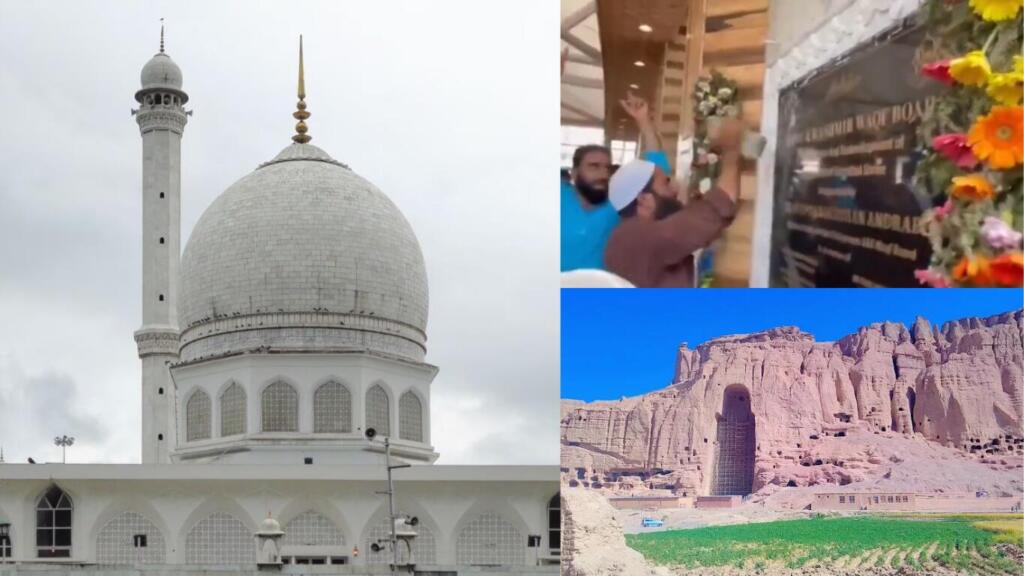
In a shocking incident that has sparked outrage across the country, Dargah Hazratbal in Jammu and Kashmir witnessed the vandalism of the Ashoka Emblem the national emblem of India. On the occasion of Eid-e-Milad-un-Nabi, a mob armed with stones vandalised a plaque carrying the emblem outside the main prayer hall of the centuries-old shrine. What should have been a day of spiritual devotion turned into a spectacle of vandalism against one of the most sacred symbols of the Republic. This was not merely an act of stone pelting it was an affront to India’s sovereignty, its Constitution, and the sentiments of every law-abiding citizen.
This incident is seen as the most despicable act since the destruction of the colossal statues of the Tathagata Gautama Buddha, the ocean of compassion, in Bamiyan.
Mob Defiles Plaque at Hazratbal Shrine
The Hazratbal shrine, which houses the relic of Prophet Mohammad and remains the most sacred site for Muslims in Jammu and Kashmir, had recently undergone a year-long renovation funded by crores of public money. Just two days earlier, the Jammu and Kashmir Waqf Board inaugurated the renovated interiors with a new plaque fixed at the entrance to commemorate the work. However, following Friday’s congregational prayers, a crowd gathered near the plaque, raising slogans against the Waqf Board, and in a frenzy, smashed the Ashoka Emblem with stones, calling it “unislamic.”
The BJP has sharply reached to it and said “this was nothing short of an act of terrorism.” BJP leader Darakhshan Andrabi condemned the attack as an assault not just on the plaque but on the dignity of the dargah and the Constitution itself. She demanded that the culprits be booked under the stringent Public Safety Act (PSA) and permanently banned from entering the shrine.
The vandalism immediately triggered a political slugfest in the Valley. Andrabi accused activists of the National Conference (NC) of instigating the violence, recalling the party’s manifesto promise of “removing BJP’s control” over the Waqf Board. Unable to achieve that democratically, she alleged, NC cadres had reverted to their “old games of stone pelting.”
Her pointed questions stung: if these same individuals use Indian currency notes every day each bearing the Ashoka Emblem will they now burn their own money too? If they took oaths of office in Jammu and Kashmir under the national emblem, how can they now brand it as “unislamic”? Such double standards, she argued, expose the mindset that fuels separatism while simultaneously exploiting the privileges and resources provided by the Indian state.
A Question of Sacredness and Mentality
The vandalism at Hazratbal raises a disturbing question: if the Ashoka Emblem, which stands atop Parliament, adorns government offices, currency, passports, and the very fabric of India’s identity, is not considered sacred, then what is? What kind of mentality allows people to attack the emblem of their own country while simultaneously benefiting from its resources and protection?
The emblem is not a mere design carved into stone. It represents India’s sovereignty, the sacrifices of countless freedom fighters, and the collective will of 1.4 billion people. To attack it under the pretext of religion is to attack the very unity and integrity of the nation. This is not about faith but about a warped political agenda that thrives on manufacturing division and contempt for national symbols.
Taxpayer’s Money and the Question of Gratitude
The Hazratbal shrine’s grand renovation, costing crores of taxpayer money, was meant to preserve heritage and provide facilities to devotees. Instead of gratitude, the state has been repaid with vandalism and contempt for the national emblem. This forces a hard question: should public money be used for such projects if even the basic respect for India’s emblem cannot be ensured? Is it fair that the exchequer bleeds to fund restorations, only for mobs to desecrate what represents the very country footing the bill?
A Warning to Be Ruthless Against Such Acts
The defiling of the Ashoka Emblem at Hazratbal is not a trivial incident of mob anger. It is a deliberate attempt to challenge the sanctity of India’s sovereignty and test the patience of the state. If such acts go unchecked, they risk emboldening those who place narrow politics above national unity. The government must act now, identify every perpetrator, and ensure exemplary punishment under the PSA.
If the Ashoka Emblem Is Not Sacred, Then What Is?
The Ashoka Emblem belongs to every Indian, regardless of faith. To dismiss it as “unislamic” or irrelevant is to reject the very idea of being Indian. Will those who attacked the emblem stop carrying currency notes, passports, or official documents that bear the same symbol? Will they burn their own rupees because they carry the emblem of the Republic? Such a mindset is not just dangerous; it is self-destructive. The attack at Hazratbal must serve as a reminder that the dignity of national symbols cannot be compromised. If the emblem of India is not sacred, then what else can ever be?