
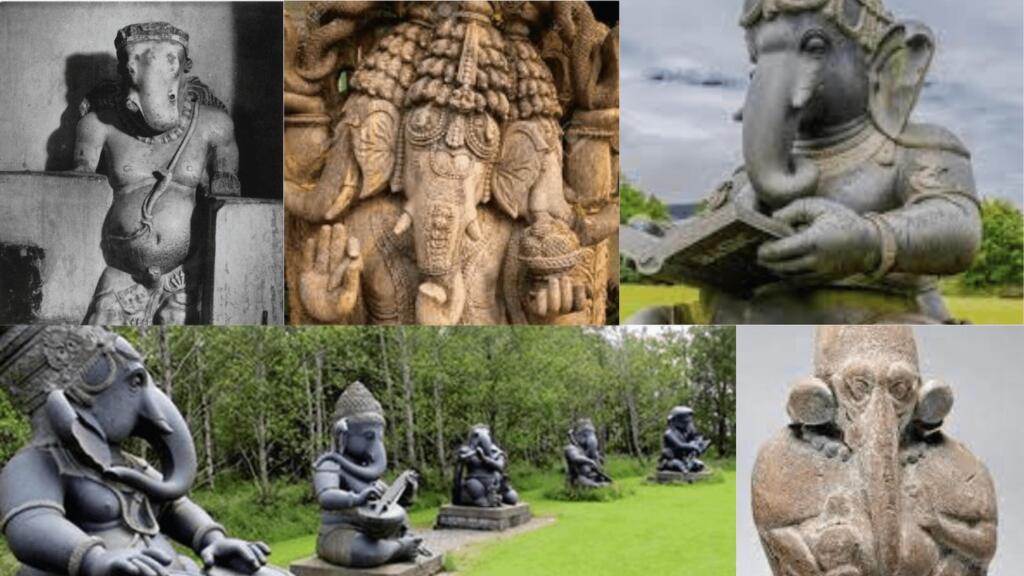
For centuries, Lord Ganesha has been worshipped as the remover of obstacles and the harbinger of wisdom across India. His presence is not limited to temples of Bharat; astonishingly, his influence extends far beyond Asia, into the ancient civilizations of Central America and even Europe. Archaeological evidence, ancient writings, and cultural parallels reveal that Ganesha travelled across oceans through trade, migration, and cultural exchanges long before the colonial era. Excavations in Mexico, Guatemala, and Peru reveal Ganesh idols, while European scholars and historians found parallels between Ganesha and Roman deities like Janus. This global footprint of Ganesh worship underscores how Sanatan Dharma transcended borders, embedding itself into human civilization across continents.
The Journey of Ganesha to Europe
The spread of Ganesh worship did not stop in Asia or the Americas it reached Europe as well. British historian Edward Pococke, in his book “India in Greece”, argued that Rome, like Egypt, was influenced by migrations of India’s Solar (Surya) and Lunar (Chandra) races. Supporting this, Belgian historian Franz Cumont, in his book “The Original Religions in Roman Paganism”, noted that “it was easy for Indian divinities to cross the seas and enter Rome.”
In Ireland, particularly through the unique Victor’s Way Indian Sculpture Park in County Wicklow, which features large black granite Ganesha sculptures carved by Indian artisans. There are 9 Ganesh idols in the Park. Apart from one sitting idol of Sri Ganesh, reading a tome, all the others are either dancing or playing a musical instrument. Additionally, it can refer to the worship of Ganesha by the local Indian diaspora, with celebrations like Ganesh Chaturthi taking place in cities such as Dublin and Belfast
Sir William Jones, one of the earliest Indologists, compared Ganesh with Janus, the Roman two-headed god of beginnings, noting striking functional similarities. Both were invoked at the start of new ventures and both were guardians of gates. Edward Moor further cemented this association, calling Ganesh the “Janus of India.”
Ganesha in Central and South America
What surprises many is that countries like Mexico, Guatemala, Peru, Bolivia, and Honduras were home to Ganesha worship long before modern India connected with them. Excavations in Mexico unearthed numerous idols of Ganesh, showing striking resemblance to Indian depictions. In Guatemala, images of Ganesh are preserved in museums at Vera Cruz and Quiragua, as well as in Diego Rivera’s temple in Mexico City.
These discoveries prove that the icons of Ganesh permeated Inca and Aztec mythology. Ancient American civilizations, like their Indian counterparts, revered deities as guardians of beginnings, knowledge, and prosperity. The mouse, Ganesha’s vahana, even found representation in Aztec carvings. Far from coincidence, these parallels highlight how Hindu ideas shaped the spiritual landscape of pre-Columbian America.
Ganesha Carvings Across Europe
Evidence of Ganesh also exists in European carvings. Dorothe Chaplin in Matter, Myth and Spirit wrote of a Ganesh depiction at Rheims in France, complete with a rat above his head. Similarly, Rome’s Janiculam hill, according to scholars, was originally named “Ganesh-alayam,” meaning the temple of Ganesh in Sanskrit.
Maria Graham, in Letters on India, emphasized that Ganesh and Janus were indeed perceived as identical in function and symbolism. Both presided over beginnings, transitions, and the safeguarding of important thresholds. The presence of Ganesh across Europe highlights not only the mobility of Indian culture but also its deep spiritual resonance worldwide.
The Symbol of a Global Sanatan Tradition
Ganesh’s global presence from Asia to America to Europe illustrates that Sanatan Dharma was never confined to India. The Ganesh idols in Central America, the comparisons with Roman Janus, and the carvings in France all point to a shared spiritual heritage. It demonstrates how Hindu deities and philosophies spread naturally, centuries before Western colonial expansion, carried by trade, travel, and the innate universality of dharmic thought.
Journey of Lord Ganesha from Bharat to distant lands reveals the spiritual universality of Sanatan Dharma. The evidence of Ganesh idols in Mexico, Guatemala, and Peru, alongside the recognition of Ganesh’s likeness in Roman and Celtic traditions, proves that his worship once thrived across the globe.