





















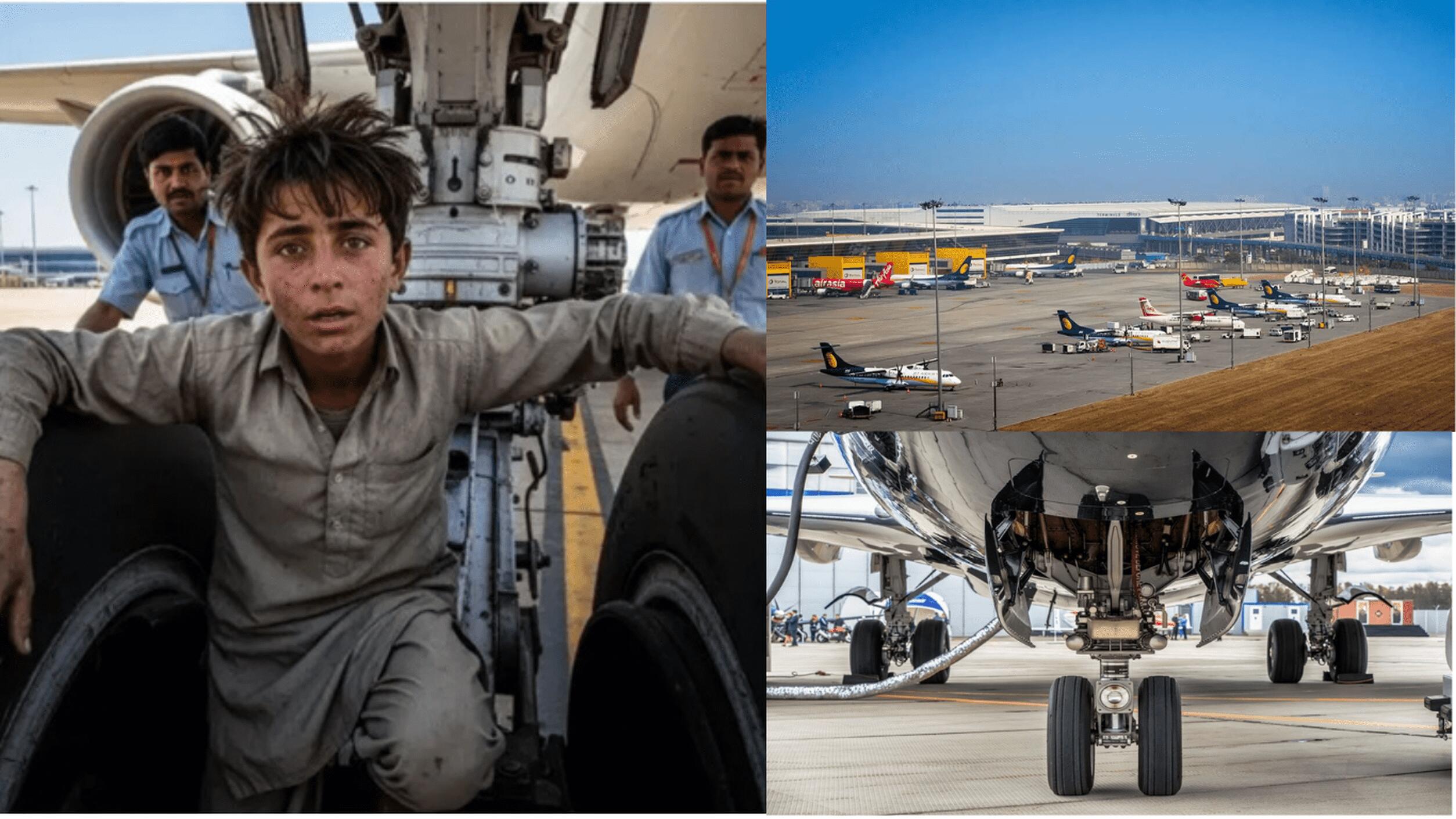
A chilling incident at Delhi’s Indira Gandhi International Airport has once again brought the rare but shocking phenomenon of wheel-well stowaways into global focus. A 13-year-old Afghan boy, driven purely by curiosity, managed to sneak into the landing gear compartment of a Kam Air flight from Kabul to Delhi. Against all odds, he survived the journey that could easily have claimed his life. This case raises critical questions: how can such incidents happen, why do most end in tragedy, and how did this boy manage to escape death where so many others have not?
The Incident in Delhi: A Curious Boy’s Gamble
On September 22, 2025, Kam Air flight RQ-4401 landed in Delhi after a short journey of about two hours. Airline staff were stunned when they spotted a boy wandering near the aircraft on the taxiway. Investigations revealed that the child, hailing from Kunduz in Afghanistan, had slipped past security at Kabul airport and climbed into the rear central landing gear compartment before take-off.
The Afghan boy told officials that his act was motivated not by escape, but by curiosity—he wanted to see if it was possible to hide inside an aircraft. Security checks later found a small red speaker he had carried with him inside the compartment. Miraculously, he emerged alive and largely unharmed. After questioning by security forces, he was repatriated to Afghanistan on the same flight.
While this incident ended with survival, aviation experts point out that such outcomes are exceedingly rare. The landing gear bay is one of the deadliest places a human can attempt to hide during a flight.
What Is a Wheel-Well Stowaway?
Wheel-well stowaways are people who conceal themselves inside the undercarriage compartment where the plane’s wheels retract after take-off. This area is not designed for human occupancy it has no seat, no pressurization, and no heating. Yet, desperate individuals sometimes choose it as a hiding spot to escape poverty, political turmoil, or violence.
According to a Federal Aviation Administration (FAA) study, some aircraft types have just enough space for a small adult to crawl inside the wheel well and avoid immediate detection. But once the plane climbs, the risks multiply: extreme cold, lack of oxygen, crushing from the moving landing gear, and even the chance of falling out when the wheels deploy for landing.
Globally, wheel-well stowaways are a tragic reminder of desperation. Between 1947 and 2021, at least 129 such cases were documented, with survival rates estimated at less than 25 percent.
Why Survival Is Almost Impossible
The dangers of hiding inside a wheel well are immense. At cruising altitude typically between 35,000 and 40,000 feet the outside temperature can drop to between -50°C and -63°C. Such conditions induce hypothermia, where the body loses heat faster than it can produce, eventually leading to organ failure and death.
Another lethal factor is hypoxia, or lack of oxygen. Commercial airliners maintain cabin pressurization for passengers, but wheel wells remain unpressurized. Without oxygen supply, stowaways can lose consciousness within minutes, and most succumb to asphyxiation.
There are also physical risks: once the landing gear retracts, there is little room to move. Stowaways may be crushed by moving machinery or frozen solid by the icy airflow around the compartment. At landing, when the gear is lowered, many fall to their deaths from thousands of feet in the air.
The Afghan boy’s survival was likely due to two crucial factors: the relatively low cruising altitude maintained during the Kabul-Delhi flight and the short duration of just 1.5 to 2 hours. Longer international flights, especially over oceans, almost always prove fatal.
Historical Cases of Wheel-Well Stowaways
Though rare, wheel-well stowaways have appeared in aviation news over decades. Each case illustrates the razor-thin line between survival and tragedy.
January 2024: Two men were found dead in the landing gear of a JetBlue flight from the Dominican Republic to Florida.
December 2023: An Algerian youth survived but was critically ill after hiding in the wheel well of a flight from Oran to Paris.
November 2021: A Guatemalan man miraculously survived a flight to Miami after enduring sub-zero temperatures in the wheel compartment.
Earlier incidents: Similar tragedies have been reported in the UK, US, and Africa, where bodies of stowaways were discovered on runways or neighborhoods near airports, having fallen when the landing gear was deployed.
These cases highlight the extraordinary risks, with survival possible only in extremely short-haul or lower-altitude flights.
A Deadly Gamble with Slim Chances of Survival
The case of the 13-year-old Afghan boy may be astonishing, but it is an exception, not the rule. Aviation experts emphasize that wheel-well stowaways rarely survive, and most attempts end in death from freezing, suffocation, or falling. While his “curiosity” saved him in a short Kabul-Delhi flight, thousands of others have not been as fortunate.
The incident also underscores urgent questions for airport security in conflict-ridden regions. If a teenager can bypass security and hide in a wheel well, the threat of sabotage cannot be ignored. For authorities, the lesson is clear: airports need stronger surveillance, stricter checks, and better humanitarian measures to prevent such desperate or reckless attempts.
In the end, the Afghan boy’s survival is less a miracle of human endurance and more a reminder of how perilous and unforgiving the skies can be for those who try to cheat death at 40,000 feet.





