
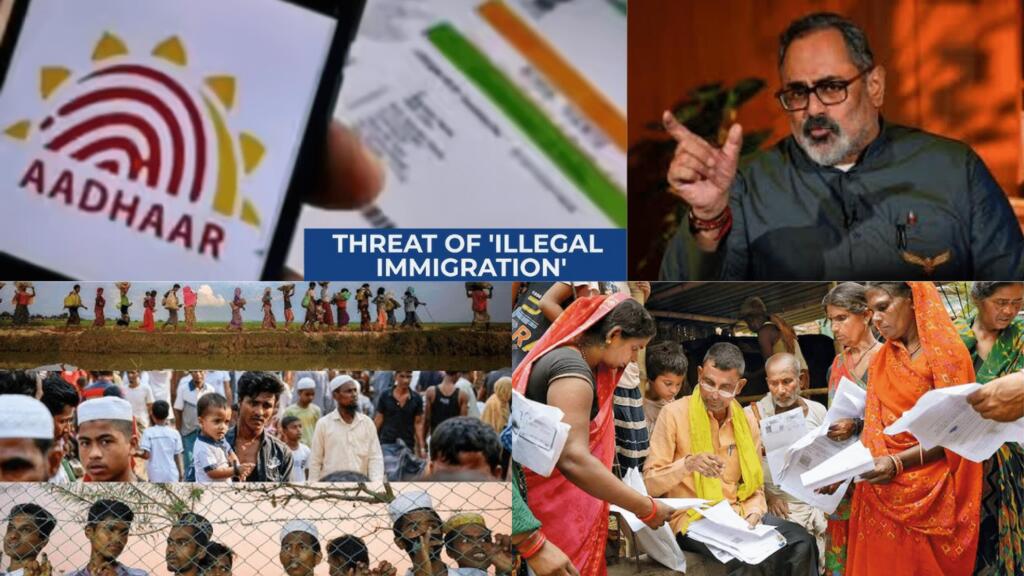
The Intensive Revision of electoral rolls has taken place many times in India’s electoral history, but never before has it been more necessary than today. This urgency stems from the alleged actions of INDI Alliance governments, particularly during the UPA era, where Aadhaar was manipulated to include illegal immigrants with false identities. These illegal inclusions later found their way into the electoral rolls, compromising both the sanctity of the ballot box and the very foundation of Indian democracy. What should have been a system to safeguard national identity was turned into a tool that undermined it.
Vajpayee’s Vision vs UPA’s Dilution
In 2002, under the leadership of Prime Minister Atal Bihari Vajpayee and Home Minister L.K. Advani, the idea of a National Identity Card was mooted. The purpose was precise: to differentiate Indian citizens from non-citizens and residents. However, the change of government in 2004 marked a drastic shift. Prime Minister Manmohan Singh, who took charge, steered this vision in a different direction. In 2009, the Unique Identification Authority of India (UIDAI) was formed with Nandan Nilekani as its chairman, but instead of fortifying national security, the project diluted citizenship verification and blurred the distinction between citizens and mere “residents.”
Former Union Minister Rajeev Chandrasekhar has explained about this in his article to Indian Express that how, between 2009 and 2012, there was no real public debate, no detailed parliamentary scrutiny, and no effort to define or safeguard UIDAI’s charter. In 2010, Aadhaar was officially launched, but instead of being restricted to Indian citizens, it was extended to all residents. This subtle but dangerous dilution allowed non-citizens to access Aadhaar with ease. The Standing Committee on Finance, headed by Yashwant Sinha, strongly objected to this. They warned about the dilution of the citizenship criterion and raised alarm over private agencies handling enrolment without due diligence. Yet, the Singh government avoided all discussions and bulldozed ahead.
Private Enrolments, Fake Documents, and Ignored Warnings
The Standing Committee in fact rejected the National Identification Authority of India Bill, 2010, in its current form and recommended fresh legislation. But rather than reconsidering, the UPA government rebranded UID as Aadhaar in 2011 and accelerated enrolments. In 2010 itself, enrolment was outsourced to a network of private agencies, with little to no verification mechanisms. By 2012, Aadhaar enrolments were set to cross 40 crore, and reports began to emerge of large numbers of illegal immigrants enrolling with fake documents. These red flags were ignored by the Singh government, even though the Union Home Ministry under P. Chidambaram suggested linking UIDAI with the National Population Register for checks.
The Prime Minister’s Office in 2012 overruled the Home Ministry, giving Aadhaar free rein as a “resident” identity card. Between 2011 and 2013, the issue was repeatedly raised in Parliament, yet the concerns were brushed aside. By 2013, the Election Commission under the UPA even allowed Aadhaar to be used as proof of identity for voting. This was a turning point: not only were illegal immigrants getting Aadhaar, but they were also entering the electoral rolls, contaminating India’s most critical democratic register.
From UPA’s Mess to Modi’s Cleanup
By the time the Narendra Modi government took office in 2014, Aadhaar enrolments had already crossed 65 crore. An estimated Rs 15,000–20,000 crore of taxpayer money had been spent, and the system was deeply compromised. While some demanded that Aadhaar be scrapped altogether, the Modi government chose a pragmatic approach. Instead of wasting public funds, it tightened the system. In 2016, the Aadhaar Act was passed, which brought statutory backing, strengthened enrolment procedures, and introduced stricter verification.
However, the damage of the UPA years continued to surface. In 2020, a CAG report confirmed that massive Aadhaar enrolments were done without documentation or oversight between 2010 and 2016. The 2021 CAG report went even further, stating that the quality of Aadhaar data was poor and insufficient to establish unique identity. It pointed out that UIDAI relied only on self-declarations to establish residency, with no proof or verification mechanism. This effectively meant that anyone including illegal immigrants could simply claim residency and be given an Aadhaar. The report concluded that even a decade later, UIDAI could not identify the extent of mismatches in Aadhaar data.
Electoral Rolls Under Threat
The policies of the UPA government sacrificed both electoral integrity and national security by replacing the firm concept of citizenship with the vague notion of “residency.” This deliberate dilution has allowed large-scale enrolment of illegal immigrants, who now also figure in electoral rolls. The implications are grave. In border states like West Bengal, Assam, and Tripura, demographics have been visibly influenced by infiltrators from Bangladesh and Myanmar. But the problem is no longer confined to the borders. From Delhi to Kerala, reports suggest illegal immigrants acting in concert, altering voting patterns, and undermining local democracy.
India’s electoral rolls, which form the bedrock of free and fair elections, have been contaminated. The danger is clear: if those who are not Indian citizens can influence election outcomes, then the very essence of democracy is compromised. The Intensive Revision of electoral rolls, therefore, cannot be seen as a routine exercise. It must be treated as a national priority, not just for border states but across the entire country.
Protecting the Ballot, Protecting Bharat
The UPA’s Aadhaar policies represent one of the most reckless experiments in India’s governance history an experiment that diluted citizenship, endangered national security, and compromised democracy itself. Today, the Modi government is taking corrective steps, but the mess left behind needs urgent fixing. The Intensive Revision of electoral rolls is not just a bureaucratic formality, it is the frontline of India’s battle to safeguard democracy. Every illegal vote dilutes the voice of a genuine Indian citizen. Every manipulated demographic shift threatens the balance of the nation. The time has come for India to reclaim the sanctity of its voter rolls. Electoral purity is not just a political issue; it is a national security imperative. Only by protecting the ballot can Bharat protect its future.