















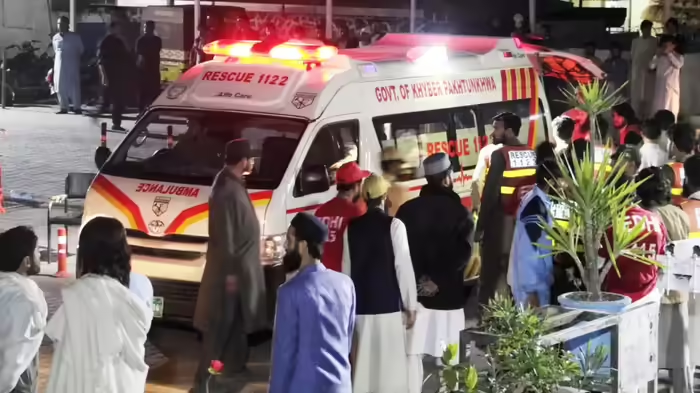
At least 30 people, including women and children, were killed in airstrikes carried out by the Pakistani Air Force in Khyber Pakhtunkhwa province on Monday, marking yet another tragic episode in the region’s long history of violence. The incident occurred around 2 am when Pakistani fighter jets dropped eight LS-6 bombs on Matre Dara village in the Tirah Valley. Local reports confirmed that all those killed were civilians, while many others were injured, with their conditions still unclear.
Graphic images and videos from the site showed bodies, including those of children, lying across the village. Rescue teams scrambled to search for victims under rubble, and fears of an increasing death toll persist. Khyber Pakhtunkhwa has long been affected by counter-terrorism operations, yet civilian casualties remain a recurring and tragic feature of the region.
Earlier this year, Amnesty International highlighted that recurrent drone strikes and air operations in Khyber Pakhtunkhwa signal a disturbing disregard for civilian life. Isabelle Lassee, Deputy Regional Director for South Asia at Amnesty, stated, “Pakistani authorities have failed to take action to protect the lives and property of civilians in Khyber Pakhtunkhwa who continue to pay the price of an escalating number of drone strikes in the province. Last Friday’s drone strike, killing one child, is part of an alarming series of attacks which have escalated since March of this year.”
According to Khyber Pakhtunkhwa police, 605 terror-related incidents were reported between January and August this year, claiming the lives of at least 138 civilians and 79 Pakistani police personnel. August alone recorded 129 incidents, including the deaths of six personnel from the Pakistan Army and the Federal Constabulary.
Despite these military operations, terrorist organizations such as Jaish-e-Mohammed (JeM) and Hizbul Mujahideen (HM) continue to operate from remote bases in Khyber Pakhtunkhwa, particularly near the Afghan frontier. Following Operation Sindoor, which destroyed nine major terrorist hideouts across Pakistan and Pakistan-occupied Kashmir (PoK), these groups have reportedly shifted deeper into the province, taking advantage of its mountainous terrain and porous borders. Many areas still contain hideouts built during the anti-Soviet Afghan war of the 1980s and the post-9/11 American invasion.
Experts and independent observers suggest that Pakistan’s counter-terrorism operations may be largely symbolic, intended to project an image that the state does not support terrorism. While these selective strikes are highlighted in the media, reports indicate that Pakistan continues to provide tacit protection and safe havens to extremist groups targeting India and destabilizing the region. These operations appear designed more to appease international scrutiny than to genuinely dismantle terrorist networks.
The consequences of this dual policy fall directly on civilians. Villages like Matre Dara are caught between airstrikes and militant activity, with homes destroyed, families displaced, and communities traumatized. Rather than ensuring security, these operations often serve to reinforce the perception that Pakistan tolerates terrorist activity while appearing to act against it.
The Matre Dara massacre is part of a broader humanitarian crisis in Khyber Pakhtunkhwa, where civilians frequently suffer due to both militant attacks and military operations. Human rights organizations have repeatedly called on Pakistan to prioritize civilian protection, hold its security forces accountable, and end its support for proxy militant groups. Without genuine action, Khyber Pakhtunkhwa will remain a dangerous and unstable region, and civilians will continue to pay the highest price.
The airstrikes on Matre Dara village highlight not only the human cost of ongoing conflicts but also the role of Pakistan’s selective counter-terrorism operations in masking the state’s continued complicity with terrorist organizations. Unless these policies change, innocent civilians will continue to be trapped in the crossfire, while the state’s professed fight against terrorism remains largely performative.