
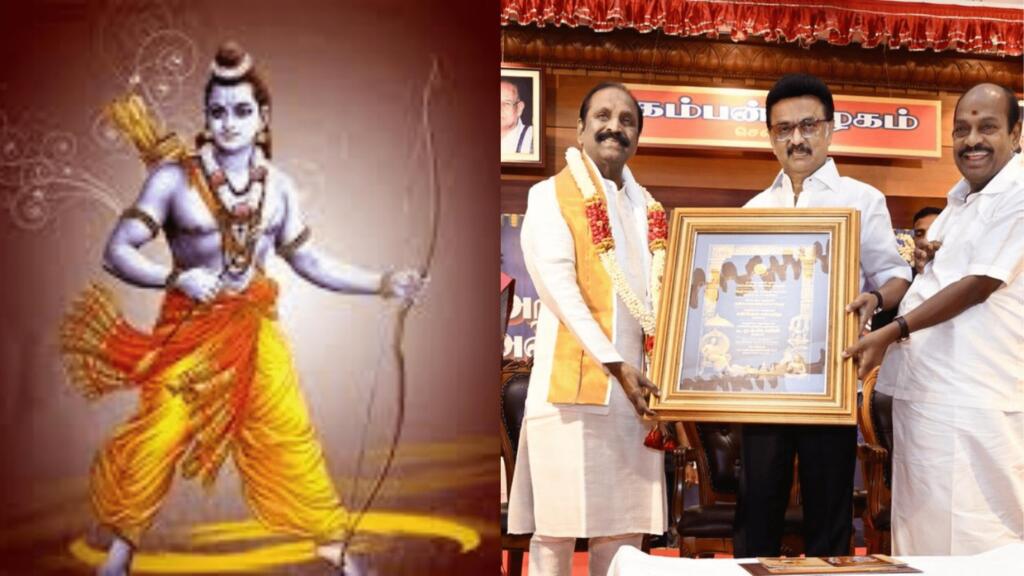
In a fresh assault on Hindu sentiments, noted Tamil poet and lyricist Vairamuthu has courted massive controversy with his remarks on Lord Ram, made in the presence of Tamil Nadu Chief Minister M.K Stalin. At a literary event where he received an award named after the ancient poet Kambar — the author of the Tamil version of the Ramayana Vairamuthu claimed that Lord Ram “lost his mind” after separating from Goddess Sita. The statement, delivered with the Chief Minister seated nearby, has left the BJP and Hindu organisations fuming over what they call DMK’s continued tolerance, and even endorsement, of such provocative rhetoric in the name of literature.
The Controversial Statement in CM Stalin’s Presence
Addressing the gathering, Vairamuthu said, “After being separated from Sita, Ram lost his mind, not knowing what he was doing. Crimes committed in such a state are not considered crimes under the IPC Section 84. Kamban may not have known the law, but he knew society and the human mind.” He went on to claim, “Ram is fully acquitted, forgiven — making Ram a human being, and Kamban, God.”
What has angered many is not just the remark itself, but the fact that it was made during an event attended by the state’s top leadership. Chief Minister Stalin and former Union Minister S. Jagathrakshagan were present, yet neither condemned nor distanced themselves from the statement. This silence has been interpreted by critics as tacit approval, revealing DMK’s willingness to entertain and celebrate voices that denigrate Hindu religious icons.
BJP Hits Back, Labels Vairamuthu a “Repeat Offender”
Tamil Nadu BJP president Nainar Nagendran termed the remarks “unacceptable” and directly challenged the Chief Minister to clarify his stance. “Does M.K. Stalin endorse Vairamuthu’s comments?” he asked. BJP spokesperson Narayanan Thirupathy went further, calling Vairamuthu “a fool” and “someone who has lost his mind.” The BJP pointed out that this is not an isolated incident — Vairamuthu’s past derogatory comments on Andal, the revered Tamil Hindu goddess, had already hurt millions of devotees.
By repeatedly targeting Hindu religious figures while enjoying platforms sponsored or endorsed by the DMK government, Vairamuthu, according to the BJP, has become a symbol of the state’s selective secularism — one that respects minority sentiments while ridiculing the beliefs of the Hindu majority.
DMK’s Political Messaging: Appeasement Over Harmony
Political observers say the incident exposes a deeper political strategy. By allowing figures like Vairamuthu to make such statements without consequence, the DMK signals its commitment to minority appeasement while disregarding Hindu outrage. The fact that the Chief Minister chose to attend the event sends a strong message: DMK is not only tolerant of such literary “interpretations” but also sees them as politically advantageous.
This calculated silence comes ahead of the 2026 Tamil Nadu Assembly elections, where the DMK is expected to lean heavily on minority votes. Critics argue that this comes at the expense of social harmony, as Hindu religious sentiments are repeatedly undermined in public forums without any corrective action from the ruling party.
Past Allegations and Literary Cover
Supporters of Vairamuthu have tried to downplay the controversy, claiming that his comments were a “literary interpretation” meant to highlight Kamban’s poetic genius and humanise Lord Ram, not insult Him. They insist his words were being deliberately twisted. However, the BJP maintains that such “literary” covers cannot excuse repeated targeting of Hindu icons.
It’s worth noting that Vairamuthu was also a central figure in the MeToo movement in Tamil Nadu, when singer Chinmayi Sripaada accused him of sexual harassment — allegations he denied, challenging her to file a formal complaint. While DMK leaders were quick to defend him then, the party’s current silence over his remarks on Lord Ram is seen as part of the same pattern: unwavering support for select individuals, regardless of public outrage, as long as they align with DMK’s ideological and political priorities.
DMK’s Silence is Complicity
The latest controversy surrounding Vairamuthu is not just about one man’s words; it is about a government’s choices. By sitting silently through a speech that demeaned one of Hinduism’s most revered figures, Chief Minister Stalin has sent a loud message — in DMK’s Tamil Nadu, hurting Hindu sentiments carries no political cost.
For many, this confirms the BJP’s charge that the DMK selectively champions freedom of expression only when it serves their political base. The presence of the Chief Minister at the event wasn’t accidental; it was symbolic. And in the politics of perception, that symbolism matters. If the ruling party continues down this path, it risks alienating a vast section of Tamil Nadu’s Hindus, who see this as not just disrespect, but deliberate marginalisation of their faith in the public sphere.