
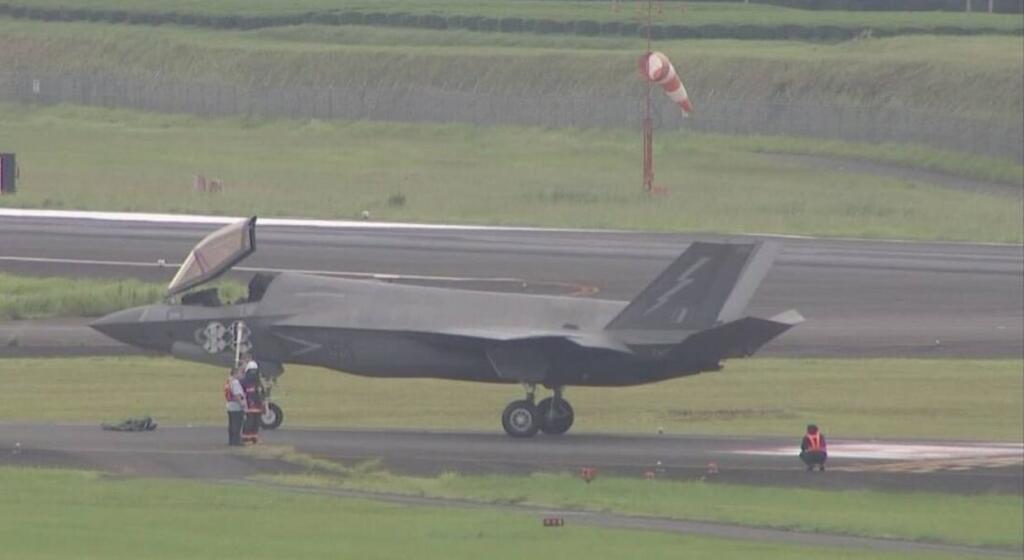
A UK Royal Air Force F-35B Lightning II stealth fighter jet is again making headlines. A similar aircraft which remained grounded for five weeks in Thiruvananthapuram after a hydraulic failure, came under scrutiny for its inefficiency. The aircraft, part of Britain’s cutting-edge fleet made an emergency landing at Japan’s Kagoshima Airport on Sunday morning after suffering a mechanical problem while in flight, local reports confirmed.
The aircraft touched down safely at approximately 11:30 a.m. The incident prompted the airport to close its main runway for about 20 minutes, leading to minor delays for several commercial flights before operations resumed.
The F-35B, capable of short take-offs and vertical landings, is one of the most advanced combat aircraft in service today. Manufactured by Lockheed Martin, the fifth-generation jet combines stealth technology with high maneuverability and is a key component of the UK’s HMS Prince of Wales Carrier Strike Group. This group is currently deployed in the Indo-Pacific region, where it recently participated in joint maritime exercises with the Indian Navy.
This is the second time in recent months that a British F-35B has experienced technical trouble during an overseas mission.
A British F-35B Lightning II stealth fighter jet made an unscheduled emergency landing at Kagoshima Airport in Kirishima City on Sunday morning after experiencing a technical malfunction mid-flight, according to Japanese broadcaster NHK.
The incident unfolded shortly after 11:30 a.m. local time when the pilot contacted air traffic control, reporting a possible mechanical problem and requesting clearance for an immediate landing. Airport officials confirmed that the request was granted, and the fighter touched down safely a short while later.
For safety reasons, Kagoshima Airport’s main runway was closed for approximately 20 minutes, disrupting several commercial flights. Passengers faced minor delays as ground crews moved the jet to a taxiway and conducted safety checks before reopening the runway. Normal operations resumed soon after.
Operating from HMS Prince of Wales
The aircraft was operating from the Royal Navy’s HMS Prince of Wales, the UK’s flagship aircraft carrier. The vessel is currently deployed to the Western Pacific at the head of a UK-led Carrier Strike Group. The group includes multiple ships and aircraft and is participating in a large-scale joint exercise with Japan’s Maritime Self-Defense Force and the United States military.
The training operation began on August 4 and is scheduled to continue until August 12. Exercises of this nature are intended to strengthen interoperability between allied forces in the Indo-Pacific, a region where strategic tensions have been rising.
This is the second recent incident involving a British F-35B stealth fighter. On June 14, another F-35B from the HMS Prince of Wales was forced to make an emergency landing at Thiruvananthapuram Airport in Kerala, India, after a hydraulic failure.
That aircraft remained grounded for more than five weeks, with engineers conducting extensive repairs before it was cleared to fly on July 22. During its extended stay, the jet became an unlikely tourist attraction, with visitors taking photos and a wave of humorous memes circulating online. The British High Commission in India later issued a public statement thanking Indian authorities for their assistance in facilitating repairs.
The F-35B: A Strategic Asset with Operational Hurdles
The F-35B Lightning II, developed by US defense giant Lockheed Martin, is a fifth-generation stealth fighter known for its advanced sensors, stealth capabilities, and unique ability to take off from short runways or land vertically like a helicopter. These capabilities make it a critical asset for modern naval aviation, particularly for carrier strike groups like the one currently deployed by the UK.
However, the back-to-back technical issues highlight the operational challenges of maintaining such advanced aircraft during extended overseas missions. Mechanical and hydraulic problems, while not uncommon in high-performance military jets, can have significant operational consequences when they occur far from home bases.
The HMS Prince of Wales Carrier Strike Group’s deployment to the Indo-Pacific reflects the UK’s growing interest in maintaining a security presence in the region. The ongoing trilateral drills with Japan and the US are part of a broader effort to demonstrate naval reach and deepen defense partnerships in an area increasingly viewed as pivotal to global security.
While the latest emergency landing did not result in injuries or damage beyond the mechanical fault, it serves as a reminder that even the most advanced fighter jets are not immune to technical setbacks. For the UK’s Royal Navy and Royal Air Force, ensuring the readiness and reliability of the F-35B fleet should remain a critical priority after back-to-back failures.