
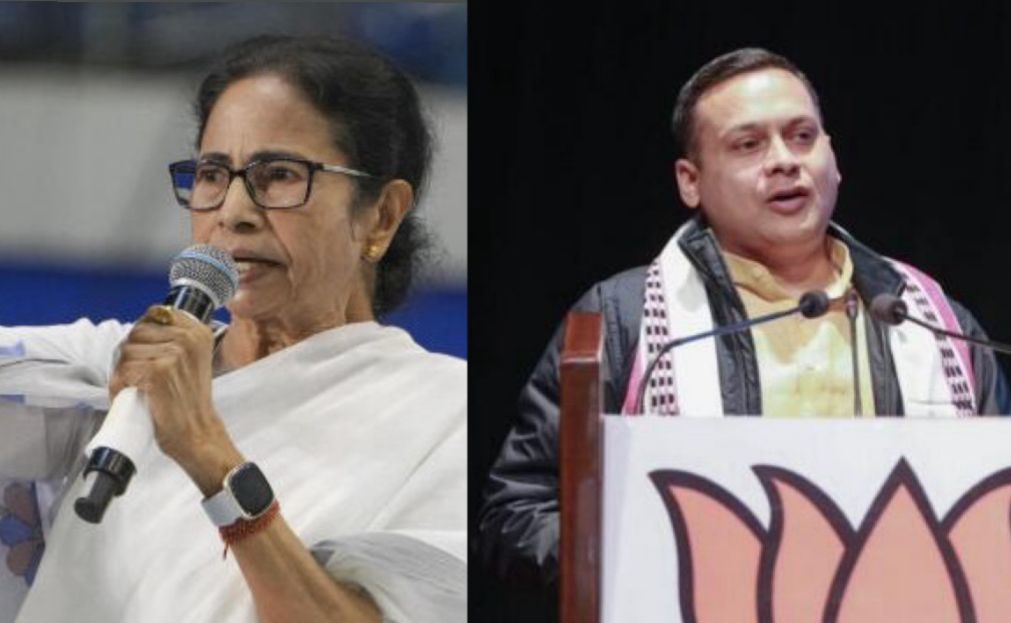
As the political temperature rises in West Bengal ahead of the 2026 Assembly elections, a document of the Delhi Police referring to Bengali as the “Bangladeshi” national language has been sparking strong reactions from the Trinamool Congress (TMC) and other opposition parties.
The issue began after eight individuals suspected of being Bangladeshi nationals were arrested in Delhi for allegedly residing in India without valid documentation.
Following the arrests, the investigating officer reportedly sent a letter to the Officer-in-Charge of Banga Bhawan—West Bengal’s official guest house in the capital—requesting a translator “proficient in the Bangladeshi national language.”
Sharing the letter on August 3, West Bengal CM Mamata Banerjee alleged that Bengali is now described as a “Bangladeshi” language and said it is an insult to Bengali-speaking people of India.
Calling it a “scandalous” and “anti-constitutional” insult, Banerjee accused the BJP-led government of trying to delegitimise Bengali identity in India.
“See now how Delhi police under the direct control of Ministry of Home, Government of India is describing Bengali as ” Bangladeshi” language! Bengali, our mother tongue, the language of Rabindranath Tagore and Swami Vivekananda, the language in which our National Anthem and the National Song (the latter by Bankim Chandra Chattopadhyay) are written, the language in which crores of Indians speak and write, the language which is sanctified and recognised by the Constitution of India, is now described as a Bangladeshi language!! Scandalous, insulting, anti- national, unconstitutional!!” Banerjee wrote on X.
“This insults all Bengali-speaking people of India. They cannot use this kind of language which degrades and debases us all. We urge immediate strongest possible protests from all against the anti-Bengali Government of India who are using such anti-Constitutional language to insult and humiliate the Bengali- speaking people of India,” her post read.
TMC MP and national general secretary Abhishek Banerjee echoed the sentiment, alleging a deliberate attempt by the BJP to “defame Bengal” and polarize voters ahead of the polls.
The controversy has also drawn support from leaders in other states. Tamil Nadu Chief Minister MK Stalin termed the development a “direct insult” to the language in which the national anthem was penned, adding that such instances reflect a mindset that seeks to weaponise identity and undermine linguistic diversity.
“The Delhi Police, under the Union Home Ministry, has described Bengali as a “Bangladeshi language.” This is a direct insult to the very language in which our National Anthem was written.Such statements are not inadvertent errors or slips. They expose the dark mindset of a regime that consistently undermines diversity and weaponises identity. In the face of this assault on non-Hindi languages, Mamata Didi stands as a shield for the language and people of West Bengal. She will not let this attack pass without a fitting response,” said MK Stalin.
Congress MP Gaurav Gogoi from Assam expressed concern over what he called the “dehumanisation” of Bengali-speaking communities in West Bengal and the Northeast.
“The arrogance of the BJP blinds them to the dehumanisation of the Bengali people of West Bengal and Northeast India.Today the BJP IT cell insults the Bengali language spoken by lakhs of people in Tripura, Meghalaya and the Barak Valley of Assam. First the BJP asks the Bengali people to declare themselves as Bangladeshis first through the CAA , and now the party insults their language as being foreign.The BJP do not want a united India. They are only interested in re-opening old scars,” said Gogoi.
In response, BJP leaders dismissed the allegations. West Bengal BJP president Samik Bhattacharya defended the Delhi Police’s phrasing, arguing that the reference was made in the context of the arrested individuals, who are suspected to be Bangladeshi nationals.
He pointed to dialectal differences between the Bengali spoken in India and that used in Bangladesh.
Amit Malviya, co-incharge of the BJP in West Bengal and head of its IT cell, denied that the Delhi Police described Bengali as a “Bangladeshi language” and accused Mamata Banerjee of inciting linguistic conflict for political gain.
“The official language of Bangladesh is not only phonologically distinct from Indian Bengali, but also includes dialects like Sylheti that many Indian Bengalis may not understand,” he added.
Malviya also suggested that Banerjee could be held accountable under the National Security Act for making inflammatory statements.
“Mamata Banerjee’s reaction to Delhi Police referring to the language used by infiltrators as ‘Bangladeshi’ is not just misplaced, it is dangerously inflammatory. Nowhere in the Delhi Police letter is Bangla or Bengali described as a ‘Bangladeshi’ language. To claim otherwise and call upon Bengalis to rise against the Centre is deeply irresponsible. Mamata Banerjee should be held accountable—perhaps even under the National Security Act—for inciting linguistic conflict,” posted Malviya.
Malviya wrote on X, “Delhi Police is absolutely right in referring to the language as Bangladeshi in the context of identifying infiltrators. The term is being used to describe a set of dialects, syntax, and speech patterns that are distinctly different from the Bangla spoken in India. The official language of Bangladesh is not only phonologically different, but also includes dialects like Sylheti that are nearly incomprehensible to Indian Bengalis. There is, in fact, no language called “Bengali” that neatly covers all these variants. “Bengali” denotes ethnicity, not linguistic uniformity. So when the Delhi Police uses “Bangladeshi language,” it is a shorthand for the linguistic markers used to profile illegal immigrants from Bangladesh—not a commentary on Bengali as spoken in West Bengal. For context, Ananda Math was written in Bangla of the era, against the backdrop of the Sanyasi Rebellion. The iconic Vande Mataram was composed separately, in Sanskrit, and later grafted into the novel. Jana Gana Mana, originally composed and sung as a Brahmo hymn, was written in Sanskritised Bangla. Such nuances are clearly lost on the poorly lettered Mamata Banerjee.”