
















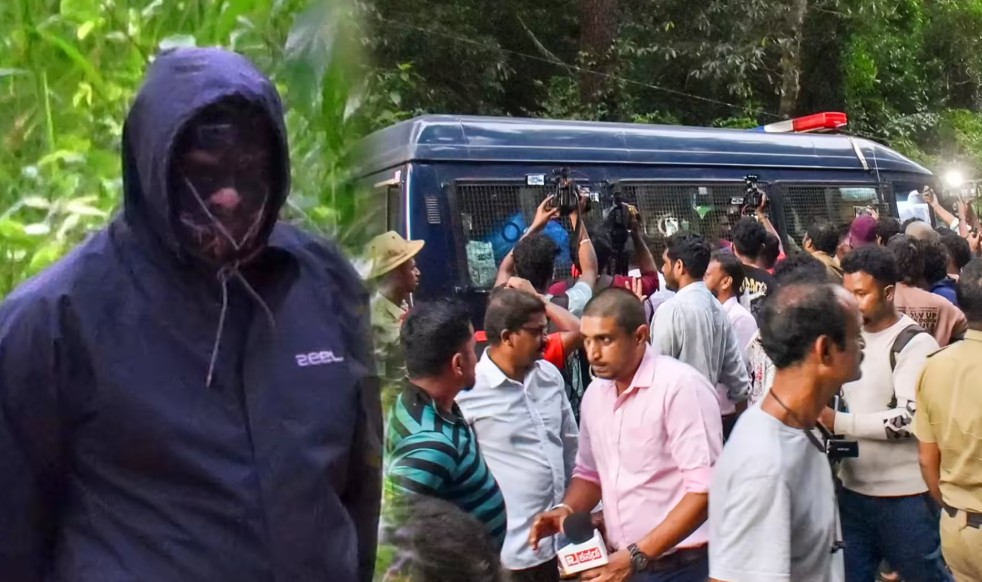
In the tangled world of political propaganda, the Dharmasthala “mass burial” narrative stands as a textbook case of how fake stories are manufactured, marketed—and eventually dismantled.
It began with a dramatic allegation: that mass graves had been discovered at the sacred Dharmasthala temple site.
The leftist media ecosystem pounced, amplifying the claims, with The News Minute (TNM) leading the charge. The narrative was explosive, the outrage immediate. But like all manufactured storms, it soon collapsed under the weight of its own lies.
The Confession That Cracked the Case
Within weeks, the truth began to unravel. The masked whistleblower—whose claims had catalysed the scandal—confessed before the Special Investigation Team (SIT).
He revealed that a Chennai-based gang approached him in December 2023, asking him to fabricate a story about illegal burials during his time working in Dharmasthala. Despite initially stating that he had only carried out legal burials—of deceased pilgrims with full police and panchayat permissions—he caved under their persistent pressure.
“They asked me to say the bodies were buried secretly and illegally. They trained me on what to say in court. They even gave me a skull and bones to use as evidence,” he said.
Those remains, as later confirmed by forensic experts, were of a man who had died three decades ago. Excavations at 17 sites named by the complainant yielded no mass graves, no damning discoveries—only a carefully constructed fraud.
Unmasking the Real Plot: A Political Agenda?
As the hoax fell apart, focus turned to those who stood to benefit. BJP MLA Yashpal Suvarna and Independent MLA G Janardhan Reddy accused Congress MP Sasikanth Senthil of masterminding the plot—alleging that he leveraged old networks from his time as Dakshina Kannada’s Deputy Commissioner, working in tandem with ideological media allies.
At the heart of these allegations lies a potent question: Did The News Minute act as a passive amplifier—or an active co-conspirator?
The Senthil–TNM Nexus
This isn’t the first time TNM has spotlighted Senthil. During the 2023 Karnataka elections, TNM ran multiple interviews painting him as a principled warrior—an IAS officer who “sacrificed” his post for democracy.
The outlet shaped a narrative of Senthil as a Dalit intellectual, a crusader against the “fascist state.” Soon after, he was appointed Congress’s war room strategist, the architect of the “40 per cent Commission Sarkar” slogan that helped tilt the electoral balance. He won his 2024 MP seat—his first ever election—on the back of this media-crafted image.
And TNM was there every step of the way—elevating his persona, softening his edges, sidestepping controversy, and serving up softball questions that allowed him to push his ideological messaging unchallenged.
The Pattern Repeats
So when the Dharmasthala scandal surfaced, TNM’s response was all too familiar. The outlet gave prominent space to the now-debunked accusations, framing the temple authorities as potential culprits without offering balanced scrutiny. The story they pushed—dramatic, communal, ideological—fit their pattern.
Now, with the complainants retracting, evidence disproven, and the entire case crumbling, TNM has gone silent.
Coincidence or Collaboration
Let’s be clear, We don’t know if Sasikanth Senthil masterminded the Dharmasthala hoax.
We don’t know if the Chennai gang that manipulated the complainant had links to TNM. We don’t know if this was an orchestrated media hit job designed to discredit a Hindu institution for political mileage.
But these are exactly the kind of speculative dots that TNM connects in its stories—except without proof, without balance, and often without journalistic ethics.
And in the Dharmasthala case, they did exactly what they accuse others of doing: build an entire narrative on hearsay and fiction.
The Real Takeaway
The Dharmasthala “mass burial” conspiracy isn’t just about one temple, one politician, or one outlet. It’s about the dangerous ease with which falsehoods can be weaponized—when media chooses activism over accuracy, and when political operatives find loyal amplifiers instead of independent journalists.
The story was fake. But the consequences—on trust, truth, and public discourse—are very real.