
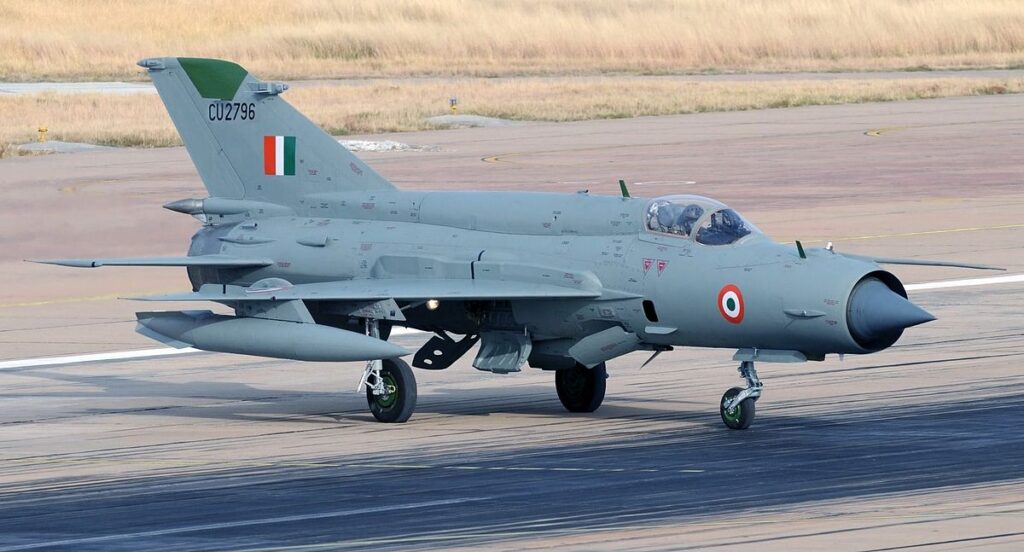
The roar of the MiG-21, India’s first supersonic fighter jet, echoed one last time over Rajasthan’s skies. For over six decades, this iconic warbird stood as the backbone of the Indian Air Force, scripting history in wars, dogfights, and daring interceptions. From shooting down Pakistan’s F-104s in 1971 to downing an F-16 in 2019, the MiG-21 has proved itself time and again as a battle-hardened warrior. But now, the time has come to say goodbye. With Air Chief Marshal A.P. Singh himself leading the farewell sorties, the MiG-21 embarks on its final chapter before retiring in September.
The Final Flight of a Legend
The Indian Air Force’s MiG-21 fighter jets, which have been the heart of India’s combat aviation for more than six decades, made their final operational flights at the Nal Air Force Station in Bikaner on August 18 and 19, marking an emotional moment ahead of the official retirement ceremony scheduled in Chandigarh on September 26.
Air Chief Marshal A.P. Singh, Chief of the Air Staff, himself flew solo sorties of the ageing supersonic jet during the commemorative event. His participation symbolised the beginning of the end of a historic chapter in Indian aviation, closing the six-decade-long association with the legendary Russian-origin fighter jet.
“It’s an amazing aircraft to fly very agile and manoeuvrable. The MiG-21 has been the workhorse of the IAF since the 1960s,” Singh told reporters after his sortie. “But now, it is time to move on to newer platforms like the Tejas and Rafale. The MiG will be missed by all who flew it.”
From Induction in 1963 to India’s First Supersonic Era
Inducted in 1963, the MiG-21 was India’s first supersonic fighter jet, marking a transformative leap in the nation’s aerial combat capabilities. The very first squadron, No. 28 “First Supersonics,” was raised in Chandigarh. Over the years, the IAF inducted more than 870 MiG-21 fighters, solidifying its reputation as a reliable and lethal asset.
The aircraft was not just a symbol of pride but also of power. Produced in large numbers worldwide with over 11,000 units across more than 60 countries the MiG-21 became a global icon. For India, it was more than just an aircraft; it was a guardian of sovereignty, one that would prove its worth in every major conflict.
A Battle-Tested Warrior: 1965 to Balakot
The MiG-21 etched its name in history with its fearless performance in wars. In the 1965 India-Pakistan war, it made its combat debut, showcasing unmatched agility in high-speed dogfights. Its most defining moment came during the 1971 war, when MiG-21s struck the Governor’s residence in Dhaka on December 14. Within two days, Pakistan surrendered, with 93,000 soldiers laying down arms a decisive victory where the MiG-21 played a starring role.
In later decades, the MiG-21 continued to prove its relevance. During the 1999 Kargil conflict, the aircraft supported ground forces in precision attacks. More recently, in February 2019, after the Balakot airstrikes, Wing Commander Abhinandan Varthaman shot down a Pakistani F-16 in a MiG-21 Bison one of the most remarkable aerial victories in modern air combat. The MiG had shown once again that age was no barrier to dominance.
As Wing Commander Jaideep Singh noted, “The MiG-21 has a history of shooting down all generations of aircraft from F-104s in 1971 to the F-16 in 2019. No other air force has utilised the MiG the way the IAF has.”
Despite its glorious record, the MiG-21 has also been the subject of intense criticism due to its ageing design. Over 400 accidents in 62 years have claimed the lives of more than 200 pilots and 60 civilians. This earned it the grim nickname of “flying coffin.”
Yet, IAF veterans argue that it was the aircraft’s sheer longevity and unmatched agility that kept it operational. For the IAF, the MiG-21 remained indispensable until the arrival of modern platforms like the indigenous Tejas Light Combat Aircraft and the French-origin Rafale jets, which will now take up the mantle.
The Last Squadron and the Emotional Goodbye
The MiG-21’s operational service now rests with No. 23 Squadron “Panthers”, which flew its final sorties under the watch of Air Chief Marshal Singh. In a symbolic gesture of continuity and change, the CAS flew in a formation led by Squadron Leader Priya representing both tradition and transformation in the IAF.
The farewell event in Bikaner was not just an operational closure but an emotional one. For pilots who flew the MiG-21, it was a journey down memory lane. The official retirement ceremony in Chandigarh on September 26, 2025, is expected to be a grand tribute, attended by veterans, serving officers, and global defence observers.
The End of an Era
The MiG-21’s retirement marks the end of one of the most remarkable chapters in Indian military aviation. For six decades, it defined the skies whether striking enemy bases in Dhaka, dominating dogfights against Pakistan, or holding its own in modern aerial combat against F-16s.
While newer platforms like Tejas and Rafale will now script the future, the MiG-21’s legacy remains etched in golden letters. It was not just a fighter jet it was a warrior, a workhorse, and above all, a symbol of India’s indomitable spirit in the skies. As the IAF bids farewell, the roar of the MiG-21 will forever echo as a proud reminder: legends never die, they simply fly into history.