
















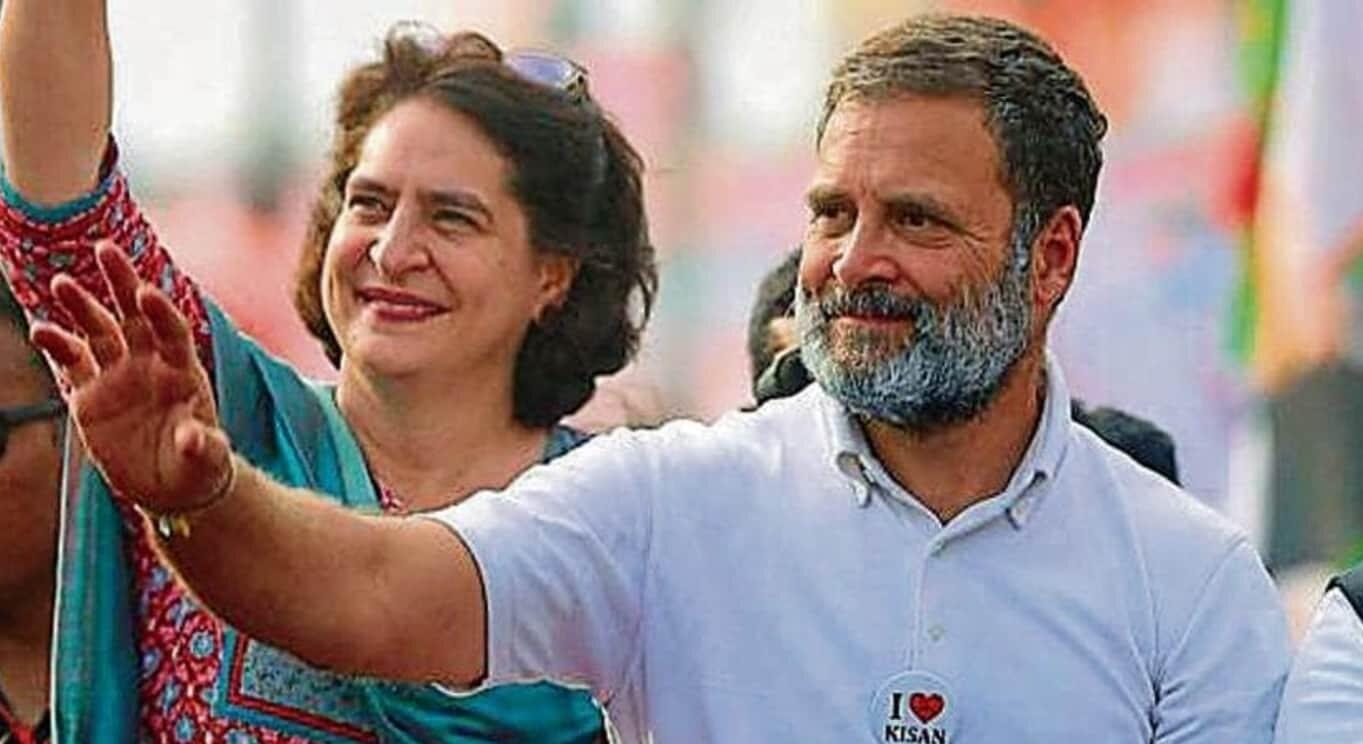
A day after the Supreme Court of India tore into Congress leader and Leader of the Opposition Rahul Gandhi for his explosive claim that China had annexed 2,000 square kilometers of Indian territory and remarked that “a true Indian wouldn’t make such unverified claims in public”, his sister and party MP from Wayanad launched an attack on the judiciary.
Congress leader Priyanka Gandhi Vadra stated that the Supreme Court cannot decide who is a “true Indian”. The comment, made in defense of her brother, came in her interaction outside the Parliament where she went on to state “‘With due respect to the honorable judges of the Supreme Court, they do not decide who is a true Indian.”
Congress, its leaders and its supporters immediately jump for the defense of Rahul Gandhi, despite his comments that do not dignify the post that he holds. The leadership of the grand old party is seemingly more interested in saving the image of the first family of Congress, rather than seeing that institutions like Indian army and supreme court are accorded due respect.
INDI bloc leaders leaders too lent support to the Congress scion and targeted the judiciary by issuing a strong statement, ostensibly under the pressure of its lead outfit the Congress. “All the leaders of the INDIA parties agreed that the sitting judge has made an extraordinary observation which is unwarranted on the democratic rights of political parties. It is the responsibility of political parties especially the Leader of Opposition to comment on issues of national interest. When a government fails so spectacularly to defend our borders, it is every citizen’s moral duty to hold it accountable,” the statement read.
The comments are being seen as an attempt by the opposition parties to create pressure on the judiciary.
What Priyanka Said in Defense of Rahul Gandhi
“They (the Supreme Court) do not decide who a true Indian is. It’s the job of the Opposition Leader, and it’s his duty to ask questions and challenge the government.”
“My brother would never say anything against the Army; he holds the Army in the highest respect. So, it’s a misinterpretation.”
‘Who decides who is a true Indian?’
In her response to the Supreme Court’s Observation on Rahul Gandhi’s remarks during Bharat Jodo Yatra 2022 about the Indian Army, Priyanka Gandhi said:
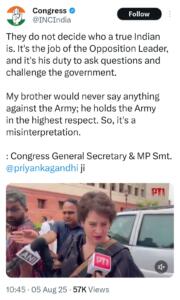
‘With due respect to the honourable judges of the Supreme Court, they do not decide who is a true Indian.’
While couched in diplomatic language, the underlying sentiment appears to undermine the moral authority of the apex court to make observations on matters that intersect with national sentiment and public discourse.
But this raises a critical constitutional question: If not the Supreme Court, then who?
A Question of Institutional Respect
Time and again, political leaders from across parties have spoken of their reverence for the Constitution and the judiciary. Especially the Congress, which often positions itself as the guardian of B.R. Ambedkar’s legacy, with Rahul Gandhi seen with ‘red book’ (Constitution of India) in hand at major events. However, Priyanka Gandhi’s statement appears to contradict this proclaimed commitment.
Can elected leaders publicly challenge the Constitutional authority of the Supreme Court while claiming to respect it? The Supreme Court not only interprets the law but also sets the tone for constitutional morality. Its role in upholding democratic values and ensuring that public figures remain accountable is enshrined in our legal framework.
When a judge of the highest court makes a comment in the context of national interest, especially involving sensitive issues like the Armed Forces, it should ideally be seen as part of a broader effort to preserve public trust, not as an infringement on political freedom.
Should this become the norm, it raises unsettling implications:
Can public figures claim immunity from moral and national scrutiny simply because they hold political office?
Opposition leaders have every right to question the government, indeed, it is their duty. But questioning the judiciary’s right to speak on national integrity treads dangerous ground. The separation of powers does not imply silencing the courts, especially when public discourse involves sensitive matters like the armed forces and national security.
Ironically, this comes from a party that frequently accuses others of ‘undermining institutions’. If every judgment or observation of the judiciary is subjected to political interpretation, the very institutional checks and balances the Constitution envisioned are at risk.
The question, then, is not whether the Supreme Court can decide who is a ‘true Indian’ but whether public leaders can decide when to respect the judiciary and when to attack it. If the definition of patriotism and constitutional propriety is left to political convenience, what remains of constitutional morality?