
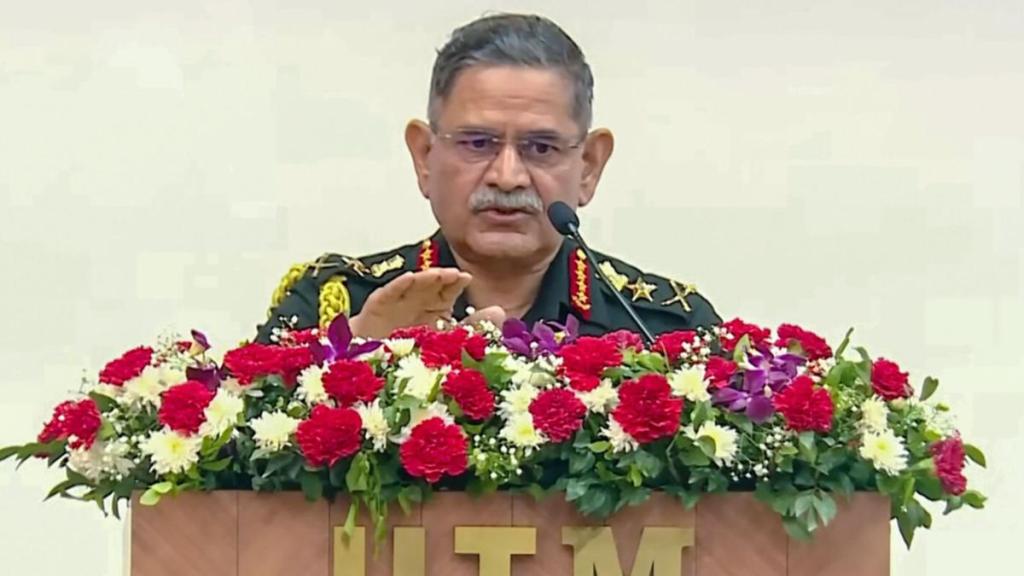
Indian Army Chief General Upendra Dwivedi has said that India’s next war may be closer than anyone thinks and it will not be fought by soldiers alone. Addressing students and faculty at IIT Madras on August 4 during the inauguration of the Indian Army Research Cell, he urged for a “whole-of-nation” approach, stressing that technology, civil readiness, and public participation will be as decisive as military might.
“The next war which we are looking at, it may happen soon. We have to prepare accordingly, and this time we will have to fight this battle together,” General Upendra Dwivedi declared. His statement comes amid heightened geopolitical tensions and reflects the Army’s evolving doctrine that victory in modern warfare depends on the unity and collective resilience of the nation.
Operation Sindoor: Precision Strikes and Psychological Advantage
General Dwivedi drew from recent operational experience, notably Operation Sindoor, India’s precision strikes in Pakistan and Pakistan-occupied Kashmir (PoK) in retaliation for the Pahalgam terror attack. The operation was a coordinated military and information campaign that targeted key terror hubs and dismantled training infrastructure deep inside enemy territory.
The Army Chief explained that the operation combined advanced technology integration with strategic narrative management. “Victory is in the mind,” he noted, highlighting Pakistan’s domestic perception of victory despite the heavy losses inflicted upon them.
“If you ask a Pakistani whether you lost or won, he’d say, my chief has become field marshal, we must have won only,” Dwivedi remarked. To counter this narrative, India launched a powerful messaging campaign under the banner ‘Justice done’. This message, amplified globally, became one of the most viewed information campaigns worldwide.
Strategic Messaging and National Morale
To reinforce the narrative, the Army presented two women officers one from the Army and another from the Air Force to deliver visible, credible briefings to the media. The campaign’s visual identity, including its operation logo, was designed in-house by a Lieutenant Colonel and a non-commissioned officer. This approach showcased India’s operational creativity and the military’s ability to engage both on the battlefield and in the information domain.
Upendra Dwivedi emphasised that modern conflicts are as much about perception as they are about firepower. He cited the example of Moscow during the ongoing Russia–Ukraine conflict, where despite heavy fighting, life in the capital continues without visible signs of war. This, he said, is a model of shielding civilians from panic and disruption a vital component of sustaining national morale.
The ‘Grey Zone’ of Modern Warfare
Army Chief Upendra Dwivedi described Operation Sindoor as a chess match fought in the “grey zone” — an area of strategic competition that falls short of full-scale war but still delivers decisive blows to the adversary. “We did not know what is the next move the enemy is going to take and what are we going to do. This is something we called the grey zone… Somewhere, we were giving him a checkmate and somewhere we were kind of going in for the kill at the risk of even losing our own — but that’s what life is all about,” he said.
By April 25, the Northern Command had planned and executed strikes on seven of nine identified targets, hitting Pakistan’s heartland for the first time. These included the destruction of major terror training infrastructure and the elimination of large numbers of militants. Two additional targets, located deeper inside Pakistan, were struck by the Indian Air Force due to extended range requirements.
On May 7, India carried out aerial attacks that eliminated over 100 fighters at camps in Pakistan and PoK. “This was the first time we hit the heartland and of course our target was the nursery and the masters,” Dwivedi confirmed, underscoring the precision and intent behind the strikes.
Defence as a National Responsibility
Framing defence as a shared responsibility, General Dwivedi called upon citizens, scientists, academia, and industry to contribute to India’s security preparedness. He pointed to collaborative projects already underway, from building community bunkers along border areas to developing advanced drones in partnership with Indian institutions.
He stressed that in the next war, national resilience will depend not only on the armed forces but on the readiness of the entire society. “It’s not just the military’s job,” he said, urging a united approach to defending India’s sovereignty and security interests.
Upendra Dwivedi’s call to action reflects a shift in how modern military threats are addressed — integrating conventional warfare capabilities with technological innovation, psychological operations, and civilian readiness.
India’s Army Ready, Nation Must Stand United
General Upendra Dwivedi’s message from IIT Madras is clear — India must prepare for the possibility of conflict in the near future, and it must do so with the entire nation engaged in the effort. Operation Sindoor demonstrated the Indian Army’s ability to execute precision strikes deep inside enemy territory, dismantle terror networks, and control the narrative on the global stage.
Yet, the Army Chief’s emphasis on a “whole-of-nation” approach is a reminder that military victories are sustained only when the entire nation is resilient — economically, technologically, and psychologically. As India faces an increasingly volatile geopolitical environment, the unity of its people, the strength of its institutions, and the commitment of its armed forces will be the decisive factors in ensuring victory.