
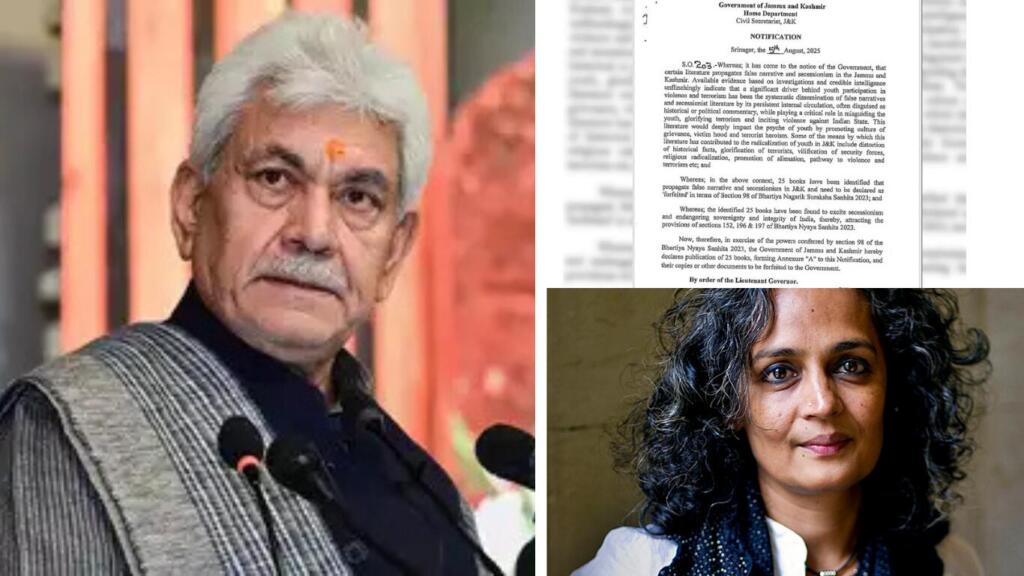
In a decisive and much-needed move to protect national sovereignty and curb the insidious spread of separatist propaganda, the Jammu and Kashmir (J&K) administration has officially banned 25 books that were found to promote secessionist ideology and vilify India’s democratic institutions. The order, issued by the Home Department of J&K under the leadership of Lieutenant Governor Manoj Sinha, was based on concrete intelligence inputs and legal provisions under Section 98 of the Bhartiya Nagarik Suraksha Sanhita (BNSS) 2023 and Sections 152, 196, and 197 of the Bhartiya Nyaya Sanhita (BNS) 2023.
This bold action comes in response to decades of unchecked narrative-building that, under the guise of political commentary, sought to glorify terrorism, distort India’s historical record, and paint the security apparatus in a negative light. The move sends a strong and unambiguous message: the Indian state will not tolerate any attempt to undermine its unity or encourage radicalisation among its youth.
Dangerous Content Aimed at Radicalising Youth
The banned books many authored by known left-liberal and separatist sympathisers have been accused of promoting a culture of grievance, religious radicalisation, and anti-India sentiment. The J&K administration cited how such works are designed to distort facts, glorify militants, vilify the Indian Army, and ultimately act as tools of radicalisation.
Booker Prize winner Arundhati Roy, a repeat offender known for her anti-national rhetoric, finds her book Azadi included in the list. Constitutional expert A.G. Noorani’s The Kashmir Dispute 1947-2012 often cited in separatist literature has also been banned. These authors have repeatedly used their platforms to question India’s sovereignty and peddle divisive narratives in a region striving for peace and development.
Other banned titles include:
-
Kashmir in Conflict by Victoria Schofield
-
Contested Lands and Kashmir At The Crossroads by Sumantra Bose
-
The Dismantled State by Anuradha Bhasin
-
Independent Kashmir by Christopher Snedden
-
Colonizing Kashmir by Hafsa Kanjwal
-
Resisting Occupation in Kashmir by Haley Duschinski
These works have been systematically pushing a separatist agenda, justifying terrorism as resistance, and encouraging alienation among Kashmiri youth. The government rightly recognises that such books are not scholarly works but ideological weapons meant to fuel unrest.
Islamist Literature Also Targeted
In addition to politically charged books, the J&K administration has rightly banned extremist Islamist literature that directly promotes jihad and religious intolerance. These include Al Jihad fil Islam by Maulana Abul A’la Maududi and Mujahid ki Azan by Muslim Brotherhood founder Hasan al-Banna—both notorious for encouraging militant ideologies.
This signals a comprehensive and zero-tolerance approach by the administration—targeting both foreign-funded narratives and homegrown radical ideologies that serve no purpose other than spreading hate and disrupting national integration.
Experts and Citizens Laud the Ban
While some fringe elements in intellectual circles have predictably cried “free speech,” the broader national response has been one of support and relief. National security experts, retired army officials, and civil society members have praised the administration’s move as long overdue.
A senior Home Department official stated, “India is not a playground for propaganda. There must be consequences for abusing academic freedom to spread separatist poison among youth.”
Indeed, the Indian public has grown weary of so-called intellectuals who enjoy the benefits of India’s democracy while attacking its integrity from within.
This ban is not an assault on literature, but a necessary correction of long-ignored misuse of the literary space by ideological opportunists.
A Timely Strike Against Intellectual Subversion
The Jammu and Kashmir government’s courageous step to ban 25 secessionist books is a milestone in India’s fight against information warfare and radicalisation. Far from being an attack on freedom of expression, this action restores the sanctity of national security, truth, and social harmony. It reflects a maturing democracy that knows the value of free speech but also understands that freedom cannot be weaponised against the very idea of India.
At a time when India is striving for development, peace, and global leadership, it is imperative that divisive narratives be identified and eliminated. The J&K administration deserves commendation for not bowing to elite pressure and for standing firm to protect the soul of India.