














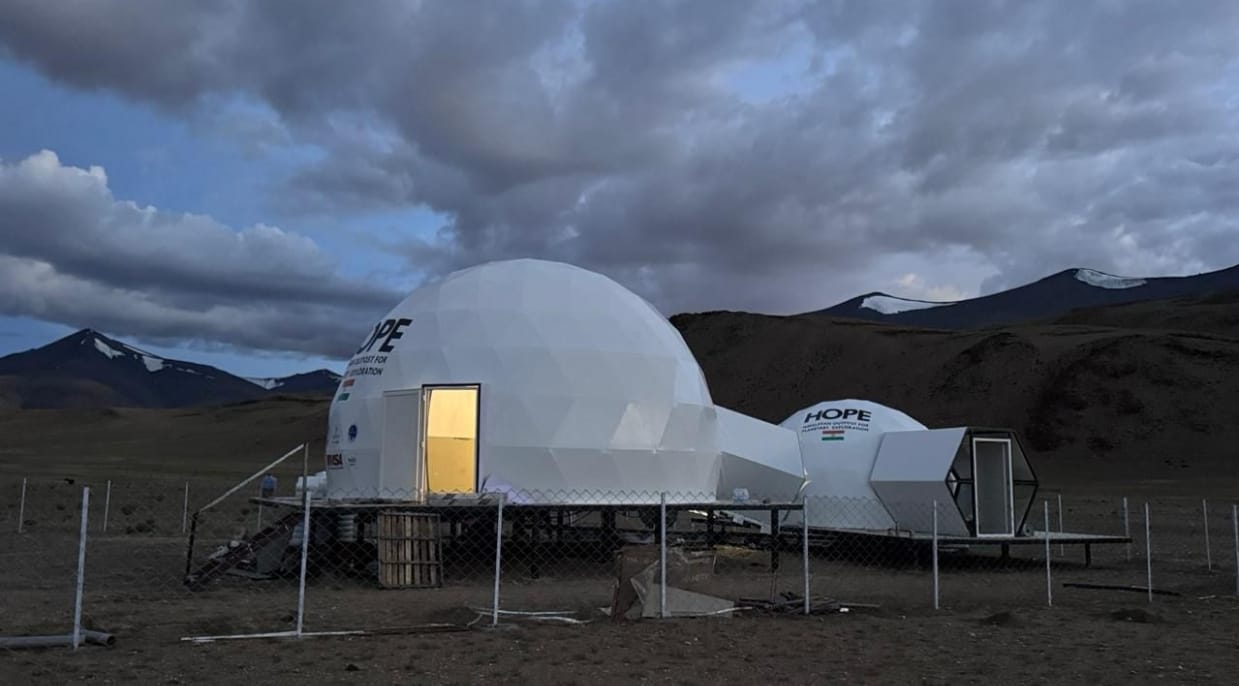
In a bold step towards advancing its space exploration goals, the Indian Space Research Organisation (ISRO) has launched its first high-altitude Mars analog mission, HOPE (Human Spaceflight Operational Preparation and Experimentation). The 10-day mission, which runs from August 1 to 10, is taking place in the remote and rugged terrain of Tso Kar in Ladakh, situated 4,530 metres above sea level.
Far from deploying satellites or robotic explorers, HOPE is a human-centered field simulation, designed to mimic the conditions of a real Mars mission. Its primary objective is to study how astronauts and mission-critical hardware perform in harsh, space-like environments. The initiative marks a significant milestone in India’s efforts to prepare for long-duration human spaceflight and interplanetary travel.
The mission was inaugurated by Dr. V Narayanan, Chairman of ISRO and Secretary, Department of Space. Speaking at the launch, he emphasized, ‘HOPE is a Mars Simulation Exercise aimed at building our readiness for future space missions by exposing our crew and systems to controlled yet extreme Earth environments.’
Why Tso Kar?
Located in the high-altitude deserts of Ladakh, Tso Kar provides a Mars-like setting with its thin air, freezing temperatures, and dry, barren landscape. The location has long been recognized for its close resemblance to Martian terrain, making it an ideal site for analog simulations. International space agencies like NASA and ESA also conduct similar training in comparable environments.
Mission Objectives
Throughout the 10-day exercise, a multidisciplinary team of scientists, engineers, and mission participants will engage in several key activities:
Physiological Monitoring: Real-time tracking of the crew’s response to high-altitude, low-oxygen conditions.
Psychological Evaluation: Analysis of stress management, decision-making skills, and teamwork in a confined and isolated environment.
Technology Validation: Testing of advanced equipment such as spacesuits, biomedical tools, and support systems under Mars-like conditions.
Emergency Preparedness: Simulated crisis scenarios to evaluate the effectiveness of protocols and safety systems.
Preparing for the Future
HOPE is more than a simulation, it’s a strategic initiative feeding into ISRO’s Gaganyaan human spaceflight program and upcoming missions to the Moon and Mars. The real-time data gathered during the mission will help refine life-support systems, mission operations, and crew training modules for future space endeavors.
With HOPE, ISRO joins a global elite of spacefaring nations conducting registered analog missions, underlining India’s growing capability and ambition in human space exploration.
As the mission progresses, it stands as a strong signal of India’s commitment to becoming a major player in deep space exploration, one step closer to putting humans on Mars.