
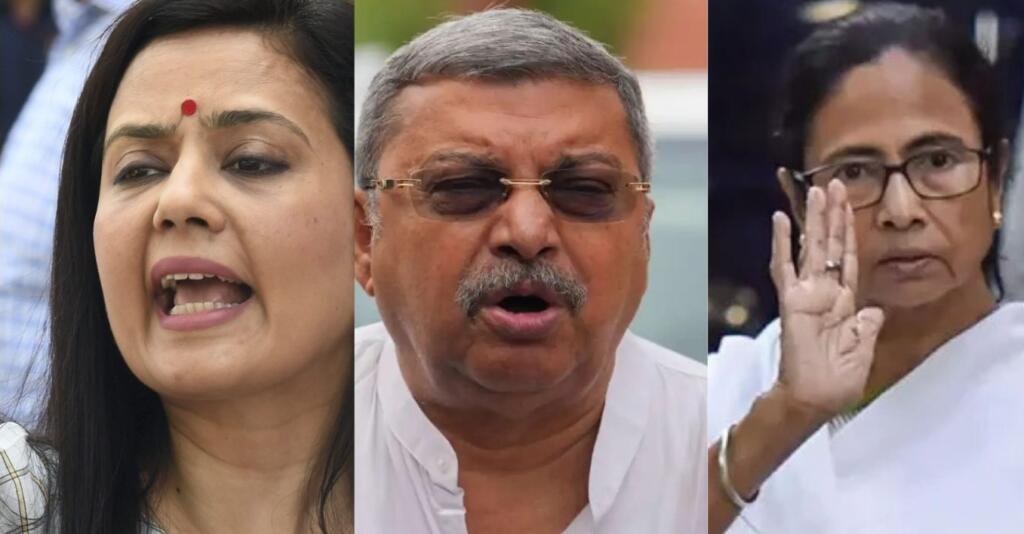
Amid escalating factional tensions and widening rift within its ranks, the Trinamool Congress (TMC) continues to grapple with a deepening internal crisis that has now culminated in a major reshuffle in its parliamentary leadership. Following days of high drama involving a bitter feud between senior MPs Mahua Moitra and Kalyan Banerjee, the party has formally accepted Banerjee’s resignation as Chief Whip of the TMC in the Lok Sabha. Veteran MP Dr. Kakoli Ghosh Dastidar has been named his replacement, while Satabdi Roy has been appointed as Deputy Leader of the TMC’s Lok Sabha unit, with immediate effect.
These developments, rubber-stamped today by the party high command, mark yet another episode in the TMC’s ongoing political soap opera, a drama featuring factional fireworks, personal vendettas, and a slow, theatrical unravelling of what once passed for internal discipline in one of India’s most tightly controlled regional parties.
Kalyan Banerjee’s Resignation Officially Accepted
After a public fallout with Mahua Moitra and a dramatic resignation announcement, Kalyan Banerjee’s exit from his position as Chief Whip has now been formalized. According to party sources, TMC Chairperson Mamata Banerjee accepted the resignation following consultations with senior MPs. Banerjee was thanked for his contributions to the party’s parliamentary functioning.
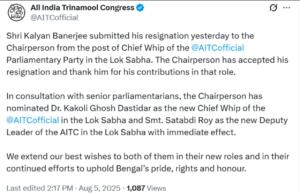

Banerjee had submitted his resignation on Monday, shortly after a virtual meeting of TMC MPs chaired by Mamata Banerjee. During that meeting, the party chief reportedly expressed dissatisfaction with poor coordination and public spats within the party’s Lok Sabha wing. Banerjee, in an emotional reaction, interpreted this as being blamed for dysfunction within the team and decided to step down.
‘I have quit as the party’s Chief Whip in Lok Sabha as ‘Didi’ said during the virtual meeting that there is a lack of coordination among party MPs. So the blame is on me’, Banerjee said. “I am so upset that I am even thinking of quitting politics altogether.”
He also lamented the party’s silence in response to what he described as repeated ‘abuse’ from a fellow MP, an unmistakable reference to Mahua Moitra.
Mahua Moitra’s ‘Pig’ Jibe
The tipping point came when Mahua Moitra made a controversial remark during a podcast with India Today, saying, ‘You don’t wrestle with a pig. Because the pig likes it and you get dirty’. Though she did not name anyone, the barb was widely interpreted as aimed at Kalyan Banerjee.
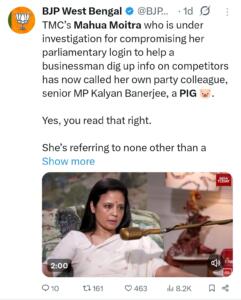

This was in response to Banerjee’s earlier comments questioning Moitra’s personal conduct and her marriage to BJD MP Pinaki Mishra, remarks that many considered intrusive and unprofessional. Moitra, in turn, accused Banerjee of being a ‘sexually frustrated, misogynistic man’, alleging that such behavior was reflective of broader systemic sexism in Indian politics.
Banerjee hit back with a lengthy statement on X, writing:
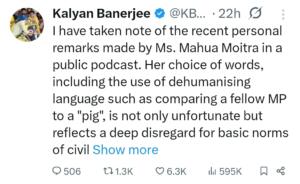

‘Her choice of words, including the use of dehumanising language such as comparing a fellow MP to a ‘pig’, is not only unfortunate but reflects a deep disregard for basic norms of civil discourse.’
He further pointed out the double standards in the political discourse:
‘Labelling a male colleague as ‘sexually frustrated’ isn’t boldness – it’s outright abuse. If such language were directed at a woman, there would be nationwide outrage.’
Factionalism and Emotional Fallout
This feud between Banerjee and Moitra is just the most public instance of growing internal tensions within the TMC. The party has been plagued by earlier altercations involving Banerjee and MPs like Kirti Azad. Leaked videos of confrontations, including those from inside Election Commission premises and WhatsApp chats, have been weaponized by political rivals to expose the party’s cracks.
Senior MP Saugata Roy even admitted that ‘all MPs went against Kalyan Banerjee’, underscoring the lack of unity within the TMC’s parliamentary wing. Party insiders revealed that Moitra was visibly emotional and broke down during one of the more heated exchanges highlighting the toxicity that has engulfed party dynamics.
Mamata Banerjee’s Reprimand and Restructuring
In response to the crisis, Mamata Banerjee has taken a firm stance. During Monday’s virtual meeting, she sternly rebuked the Lok Sabha MPs for public infighting and praised the Rajya Sabha contingent for their discipline. She hinted at forming a disciplinary committee and restructuring the parliamentary team, moves seen as an attempt to restore order and reinforce internal control.
Abhishek Banerjee, the party’s General Secretary and Mamata’s nephew, had earlier attempted to broker peace by reaching out personally to Kalyan Banerjee. However, the effort failed to reverse the resignation, highlighting the limitations of the leadership’s influence amid growing factionalism.
An “Old vs. Young” Power Struggle?
Many observers believe this episode reflects a broader struggle within the TMC between the party’s old guard and emerging new faces. Kalyan Banerjee, a four-time MP and longtime loyalist of Mamata Banerjee, represents the traditional camp. Mahua Moitra and others like her are seen as part of a newer, more assertive generation, often aligned with Abhishek Banerjee’s modern, combative style of politics.
The inability of the leadership to contain such clashes suggests deeper ideological and generational divides, exacerbated by a lack of robust internal mechanisms to mediate disputes.
The TMC, once celebrated for its cohesion and centralized leadership under Mamata Banerjee, now finds itself mired in public embarrassment, emotional breakdowns, and escalating internal feuds. The acceptance of Kalyan Banerjee’s resignation and the restructuring of parliamentary leadership are signs of a party trying to stem the bleeding.
However, unless systemic changes are introduced to resolve factionalism and restore trust among its ranks, the Trinamool Congress may face long-term damage, both to its internal morale and public credibility.