
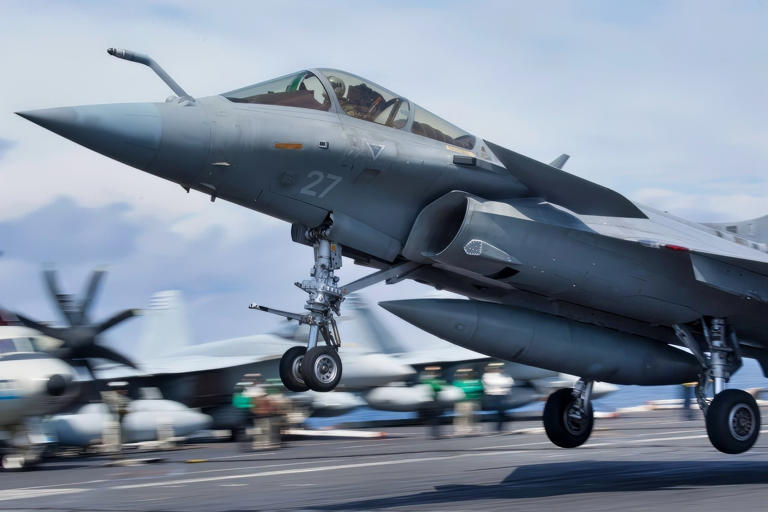
In a significant shift in its fighter jet acquisition strategy, the Indian Air Force (IAF) is preparing to move forward with a direct government-to-government (G2G) deal with France for 114 Rafale fighter jets, bypassing the long-delayed global Multi-Role Fighter Aircraft (MRFA) tender process, The Times of India has reported.
The proposal, aimed at urgently bolstering IAF’s depleting squadron strength, is expected to be submitted for “Acceptance of Necessity” (AoN) — a key step in the procurement process — to the Defence Acquisition Council (DAC) by October 2025. A final decision will rest with the government.
The urgency stems from a critical shortfall in the IAF’s combat strength. The force currently operates just 31 fighter squadrons — each comprising 16 to 18 aircraft — against the sanctioned strength of 42.5 squadrons needed to counter simultaneous threats from Pakistan and China.
With the last of the MiG-21s set to retire next month, that number is projected to fall to just 29 squadrons — the lowest in IAF history.
Sources quoted in the report said the IAF considers the Rafale the best option to quickly replenish its fleet, especially following Operation Sindoor, a high-profile offensive conducted between May 7 and 10 this year, during which Rafale jets were used in long-range strikes against targets in Pakistan.
Islamabad claimed it had downed six Indian aircraft — including three Rafales — using Chinese-supplied J-10 fighters armed with PL-15 beyond-visual-range missiles. India, however, has denied any losses. Regardless, the incident has intensified calls within the IAF for enhanced air superiority capabilities.
Officials argue that a direct G2G route would be both cost-effective and logistically efficient compared to an open tender. With 36 Rafales already in service, infrastructure at Ambala and Hasimara is fully ready to absorb at least two more squadrons without major upgrades.
However, negotiations face a key hurdle: India’s demand for access to the Rafale’s source codes to integrate indigenous weapon systems. French defence firms — including Dassault Aviation, Safran, Thales, and MBDA — remain cautious, citing concerns over the protection of proprietary technology.
Despite this, industrial cooperation between India and France around the Rafale is deepening. In June 2025, Dassault and Tata Advanced Systems Ltd (TASL) signed four production transfer agreements to begin manufacturing Rafale fuselages in Hyderabad — the first time such components will be built outside France.
The facility will produce complete front, central, and rear fuselage sections for both Indian and potential export aircraft, with production slated to begin in FY2028 at a rate of two fuselages per month.
Further expanding defence ties, India is also in advanced talks with France’s Safran to co-develop a new high-thrust engine for the indigenous Advanced Medium Combat Aircraft (AMCA), targeted for induction by 2035.
Meanwhile, the Indian Navy is set to receive 26 Rafale-M fighters for deployment aboard INS Vikrant, beginning in 2028 — a move that could create significant interoperability benefits. A common fighter platform across the Air Force and Navy is expected to streamline training, maintenance, and spare parts logistics.
While speculation had circulated around South Korea’s KF-21 Boramae, IAF sources have categorically ruled out its inclusion in the MRFA race. Competing contenders still in the fray include the Lockheed Martin F-21 (F-16V variant), Saab Gripen E/F, Boeing F-15EX, Eurofighter Typhoon, and Russia’s MiG-35 and Su-35.
India has ruled out the US-made F-35A amid a continuing trade dispute with Washington, but is reportedly exploring co-production of 50–60 Su-57E fifth-generation fighters with Russia’s United Aircraft Corporation and Hindustan Aeronautics Ltd (HAL).
Talks are expected to advance during President Vladimir Putin’s scheduled visit to New Delhi in September this year.
With strategic imperatives mounting and geopolitical dynamics shifting rapidly, the proposed Rafale deal signals a decisive move by India to fast-track its air combat readiness.