

















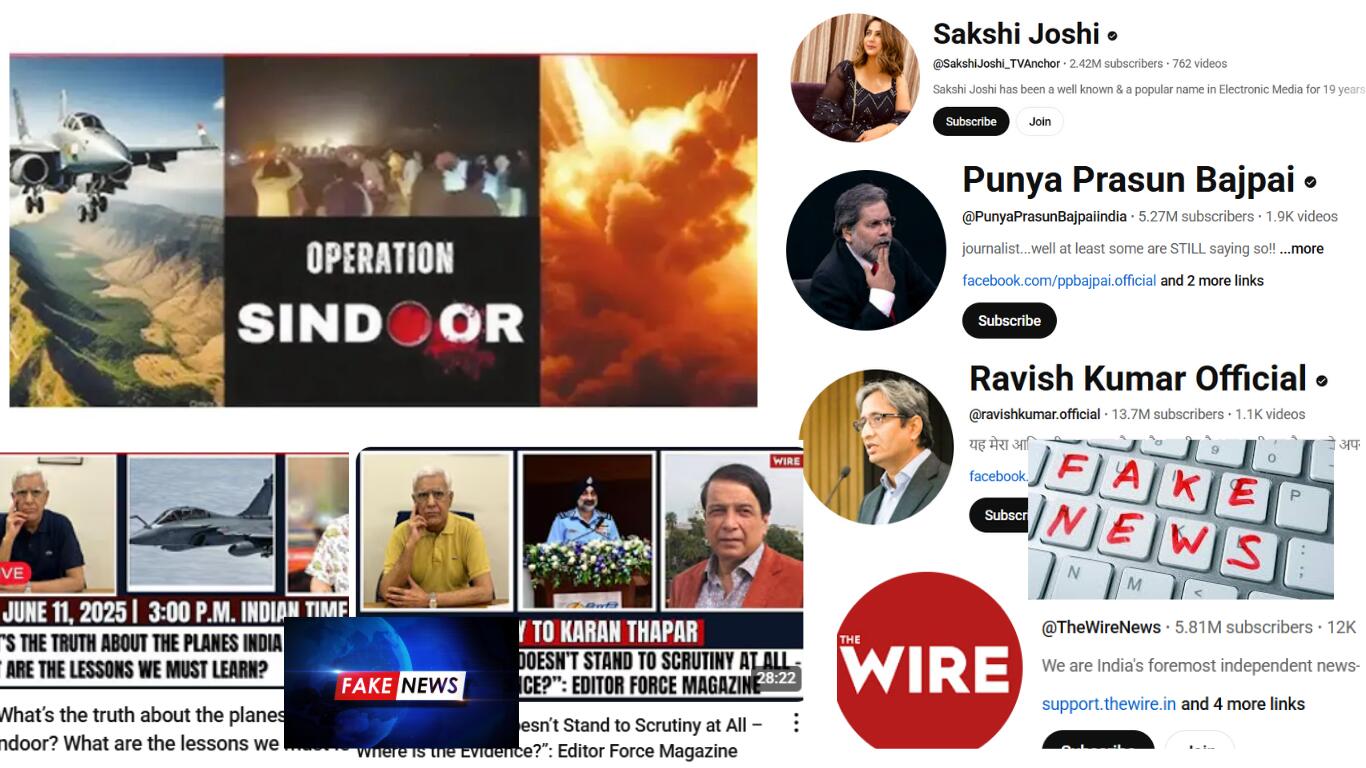
When the Pakistan Air Force (PAF) falsely claimed to have shot down six Indian fighter jets without a single shred of proof certain prominent journalists and media outlets in India amplified the claim without hesitation. Ravish Kumar? 0 videos countering it. Punya Prasun Bajpai? 0 videos. The Wire, 4 PM, Shakshi Joshi? Silence. Instead they went onto question Indian government’s Op Sindoor and IAF by posting several vidoes in their you tube channel and propagated the fake agenda
Yet, when our own Indian Air Force (IAF) revealed with concrete data and verifiable proof that it had destroyed five Pakistani jets during Op Sindoor, the same voices were nowhere to be found. No primetime specials, no viral videos, no applause for the forces — just deafening silence.
This selective outrage and selective silence reveal a disturbing mindset in sections of the media, one that undermines India’s armed forces while seemingly giving a free pass to Pakistan’s propaganda machine.
The Historic Operation Sindoor Kill
Chief of the Air Staff, Air Chief Marshal AP Singh, recently credited the “political will” of the Central Government for the unprecedented success of Op Sindoor. Addressing an event at HAL Management Academy in Bengaluru, he revealed that the IAF faced “no restrictions” and carried out operations without external interference.
The most striking revelation was the destruction of a large Pakistani airborne platform — possibly an ELINT (Electronic Intelligence) or AEW&C (Airborne Early Warning and Control) aircraft — from an astonishing distance of about 300 km. According to the IAF Chief, this was the “largest-ever recorded surface-to-air kill that we can talk about”.
A senior IAF officer clarified that while the engagement was not “quantitatively the largest,” it was the longest ever recorded surface-to-air kill — an achievement rare in modern air warfare and virtually unheard of in public disclosures.
This feat was made possible through advanced systems such as the Barak 8 Medium Range Surface-to-Air Missile (MRSAM) and India’s indigenous Akash missile system — both critical in thwarting Pakistani threats. The S-400 system also played a role, with the Defence Acquisition Council recently approving a comprehensive maintenance contract for it.
Pakistani Lies, Indian Proof & Media Bias
When the PAF pushed its false narrative of downing six Indian jets, there was zero evidence — no radar data, no debris, no images. Still, certain Indian journalists treated it as credible. On the other hand, the IAF’s claims are backed by radar imagery, mission logs, and independent verification — yet these same journalists ignore them.
This is not healthy scepticism. This is bias. And it’s a dangerous one — the kind that chips away at national morale.
Why do some Indian journalists trust the Pakistani military — a known propaganda factory — more than their own armed forces? Is it political hatred for the current government? Is it ideological bias? Or is it simply because bashing India sells better in certain circles?
Ignoring India’s Defence Achievements
Another glaring omission in the coverage by these so-called “neutral” media voices is the complete lack of praise for India’s defence ecosystem. DRDO, HAL, and other institutions worked for years to develop systems like the Akash missile, which played a key role in this operation. Yet, these achievements find little mention in primetime debates that are otherwise quick to spotlight failures.
Instead of celebrating Indian technological and strategic prowess, these journalists fixate on narratives that paint India as weak or reckless — while giving a pass to Pakistan, a country whose entire state apparatus has been linked to terrorism.
The Real Threat: Internal Proxies
India’s military is more than capable of defeating Pakistan in any direct confrontation. But an equally dangerous battle is being fought within — against internal proxies. These are people who live in India, earn in India, enjoy its freedoms, yet work tirelessly to push anti-India propaganda that aligns with hostile foreign agendas.
These proxies are far more insidious because they operate under the guise of journalism, activism, or “fact-checking” all while eroding public trust in our armed forces.
The tragedy is that their words don’t just damage reputations; they have the potential to weaken national resolve in moments of crisis.
The Need for Vigilance
The story of Op Sindoor should have been a moment of national pride a reminder of India’s technological strength, strategic clarity, and the courage of its armed forces. Instead, it has exposed how a segment of Indian media willingly undermines the country’s narrative while echoing enemy propaganda.
The lesson for citizens is clear: verify before you believe. Don’t let agenda-driven journalism manipulate your perception of national security. Trust facts, not bias. And never forget that the strength of a nation lies not just in its weapons, but in the unity of its people behind the truth.