
















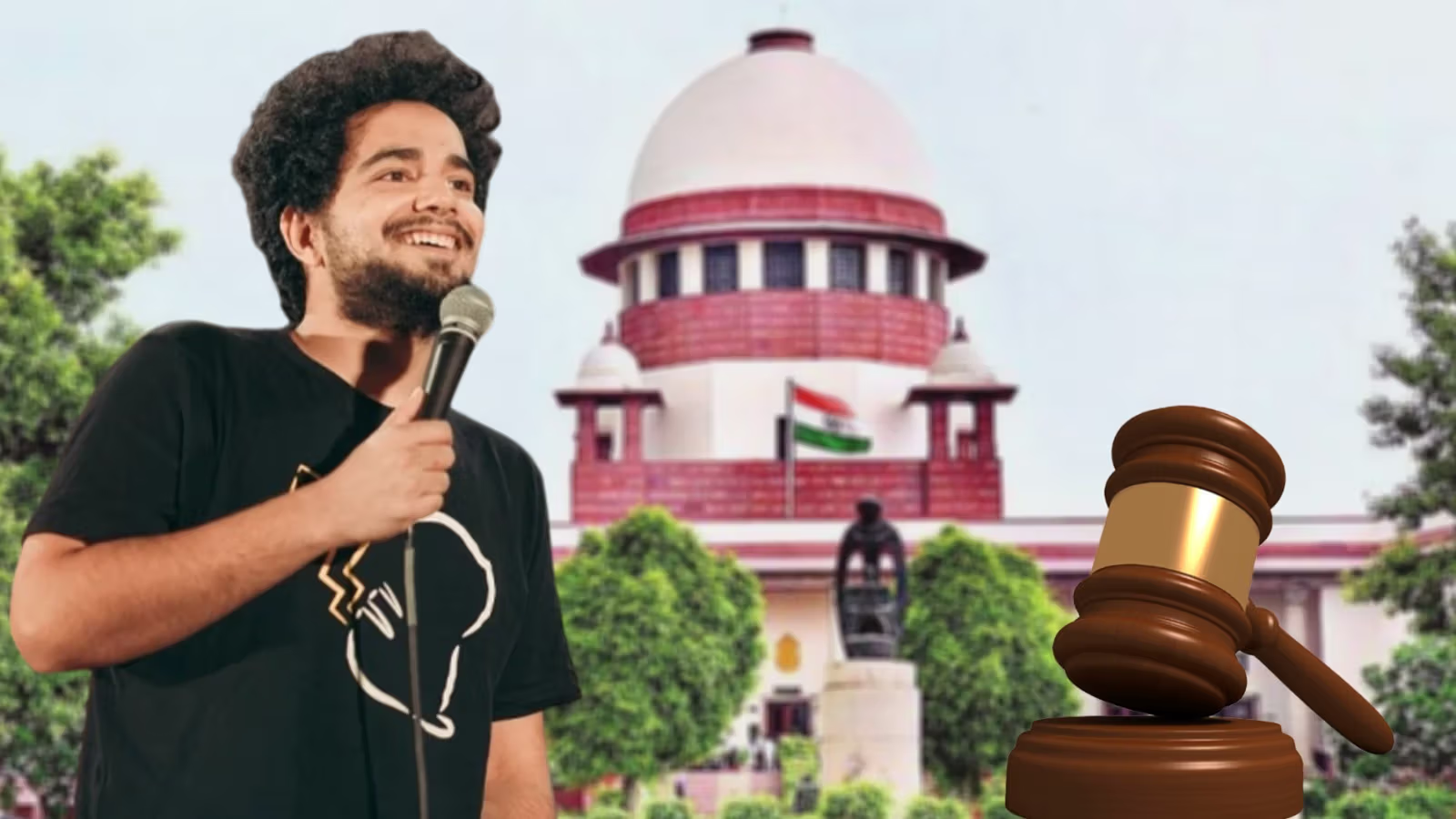
In an observation underscoring the limits of free speech in the digital age, the Supreme Court on Monday directed five social media influencers — including stand-up comedian and India’s Got Latent host Samay Raina — to issue public apologies for mocking persons with disabilities in a recent online video.
The court pulled up the creators for their “insensitive and crass humour” and held that freedom of speech and expression cannot be stretched to cover commercial content that ridicules or hurts the sentiments of vulnerable communities.
The top court’s stern intervention send out a clear message that when humour becomes a tool for commercial gain at the cost of dignity, it cannot be defended under the guise of artistic liberty.
The bench said, “Freedom of expression is a constitutional right, but it cannot extend to commercial speech that offends or marginalises sections of society. Such expressions must come under scrutiny.”
The top court added that speech delivered for monetary gain — especially when peddled to large digital audiences — carries added responsibility.
The court also directed the Centre to frame comprehensive guidelines for regulating content on social media platforms, including OTT spaces, to ensure better protection for persons with disabilities, women, children, and senior citizens.
Importantly, the bench cautioned against framing such rules in haste. “Guidelines should not be a knee-jerk reaction to a single incident. They must be shaped through consultation, keeping in view the voices of all stakeholders, including digital creators, regulatory bodies, and civil society,” the court said.
The SC directed Samay Raina and four others to issue public apologies on social media after they made insensitive jokes about an infant suffering from spinal muscular atrophy (SMA).
A bench of Justices Surya Kant and Joymalya Bagchi indicated that on the next hearing, it would decide the penalty to be imposed on comedians Raina, Vipul Goyal, Balraj Paramjeet Singh Ghai, Sonali Thakkar alias Sonali Aditya Desai, and Nishant Jagdish Tanwar.
The development came after the comedians filed their written apologies before the top court and remained personally present during the hearing.
The Justice Surya Kant-led Bench was hearing an application by the Cure SMA Foundation of India, which objected to the stand-up comedians making fun of the dependence of poor patients on fundraising to access medicines for the rare genetic disease.
This came after a main petition was filed by the Cure SMA Foundation of India concerns the exorbitant prices of drugs used for treating the condition.
The life-saving drugs for SMA include Zolgensma, a one-time gene therapy priced at around Rs 16 crore. In its application, the foundation urged “the highest degree of sensitivity and compassion” in discussions about people suffering from SMA.
During his show, “India’s Got Latent”, Raina pointed out a charity case of a two-month-old baby.
He said “something crazy” had happened, “A two-month-old baby requires a Rs 16 crore injection.”
Calling out a woman in the audience, he added, “Ma’am, you tell me… if you were that mother and one day Rs 16 crore appeared in your bank account… while you had a two-month-old… wouldn’t you at least look at your husband once and say… ‘Hmmm… inflation is rising’.”
Why the Guidelines Matter
With the exponential rise of digital media and OTT platforms, content creation has increasingly veered into controversial and often offensive territories, frequently justified under the blanket of satire or free speech.
In particular, the monetisation of social media content has led to a blurring of lines between ‘personal expression and commercial broadcast.’
What was once limited to drawing-room comedy or personal opinion now reaches millions — and earns revenue. The court’s emphasis on the distinction between private opinion and commercialised content underlines the urgent need to reconsider the boundaries of digital expression in a monetised ecosystem.
Crass humour targeting marginalised communities — often masked as “dark comedy” — has become a recurring trend across digital platforms.
The ruling, therefore, isn’t just about one video or a few individuals; it is a broader reflection on how digital creators must align their content with fundamental rights and human dignity.
The Road Ahead for Digital Platforms
This development places the onus not just on individual creators but also on hosting platforms to moderate harmful content more responsibly. While OTT and social media platforms have long argued for creative freedom, the ruling reaffirms that this freedom cannot come at the cost of dignity and inclusion.
As the government begins the process of framing new guidelines, the focus is likely to be on ensuring safeguards without stifling genuine creativity. Balancing innovation with empathy may become the new litmus test for digital expression.
The Supreme Court’s ruling sets a precedent — that in a society where humour and content travel faster than ever before, accountability must keep pace.
According to LiveLaw, counsel for the respondents undertook that each of them would display an apology on their YouTube channels and podcasts and also file affidavits confirming compliance. The court said their personal appearance was dispensed with for now, provided they adhered to this undertaking.
“Humor is well taken and is a part of life. We laugh at ourselves. But when we start laughing at others and create a breach of sensibility…on a community plane, when humor is generated, it becomes problematic. And this is what so-called influencers of today should bear in mind. They are commercialising speech. The community at large should not be utilised to hurt the sentiments of certain sections. It’s not only freedom of speech, it’s commercial speech,” the bench said, as quoted by LiveLaw.
The bench of Justices Surya Kant and Joymalya Bagchi also said the question of penalty or costs would be decided later. During the hearing, Justice Kant remarked, “There should be a balance of rights and duties”.
The petition was filed by NGO Cure SMA Foundation of India. The court previously warned that mocking the disabled cannot be allowed under the guise of free speech and termed the influencers’ actions “damaging” and “demoralising.
”Raina, along with podcaster Ranveer Allahbadia, was booked by Maharashtra and Assam police. The court earlier granted Allahbadia interim protection from arrest, calling his remarks “vulgar” and evidence of a “dirty mind which put society to shame.”
In an age of virality, words aren’t just spoken — they’re broadcast. With reach comes responsibility, and with humour, a duty to uphold human dignity. Hence, the right to speak doesn’t include the right to demean because creativity thrives best when rooted in compassion.