
















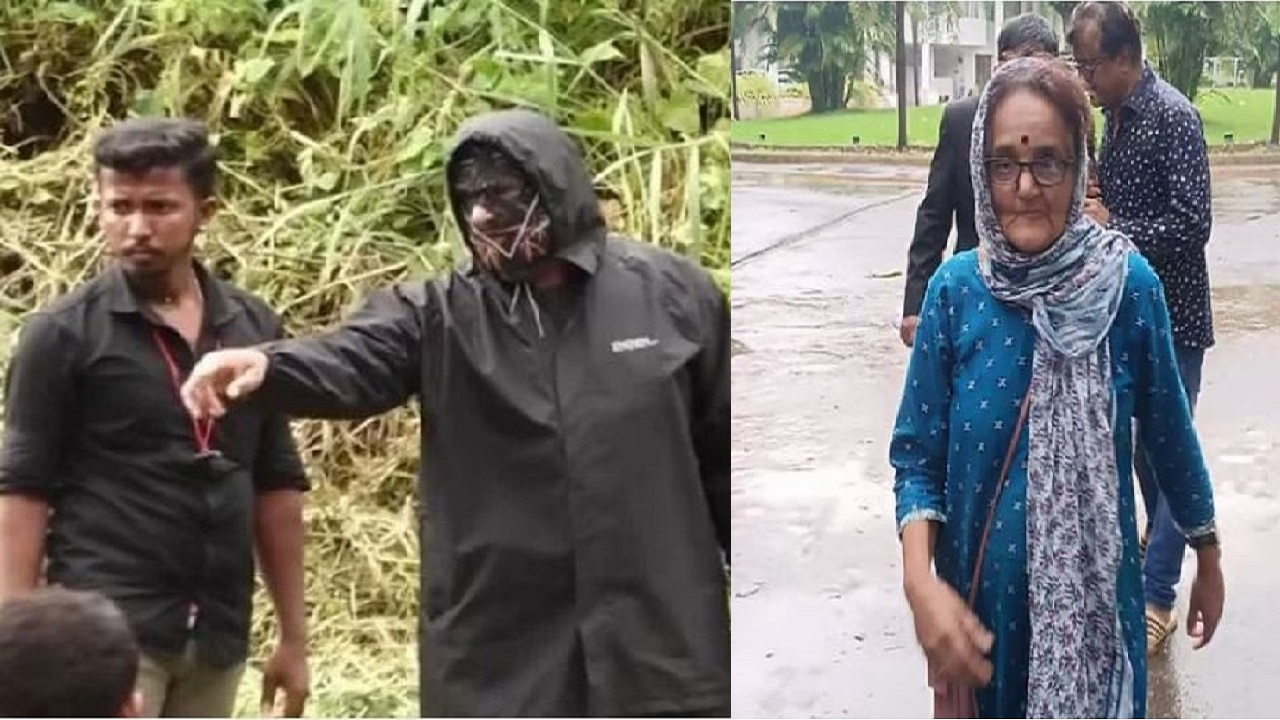
In a twist in the Dharmasthala ‘mass burial’ case of Karnataka, an elderly woman whose testimony sparked serious allegations of mass graves and sexual assault in the temple town, has admitted that her claims were entirely fabricated.
The woman identified as Sujata Bhat on August 22 conceded her testimony while speaking to a YouTube channel.
Bhat revealed that she had been manipulated by two activists — Girish Mattannavar and T Jayanti — into making false statements about a missing daughter named Ananya Bhat, who, she now confirms, never existed.
She added that the photo circulated as evidence of Ananya’s identity was fake and claimed that it was all due to a property dispute involving her grandfather and the temple administration.
Bhat also denied any financial motive or transaction behind her role in the conspiracy.
Sujatha had earlier alleged that Ananya, described as an 18-year-old medical student, went missing in Dharmasthala in 2003.
She had claimed she was kidnapped, assaulted, and threatened not to return to the town or speak out. At one point, she even asserted she was hospitalised in Bengaluru and had fallen into a coma.
“It is not true. There was never any daughter named Ananya Bhat. Some people told me to say it. I was asked to do it because of the property issue. That’s the only reason,” the woman acknowledged.
Sujatha Bhat claimed that she never received or paid money in connection with her fake testimony. “Nobody demanded money from me,” she was heard saying.
She further apologised to the people of Karnataka for hurting their religious sentiments.
“Yes, for the people of Karnataka, for the devotees of Dharmasthala…I ask the people of this state, and the whole country, to forgive me…” Bhat added.
Following her public retraction, the Special Investigation Team (SIT) summoned her to appear at its Belthangady office for questioning.
SIT Finds No Evidence of Mass Burials
Meanwhile, the SIT, formed by the Karnataka government on July 19 to investigate the explosive allegations, has so far found no evidence to support the claims of mass killings or secret burials.
Excavations began on July 29 at 13 sites identified by a self-proclaimed former sanitation worker of the Lord Manjunatha shrine.
By July 30, five sites had been dug without any findings. On July 31, the SIT exhumed human remains at the sixth site — bones later confirmed to belong to a male. No female skeletons have been discovered so far.
Investigators reportedly found about 15 bones at that location, though no skull was recovered. A debit card belonging to a woman and a PAN card registered to a man named Suresh from Nelamangala, Bengaluru Rural district, were also recovered.
When traced, Suresh’s father confirmed his son had died of jaundice in March 2025 and had struggled with alcoholism.
The Origins of the Case
The case began on June 3 when a masked man, claiming to be a former sanitation worker, filed a complaint alleging he had been forced to bury the bodies of women and minors who were murdered in Dharmasthala between 1995 and 2014.
He later appeared in court, concealing his identity, and presented what he claimed were skeletal remains from a burial site.
A week later, Sujatha Bhat came forward with her now-recanted testimony, further fuelling public outrage. The gravity of the allegations led to the formation of the SIT, which began thorough excavation of the 13 sites listed by the whistleblower.
However, the investigation began to unravel when the skull submitted to the court was tested at two hospitals — both confirmed it belonged to a male who had died approximately 30 years ago. The most sensational claim — that 60 to 100 bodies were buried 16 feet deep at one of the sites — was debunked after Ground Penetrating Radar scans and subsequent digging revealed nothing.
With the primary witnesses discredited and no physical evidence found, the case is rapidly collapsing under the weight of its own falsehoods.