















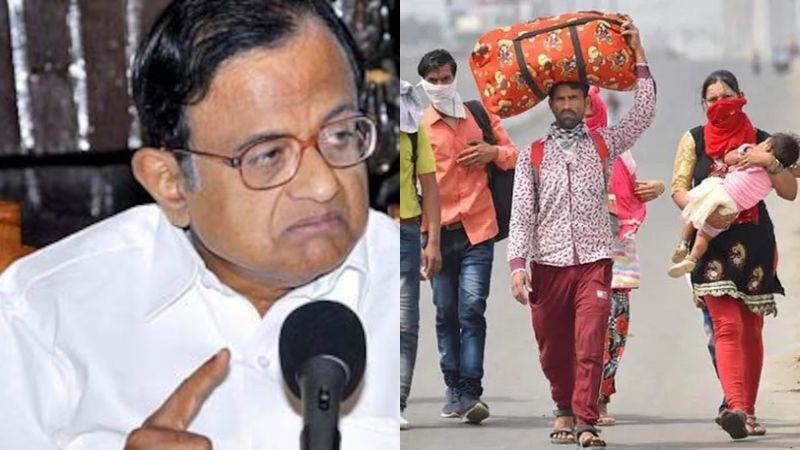
A tweet from senior Congress leader and Rajya Sabha MP P. Chidambaram has triggered a political storm and renewed scrutiny over migrant workers’ voting rights in India. Chidambaram questioned the legitimacy of over 6.5 lakh migrant voters, mainly from Bihar, being added to Tamil Nadu’s electoral rolls, calling the process ‘dangerous and illegal.’
The remarks have not only ignited a legal and ethical debate but also drawn sharp responses from rival political parties, civil society, and constitutional experts with many accusing the Congress of promoting regional discrimination and undermining the fundamental rights of Indian citizens.
Chidambaram’s Controversial Claim
On August 3, 2025, Chidambaram tweeted:
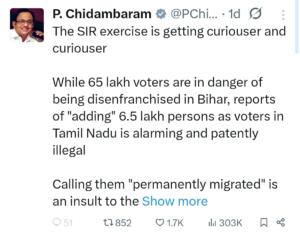
‘The Election Commission is reportedly adding 6.5 lakh migrant workers to Tamil Nadu’s voter list. This is a serious threat to the integrity of the electoral process. These individuals are not permanent residents; many return to Bihar for Chhath Puja. Their inclusion is not only illegal, it alters Tamil Nadu’s electoral character.’
The former Finance Minister framed his concern as a legal and procedural issue, but critics argue his remarks reflect regional bias and a mindset reminiscent of the now-abrogated Article 370, which once barred non-residents from settling in Jammu & Kashmir.
Legal Standpoint
According to the Representation of the People Act, 1950, any Indian citizen who is ordinarily resident in a particular constituency is entitled to register as a voter there, regardless of their place of origin or property ownership.
‘Even a tenant or a daily wage laborer can register to vote if they have lived in the area consistently,’ said an Election Commission official who requested anonymity. ‘There’s no law preventing migrants from becoming voters if they meet the basic residency criteria.’
Double Standards?
Chidambaram’s critics were quick to point out a perceived double standard.
Rahul Gandhi, a permanent resident of Delhi, has contested and served as MP from Wayanad (Kerala) and Amethi (UP). If political leaders can contest from any state, why are migrant laborers denied the same democratic right to vote in the state where they live and work?
‘What applies to politicians must also apply to citizens,’ said a political analyst. ‘The Constitution doesn’t have one rule for elites and another for the working class.’
Backlash from Bihar: ‘An Insult to Migrants’
The reaction from Bihar was swift and scathing.
JDU spokesperson Neeraj Kumar accused Congress of ‘regional elitism’ and called Chidambaram’s remarks an insult to Bihari dignity and constitutional rights.
‘Biharis work across the country, building infrastructure, driving the economy. Now they are being treated like second-class citizens. This is unacceptable,’ he said.
He also questioned the silence of the Rashtriya Janata Dal (RJD), a key Congress ally in Bihar, which champions the cause of social justice.
‘Where is Tejashwi Yadav? Why isn’t he defending the people of Bihar? Is he more loyal to Rahul Gandhi than to his own state?’ Kumar asked.
Past Precedents that echoed Anti-Bihari Sentiment
Chidambaram’s remarks are not an isolated incident.
In the 2021 West Bengal elections, TMC leader Mamata Banerjee portrayed Hindi-speaking migrants, especially Biharis, as ‘outsiders‘. In Maharashtra, parties like Shiv Sena have a long history of targeting Bihari migrants under the banner of ‘Marathi pride’.
Now, political analysts fear that such language from a senior Congress leader could reignite regional tensions and alienate millions of migrant workers across India.
Congress on the Defensive
While Bihar Congress spokesperson Asit Nath attempted to defend Chidambaram, he did not directly oppose the statement. Instead, he claimed the State-Informed Register (SIR) is flawed and being manipulated ‘at the behest of RSS,’ implying that voter list manipulation is a bigger concern than the rights of migrant voters.
‘My own wife’s name is missing from the final list despite voting in the last election. We may move court,’ he added, but carefully avoided criticizing Chidambaram.
This ambiguity raises a key question:
Is Congress prioritizing procedural issues, or using them as a pretext to exclude certain voter groups?
Dangerous Implications for National Unity
Tamil Nadu is home to over 1 million migrant workers, a majority of them from Bihar. They are employed in sectors like construction, textiles, small businesses, and services. Many have lived there for years, some even with families and children attending local schools.
They pay taxes, contribute to the state economy, and often work under harsh conditions. Should they not be allowed to vote where they live?
Many fear Chidambaram’s remarks could set a dangerous precedent of legitimizing regional exclusion and sparking inter-state hostility. The principle of ‘one nation, one citizenship’ is under threat when political leaders question the inclusion of fellow Indians in the democratic process based on their state of origin.
Key Questions That Arise
Can Indian citizens be denied voting rights in a state where they live and work?
Why is Congress silent on its own leaders contesting elections outside their home states?
Are regional political gains being prioritized over national unity and migrant dignity?
P. Chidambaram’s tweet may have been intended to raise procedural concerns about voter list integrity. However, its language and implications reveal deeper regional biases and constitutional misunderstandings.
At a time when India is grappling with migrant welfare, internal mobility, and electoral reforms, such remarks only deepen divisions. Because the right to vote is not a privilege, it’s a constitutional guarantee.