
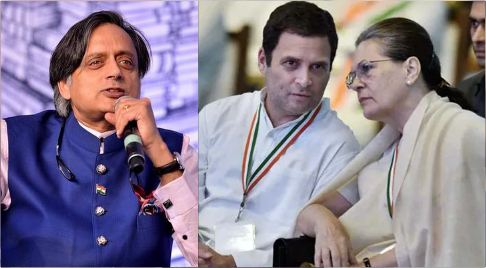
When Shashi Tharoor speaks, he often chooses his words carefully. But every now and then, he says something that shakes the room. Especially when it’s directed at his own party, with which he shares a love-hate relationship. His latest remark, calling out the controversial role of Sanjay Gandhi during the Emergency, did just that. And once again, it has put a spotlight on not just India’s troubled political past, but also the current fault lines within the Rahul Gandhi-led Congress.
In many ways, this is a moment of déjà vu. Tharoor has long walked a tightrope in the Congress, deeply loyal to the party’s founding ideals, yet increasingly out of step with how it is run today. And also raising questions on the Congress over its “Constitution is in danger” pitch.
Ghost of Sanjay Gandhi, and Congress’s Silence
Tharoor’s statement wasn’t off-base. History has clearly documented Sanjay Gandhi’s informal but forceful grip on power during the Emergency, muzzling the democracy. Sanjay’s hand in forced sterilizations, evictions, and a brutal clampdown on dissent during the dark period. What’s surprising is not what Tharoor said, but that it came from a sitting senior Congress MP, someone still expected to toe the party line, especially on the Gandhi family legacy.
The truth is, Congress has never truly confronted that chapter in its history, never apologized. It’s easier for the party to criticize Prime Minister Narendra Modi’s centralization of power than to honestly acknowledge its own dismal record on democracy. Tharoor, by speaking out, pulled the curtain back on this selective amnesia and in doing so may have crossed an unspoken line.
Tharoor vs Congress
It’s no secret that Tharoor has never been fully embraced by the Gandhi-led inner circle, despite his intellect, popularity, and three consecutive wins as a Lok Sabha MP from Thiruvananthapuram. Ever since he dared to contest the party presidential election against the “official” candidate Mallikarjun Kharge in 2022, he’s been kept at arm’s length by the inner coterie.
Tharoor’s appeal, articulate, modern, reformist, is exactly what many say the Congress needs. But within the party, these very qualities seem to make him a threat. The Congress under Rahul Gandhi doesn’t seem to know what to do with someone who’s loyal but not unquestioning, prominent but not pliable.
That’s the paradox of Tharoor’s place in the Congress: he’s too valuable to discard, but too independent to promote.
Dissent Dilemma in Rahul Gandhi’s Congress
Under Rahul Gandhi’s leadership, the Congress has increasingly become a space where internal criticism is viewed with suspicion, and outright rejection. Leaders like Ghulam Nabi Azad, Kapil Sibal, Jyotiraditya Scindia and Himanta Biswa Sarma left not because they opposed the party’s ideology, but because they felt shut out, alienated by a system that rewards loyalty to the family over performance or opinion.
Tharoor, to his credit, has stayed like a loyal soldier of the party. But his recent statements, whether about the Emergency or the need for internal reform, highlight what many Congress insiders won’t say out loud: Rahul Gandhi’s Congress doesn’t handle dissent well.
Even symbolic debates, like acknowledging Sanjay Gandhi’s missteps, remain untouchable. It’s as if any critique of the past is seen as disloyalty, not honesty.
Cost of Avoiding Hard Truths
Rahul Gandhi regularly accuses the Modi government of authoritarianism. He talks about saving the Constitution, protecting institutions, defending dissent. But unless Congress is willing to look within and confront its own democratic failings, including its dynastic culture and silencing of internal critics, those words can ring hollow.
You can’t be the party of democratic values while ignoring your own history or shutting out your own best minds. Interestingly, it must be pointed out that a group of senior Congress leaders has been batting for regular debates with the NDA government on the floor of the Parliament. However, they have all been become out of favor with the scion of Congress as he still wants to continue with shouting matches and rushing into the well of Lok Sabha and Rajya Sabha in each session of Parliament.
Why Tharoor Still Matters
Shashi Tharoor may be inconvenient for the Congress leadership, but he remains one of its most relevant figures. In a party struggling to connect with India’s aspirational, urban, younger voters, he brings clarity, vision, and a modern voice. He’s willing to acknowledge mistakes, including the ones committed by Congress. That kind of honesty is rare in Indian politics and almost unheard of in his party. And this goodwill of Tharoor extends across party lines as well.
If Congress was serious about rebuilding itself, leaders like Tharoor should be leading the charge and not kept waiting outside the door.
The Bigger Picture
Tharoor’s comments on Sanjay Gandhi weren’t just a reminder of the Emergency. They were a quiet challenge to a party that refuses to fully confront its past, a nudge to a leadership that still values family allegiance over institutional renewal.
For the Congress, the road to revival doesn’t just run through winning elections, it runs through winning back credibility. And that begins with owning up to history, listening to truth-tellers, and making space for those with both backbone and vision.
Because if the party can’t deal with someone like Tharoor, it’s hard to believe it’s ready to deal with India’s future.