
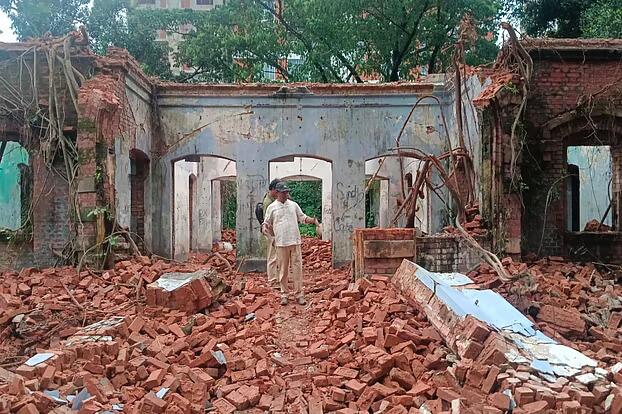
Despite repeated diplomatic efforts from India, the Bangladesh government has pressed ahead with the demolition of legendary filmmaker Satyajit Ray’s ancestral home in Mymensingh. This act of cultural insensitivity carried out even after New Delhi offered restoration support reveals a startling disregard for Bangladeshi heritage and, by extension, a contemptuous attitude toward shared Indian heritage. The film icon’s grandfather, Upendrakishore Ray Chowdhury, was a pivotal figure in Bengal’s literary and artistic renaissance. Yet, the Dhaka administration seems determined to erase this legacy, replacing historic identity with soulless concrete, betraying a troubling intolerance for symbols of Indo-Bangladesh cultural unity.
A Priceless Heritage Under the Bulldozer
Satyajit Ray’s ancestral home, located on Harikishore Ray Chowdhury Road in Mymensingh some 120 km north of Dhaka was built over a century ago by Upendrakishore Ray Chowdhury, a revered zamindar and writer. The house later housed the Mymensingh Shishu Academy from 1989, transforming it into an institution of learning while preserving its rich legacy.
Earlier this Tuesday, the Indian Ministry of External Affairs (MEA) voiced deep regret over demolition efforts, emphasising that the property symbolises a shared Indo-Bangladesh cultural renaissance. New Delhi offered to collaborate on restoring the site as a literature museum. However, Dhaka’s authorities, citing safety concerns, have ignored both the offer and India’s protests, proceeding with demolition and unveiling plans for a “semi‑concrete” multi-use academy building in its place.
The India-Bangladesh Cultural Rift
The demolition not only erases history but also shatters decades of cross-border cultural synergy. The house once belonged to Upendrakishore, whose literary and artistic contributions inspired his son Sukumar Ray and grandson Satyajit Ray to become pillars of Bengali creativity.
The MEA urged Bangladesh to reconsider, highlighting the symbolic value of restoring the property: “Given the building’s landmark status, symbolising the Bangla cultural renaissance, it would be preferable to reconsider the demolition and examine options for its repair and reconstruction as a museum of literature.” Yet far from diplomacy, Bangladeshi officials appear to view Indian interventions not as cooperation but as interference illustrating a troubling disconnect between shared heritage and nationalist priorities.
#Bangladesh | Satyajit Ray’s ancestral home being demolished in Mymensingh
In Bangladesh, the ancestral home of eminent filmmaker #SatyajitRay in #Mymensingh city, formerly used as the Mymensingh Shishu Academy, is being demolished to make way for a new semi-concrete structure.… pic.twitter.com/2fNZJ4vec1
— DD News (@DDNewslive) July 15, 2025
Safety vs. Erasure: The Official Justification
Local authorities, including Mymensingh’s Deputy Commissioner Mofidul Alam and the district’s children affairs committee, defended their choice as a matter of child safety. The structure reportedly had cracks in the roof and unsafe rooms facts raised by the Department of Archaeology, which noted it was originally built over a century ago. The ministry confirmed it came under government ownership after the 1947 Partition and was repurposed for child education in 1989.
Despite these concerns, many Bangladeshi citizens and literary figures question whether demolition was truly necessary or simply a cheaper way to sidestep preservation costs. Poet Shamim Ashraf lamented, “The house remained in a sorry state for years… locals had repeatedly called for its preservation, but to no avail.” Critics argue that a structural retrofit could have addressed safety needs while keeping the cultural legacy intact.
Heritage at Stake: What This Loss Represents
The loss extends beyond brick and mortar it is a blow to communal memory. Satyajit Ray’s global acclaim owes much to his formative family roots. Without this physical touchstone, future generations may lack reminder of Bengal’s literary lineage and its cross-border resonance.
In place of the century-old home, a featureless concrete structure will serve as a children’s academy perhaps safer, but devoid of historical weight. While education must be prioritised, the replacement underscores a dismal worldview: heritage as a hindrance, not a bridge.
The Need for Restoration, Not Replacement
Bangladesh’s decision to demolish Satyajit Ray’s ancestral home, despite India’s earnest offer to restore it, reflects a disturbing cultural myopia. It is not merely a structural loss it is an ideological failure, marking a preference for short-term efficiency over long-term legacy.
Demolishing sites that resonate beyond national boundaries erodes public accountability and hinders future collaboration. If safety truly had to be ensured, restoration supported by India or international heritage bodies would have been the better alternative.
To reclaim this heritage, Bangladesh should freeze demolition and initiate a restoration project, transforming the site into a museum celebrating shared Bengali culture. Otherwise, the loss of Upendrakishore Ray Chowdhury’s home will be more than architectural it will signify a cultural amnesia, dissolving a pivotal chapter in the Bengal Renaissance, and a dangerous erosion of Indo-Bangladesh unity