





















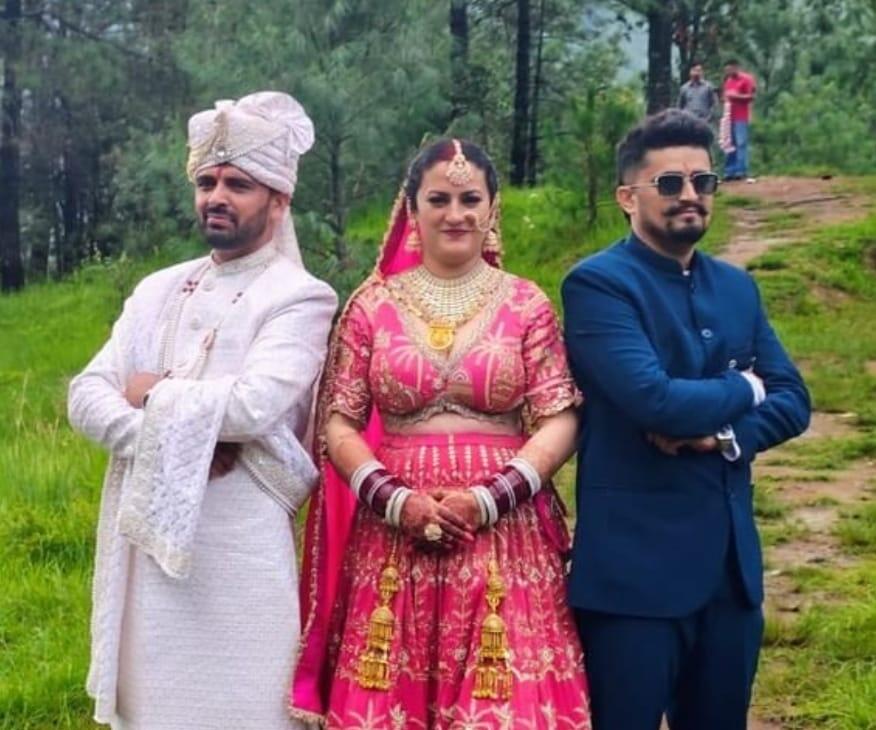
A photo making rounds on the internet has captured the attention of the nation- a young bride standing beside not one but two grooms. The woman, Sunita Chauhan, recently entered into a marriage with two brothers, Pradeep and Kapil Negi, in a remote village in Himachal Pradesh. While it may seem unconventional to many, the practice is not entirely unheard of in her community. It is, in fact, part of a centuries-old tribal tradition known locally as ‘Jodidaran’.
A Longstanding Tradition
Sunita belongs to the Hatti tribe, an indigenous group residing in the Trans-Giri region of Himachal Pradesh. The tribe was officially recognised as a Scheduled Tribe (ST) by the central government in 2022. The Hattis have practiced polyandry, specifically, fraternal polyandry, a tradition where multiple brothers marry the same woman as part of a shared marital arrangement.
According to community elders, the custom originally served a pragmatic purpose: to prevent division of family-owned agricultural land. By marrying one woman, brothers could maintain a joint household and undivided inheritance. Beyond land preservation, some also see the tradition as a way to strengthen familial ties and offer shared responsibility for a woman’s wellbeing.
Sunita’s marriage is reportedly the fifth such union in the past six years, underscoring that while rare elsewhere, this practice remains alive in tribal communities.
Is Polyandry Legal in India?
Under Indian law, both polyandry and polygamy are prohibited. The Hindu Marriage Act, 1955, the Special Marriage Act, and the Bharatiya Nyaya Sanhita clearly outlaw multiple simultaneous marriages, regardless of gender.
However, there’s a constitutional carve-out when it comes to Scheduled Tribes.
The Hindu Marriage Act explicitly excludes STs from its purview under Section 2(2), unless the central government issues a notification stating otherwise. In the absence of such a notification, tribal communities like the Hattis remain governed by their own customary laws, many of which are oral and undocumented.
Customs like these are recognised in law but only under certain conditions, such as it must be shown to have been consistently practiced, be reasonable, and not be contrary to public policy. If challenged in court, the burden of proof falls on the community to prove the existence and legitimacy of the custom.
What Does the Uniform Civil Code Say?
The conversation becomes more complex in the light of Uniform Civil Code (UCC) debates.
In 2024, the Uttarakhand government enacted a UCC, introducing common rules for marriage, divorce, inheritance, and adoption across communities. The law also prohibits polygamy and polyandry, and mandates marriage registration. However, in line with constitutional protections, the UCC does not apply to Scheduled Tribes.
Section 2 of the Uttarakhand UCC Rules, 2025 specifically exempts ‘members of any Scheduled Tribes‘ and communities whose customary rights are protected under Part XXI of the Constitution.
This maintains a longstanding legal tradition in India: protecting tribal autonomy in cultural and personal matters, even where it may appear to conflict with mainstream laws.
Courts Weigh Tradition Against Constitutional Rights
Over the years, Indian courts have increasingly tested such customs against the touchstone of fundamental rights guaranteed by the Constitution.
In 2017, the Supreme Court struck down triple talaq, declaring it arbitrary and in violation of Articles 14 and 21 which guarantee equality and dignity. Similarly, in the 2018 Sabarimala judgment, the court ruled that barring women from temple entry based on menstruation was unconstitutional.
Most recently, on July 17, 2025, the apex court delivered a landmark verdict in Ram Charan & Ors. vs. Sukhram & Ors., a case concerning succession rights of tribal women. The court held that when custom is silent on inheritance, there is no legal ground to deny women the right to ancestral property. The bench observed that ‘customs too, like the law, cannot remain stuck in time’, and cannot be used to deny others their constitutional rights.
A Delicate Balance of Culture, Identity and Constitution
Sunita Chauhan’s marriage to two brothers reflects a crossroad of cultural identity and constitutional rights. While it is legal under tribal customs, it raises pressing questions about gender equality, legal consistency, and the future of personal laws in a rapidly modernising India.
As the country moves towards broader discussions on the Uniform Civil Code, cases like this prompt reflection:
Should tribal practices continue to be protected, or should all citizens be bound by a common civil framework?
For now, India’s Constitution continues to walk a fine line, respecting cultural diversity while holding the door open for legal reform.