
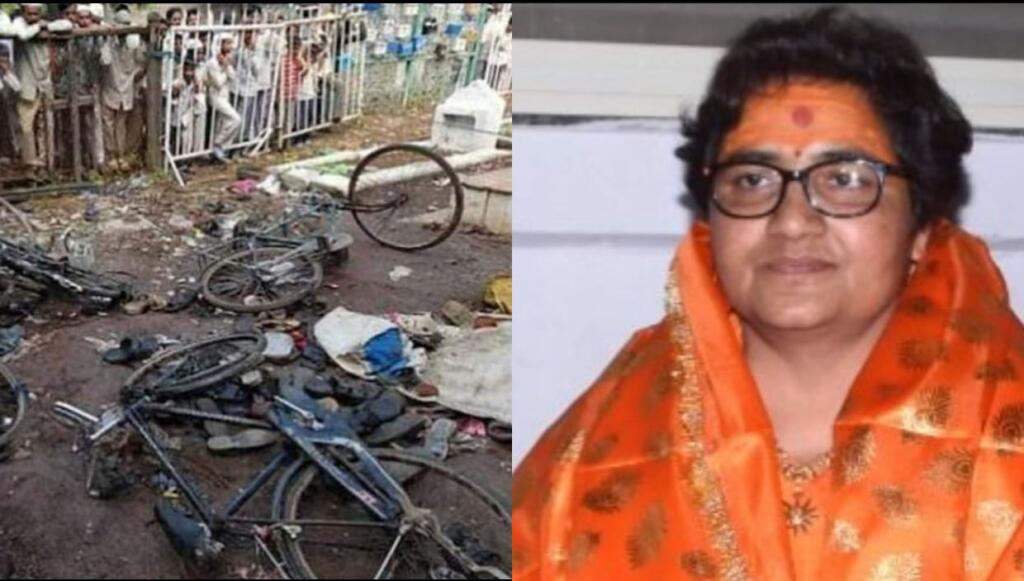
In a landmark verdict, a special NIA court acquitted all seven accused in the 2008 Malegaon blast case, including BJP MP Sadhvi Pragya Singh Thakur and Lt Col Prasad Purohit, stating the prosecution failed to prove charges beyond reasonable doubt. The judgment delivers a crushing blow to the long-propagated theory of ‘Saffron Terror’.
Court Finds No Evidence Linking Thakur or Purohit
Special Judge A.K. Lahoti ruled that there was no proof Sadhvi Pragya owned the motorcycle used in the blast, nor was there evidence to suggest Col Purohit was involved in making the bomb. ‘Mere suspicion cannot take the case forward,’ the court said, adding that ‘a grave incident occurred, but convictions cannot rest on moral grounds.’
17 Year Trial Ends in Acquittal
The Malegaon blast took place on September 29, 2008, killing six and injuring over 100 during the Muslim holy month of Ramadan. Initially investigated by the Maharashtra ATS and later handed over to the NIA, the case became one of India’s longest-running terror trials. The trial concluded in April 2025, and the court pronounced its verdict on July 31.
Background of Malegaon Blast Case
On September 29, 2008, a powerful bomb exploded in a crowded area of Malegaon, a Muslim-majority town in Maharashtra’s Nashik district. The attack occurred during the holy month of Ramadan, at a time when large numbers of people were gathered in the area. The blast, which was caused by an improvised explosive device (IED) planted on a motorcycle, killed six people and injured over 100.
Initially investigated by the local police, the case was soon handed over to the Maharashtra Anti-Terrorism Squad (ATS). The ATS claimed that the motorcycle used in the blast was an LML Freedom with a fake registration number. The engine and chassis numbers had been deliberately erased but were later restored through forensic examination. The ATS identified the vehicle as being registered in the name of Sadhvi Pragya Singh Thakur, leading to her arrest on October 23, 2008.
Following her arrest, several others were detained, including serving Army officer Lt Col Prasad Purohit. The ATS alleged that the accused were part of a radical group named ‘Abhinav Bharat’ and had orchestrated the blast as retaliation for terror attacks carried out by Islamist groups.
In 2009, the ATS filed a chargesheet under the Unlawful Activities (Prevention) Act (UAPA), the Indian Penal Code (IPC), and the Maharashtra Control of Organised Crime Act (MCOCA). However, in 2011, the investigation was transferred to the National Investigation Agency (NIA). After further review, the NIA, in its 2016 supplementary chargesheet, dropped the MCOCA charges and stated that the ATS had invoked them prematurely and without sufficient basis.
The NIA also cast doubt on the strength of the evidence against some of the accused, including Sadhvi Pragya. It claimed that while the motorcycle was registered in her name, it had been in the possession of an absconding accused, Ramchandra Kalsangra, for over a year before the blast.
After years of legal proceedings, witness testimonies, and evidence scrutiny, the trial concluded in April 2025. On July 31, 2025, the special NIA court acquitted all seven remaining accused, stating that the prosecution had failed to prove their involvement beyond reasonable doubt.
Collapse of the ‘Saffron Terror’ Narrative
The case was often cited by the previous UPA government as proof of what it termed ‘Hindu terror.’ Senior Congress leaders including Sonia Gandhi, P. Chidambaram, and Sushil Kumar Shinde had invoked the term repeatedly, triggering widespread political controversy.
With Thursday’s acquittal, that narrative now stands completely discredited. The court’s finding that no substantive evidence existed against the accused has vindicated claims that the theory was politically motivated.
NIA Undermined Earlier ATS Findings
In 2016, the NIA filed a supplementary chargesheet that questioned the ATS’s handling of the case. It dropped charges under the Maharashtra Control of Organised Crime Act (MCOCA) and stated that the motorcycle allegedly linked to Thakur had actually been in the possession of absconding accused Ramchandra Kalsangra for over a year before the blast.
The NIA even recommended that Sadhvi Pragya’s name be dropped from the list of accused, citing lack of credible evidence. Yet the court, while allowing the trial to proceed, has now concluded there was no link strong enough for conviction.
A Political and Religious Vindication
Reacting to the verdict, Sadhvi Pragya said, ‘This is not just my acquittal, it is the victory of truth and Sanatan Dharma. Those who defamed it must now answer to the nation.’
The ruling has sparked calls for an unconditional apology from Congress leaders who had championed the cause of ‘Saffron Terror’. Critics have accused them of demonizing Hindus for political mileage and weaponizing terror probes to target ideological opponents.
Questions Over Misuse of Terror Laws
Legal experts note that the judgment highlights serious concerns about the politicization of law enforcement and the premature labeling of religious communities. The Malegaon case, once held up as proof of a new kind of extremism, has now ended in total acquittal with not a single conviction after 17 years.
As the case closes, it leaves behind not only unanswered questions about the real perpetrators, but also a chilling reminder of how easily justice can be derailed when politics drives the investigation.