
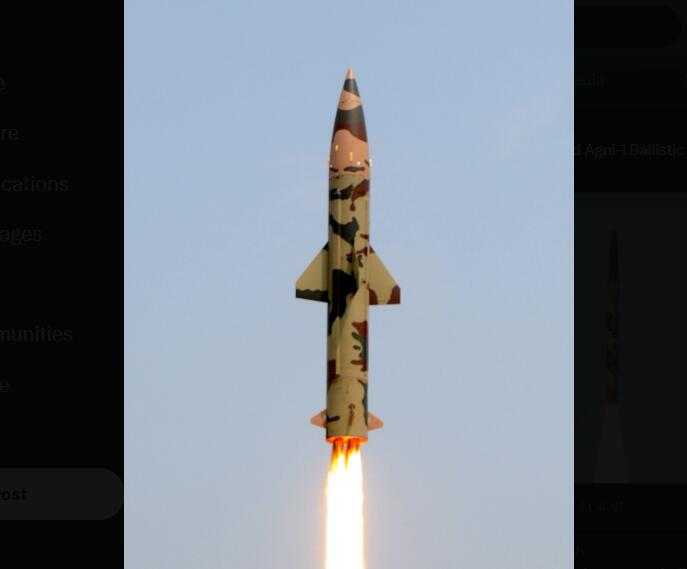
In a significant boost to India’s military preparedness, the Strategic Forces Command successfully test-fired two nuclear-capable ballistic missiles – Prithvi-II and Agni-I – from the Integrated Test Range in Chandipur, Odisha, on Thursday. The tests reaffirm India’s strategic deterrence capabilities, particularly in the backdrop of rising tensions in the region. The defence ministry confirmed that both missile systems met all operational and technical parameters.
This achievement comes just a day after the successful high-altitude trial of the upgraded Akash Prime air defence system in Ladakh. These successive trials reflect India’s growing emphasis on strengthening its indigenous weapons infrastructure and sending a clear message to its adversaries, particularly after recent cross-border military encounters with Pakistan and persistent Chinese aggression near the LAC. With Defence Minister Rajnath Singh commending the armed forces and DRDO for the back-to-back successes, India has reiterated its resolve to safeguard national security through technological self-reliance.
Successful Test of Prithvi-II and Agni-I from Odisha
The Ministry of Defence announced that India successfully conducted test-firings of the Prithvi-II and Agni-I ballistic missiles from the Integrated Test Range (ITR) in Chandipur, Odisha. Both missiles were launched by the Strategic Forces Command as part of regular training and validation drills. According to the ministry, the launches were smooth and validated all mission objectives, including the operational readiness and accuracy of the weapons systems.
Prithvi-II, with a range of approximately 350 kilometers, can carry a payload of up to 500 kilograms and is capable of delivering both conventional and nuclear warheads. The Agni-I, on the other hand, has a longer range of 700 to 900 kilometers and can carry a payload of up to 1,000 kilograms. These two systems form the backbone of India’s short and medium-range nuclear deterrence and are integral to its second-strike capability.
“These tests validate key capabilities of India’s nuclear-capable delivery systems and demonstrate the robustness of its indigenous missile arsenal,” said a statement from the Ministry of Defence.
Akash Prime Scores Direct Hits in Ladakh
Just a day before the successful ballistic missile trials, the Indian Army conducted a major high-altitude test of the Akash Prime missile in Ladakh, at an elevation of over 4,500 meters (approximately 15,000 feet). The upgraded variant of the indigenous Akash air defence system achieved direct hits on two high-speed unmanned aerial targets, according to defence officials.
Developed by the Defence Research and Development Organisation (DRDO), Akash Prime is designed to intercept aerial threats in extremely harsh terrain and low-oxygen environments, making it a strategic asset for deployments near the Line of Actual Control (LAC).
The system has been equipped with an indigenous radio frequency seeker, and modifications were made based on operational feedback from the armed forces. The Defence Ministry confirmed that Akash Prime is slated for deployment in the Army’s third and fourth Akash Regiments, bolstering India’s air defence shield in critical frontier areas.
Operation Sindoor Highlights Akash’s Battlefield Role
The significance of Akash Prime is not just technological but also operational. During the recent Operation Sindoor a covert, coordinated military response to a proxy attack allegedly involving Pakistani forces and Chinese-origin drones — the Akash system played a decisive role. The air defence system intercepted multiple incoming threats, including Chinese fighter aircraft and Turkish-made drones, underscoring its relevance in modern combat scenarios.
Akash Prime builds on this experience, ensuring that India’s military can defend its skies even under complex threat environments involving high-altitude, low-visibility, and hypersonic aerial platforms.
Defence Minister Rajnath Singh lauded the successful test in Ladakh and appreciated the combined efforts of the Indian Army, DRDO, and Indian defence industry, calling it a “remarkable achievement.”
Strengthening Indigenous Defence Capability
These sequential tests are part of a broader push towards indigenisation under the Make in India initiative in the defence sector. Both the Akash and Agni-Prithvi systems are examples of homegrown innovation in missile technology, created to reduce dependency on foreign suppliers and increase the strategic autonomy of India’s armed forces.
The focus on high-altitude warfare systems and nuclear-capable delivery platforms shows that India is preparing for any eventuality, be it a conventional war or a nuclear standoff. As India continues to face multiple security threats across its borders, such developments are vital in maintaining a credible deterrence posture.
Conclusion: A Bold Step Towards Self-Reliance in Strategic Defence
India’s successful test-firings of Prithvi-II and Agni-I ballistic missiles, along with the high-altitude validation of Akash Prime, mark a crucial leap in the country’s strategic defence framework. These trials underscore not just technical prowess but also the resolve to secure India’s sovereignty through indigenous solutions. At a time when regional threats are on the rise and modern warfare demands cutting-edge preparedness, India’s investment in self-reliant defence technologies is both timely and necessary. As these systems move closer to full deployment, India sends a clear message to the world it is ready, capable, and not reliant on imported firepower to defend its borders.