
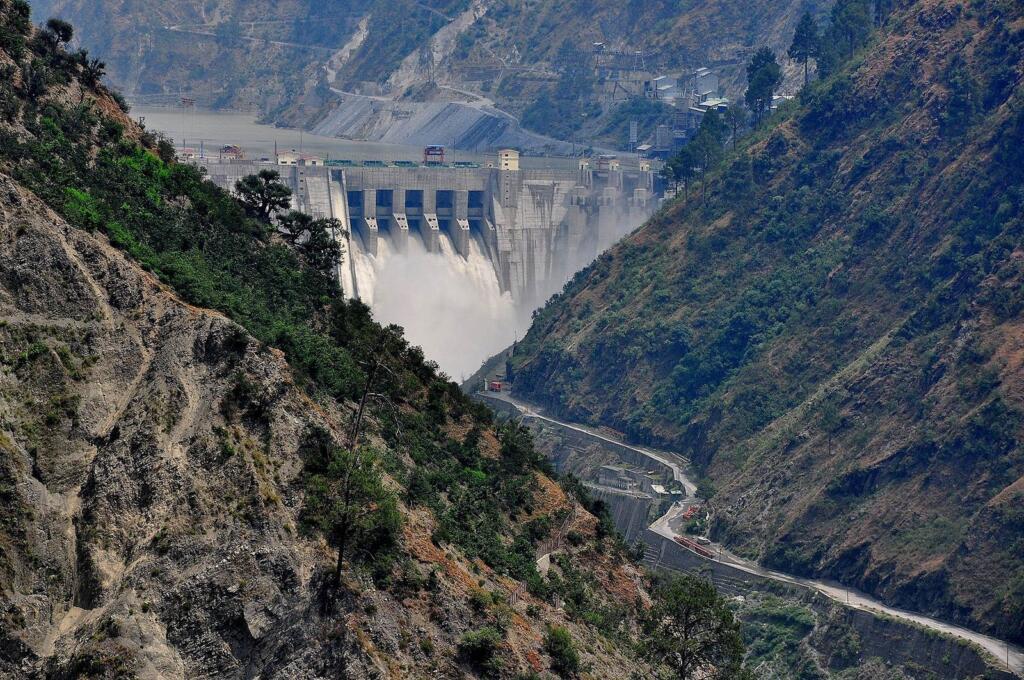
In a decisive move that signals a firm shift in India’s water diplomacy, the central government has invited tenders for the 1,856 MW Sawalkote Hydro Project on the Chenab River in Jammu and Kashmir. The announcement comes in the wake of India’s suspension of the Indus Waters Treaty (IWT) — a landmark development in Indo-Pak water relations. The project, expected to significantly strengthen India’s control over western river waters, could create major strategic and operational challenges for Pakistan.
The Sawalkote project, first conceptualized in the 1960s, will be constructed near Sidhu village in Ramban district of J&K. The last date for online submission of bids is September 10. This is just one among several hydro projects that the Modi government is reviving to assert India’s water rights and accelerate infrastructure development in the Union Territory.
Hydro Push in J&K: Six Mega Projects to Maximize River Use
The decision to float tenders for Sawalkote is part of a broader plan to fast-track six major hydroelectric projects that had been in limbo for decades. These include the 1,320 MW Kirthai I & II, the 1,000 MW Pakal Dul project, and three others, totalling 2,224 MW of additional capacity. Once complete, these initiatives are expected to boost J&K’s power generation potential to 10,000 MW — a move that not only promotes regional development but also optimizes India’s share of river water for irrigation, domestic use, and energy security.
Union Home Minister Amit Shah, addressing Rajya Sabha during a discussion on Operation Sindoor, emphasized the strategic and national interest at stake. “The Indus Waters Treaty was one-sided. Indian farmers and citizens have a rightful claim over the waters that originate from Indian territory,” Shah said, adding that the decision will ensure greater water access for Kashmir, Punjab, Haryana, Rajasthan, and Delhi.
Modi: Rectifying Nehru’s “Historic Blunder”
Speaking in the Lok Sabha during a marathon 19-hour debate on Operation Sindoor, Prime Minister Narendra Modi strongly defended the government’s decision to put the Indus Waters Treaty in abeyance. He described the 1960 agreement signed by Jawaharlal Nehru as a “big betrayal” of India’s dignity and interests.
“Nehru handed over 80% of the Indus river waters to Pakistan while India, a much larger nation, kept only 20%. What kind of diplomacy was that?” Modi questioned. He went on to label the treaty as one of the biggest strategic missteps in Indian post-independence history.
“The Congress has a long-standing habit of mortgaging India’s national interest. The Indus Waters Treaty is a glaring example,” he said. Modi also pointed out how crores of rupees were given to Pakistan to build canals on Indian-origin rivers and how India was denied even the basic right to de-silt its own dams built on those rivers.
“India gets its very name and identity from the Indus river, but Nehru’s government allowed the World Bank to dictate how we share our own waters,” the Prime Minister stated, calling the recent suspension of the treaty a historic correction in the best interest of India’s future generations.
Understanding the Indus Waters Treaty and Its Impact
Signed in 1960, the Indus Waters Treaty (IWT) was a water-sharing agreement brokered by the World Bank between India and Pakistan. Under its terms, India received rights over the eastern rivers (Ravi, Beas, Sutlej), while Pakistan was granted exclusive rights over the western rivers (Indus, Jhelum, Chenab), even though they all originate in Indian territory.
For decades, India respected the treaty, even during wars and terror attacks. However, it restricted India’s ability to build major storage or diversion projects on the western rivers. This created structural disadvantages for India’s development and limited its strategic leverage.
The Modi government had long voiced concerns that the treaty failed to account for India’s evolving security and developmental needs. With internal hydro potential untapped and recurring terror threats emanating from Pakistan, the treaty was increasingly seen as outdated and imbalanced.
Why India Suspended the Treaty After Pahalgam Attack
The turning point came on April 22, 2025, when a terrorist attack in Pahalgam claimed the lives of 26 Indian citizens. The attack, widely believed to have links with Pakistan-backed terror outfits, prompted the Indian government to adopt a no-tolerance stance.
Foreign Minister Dr. S. Jaishankar, addressing Rajya Sabha, stated, “The Indus Water Treaty will remain in abeyance until Pakistan irrevocably ends its support for terrorism. We have clearly conveyed that blood and water cannot flow together.”
This firm policy stance represents a shift from symbolic protests to action-oriented retaliation. For decades, India’s options to penalize Pakistan for cross-border terrorism remained confined to diplomatic and economic routes. Now, by leveraging a critical resource like water, India has added a new dimension to its strategic arsenal.
The government has not revoked the suspension despite repeated appeals from Pakistan and pressure from global institutions. In fact, the decision to invite tenders for Sawalkote and move forward on multiple hydro projects underlines India’s irreversible intent to reclaim and utilize its river resources effectively.
India Reclaims Its Waters and Strategic Leverage
The invitation for tenders for the 1,856 MW Sawalkote Hydro Project is not just a development milestone — it is a symbol of India reclaiming its rightful share of the Indus waters. By suspending the Indus Waters Treaty and moving forward with key infrastructure projects in Jammu & Kashmir, the Modi government is making it clear: India will no longer be held hostage by historical blunders or asymmetric treaties.
With water security tied closely to national security, agriculture, and energy independence, this bold move asserts India’s sovereign rights, prioritizes its citizens’ needs, and sends a clear message to adversaries — terror and treaties cannot coexist.
India’s approach is now rooted in assertiveness, pragmatism, and self-reliance. As the government pushes ahead with long-stalled hydro projects, the era of compromise is being replaced by an era of strategic clarity and national dignity.