
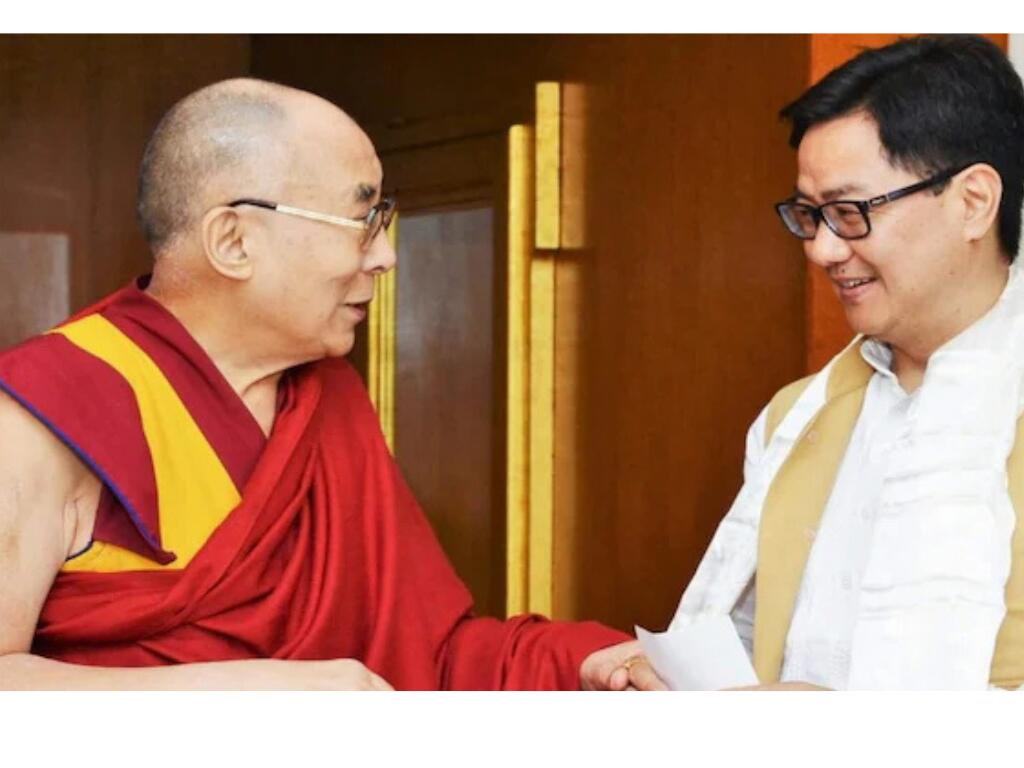
In a significant diplomatic move, the Indian government is sending Union Ministers Kiren Rijiju and Rajiv Ranjan Singh (Lalan Singh) to participate in the 90th birthday celebrations of His Holiness the 14th Dalai Lama in Dharamshala. The visit is not just symbolic it is a strong political message asserting India’s support for the Tibetan leader’s spiritual autonomy amid China’s persistent attempts to control the succession process. Rijiju, speaking ahead of the event, made it clear: “No one has the right to interfere in the process of identifying the Dalai Lama’s successor.” Chief Minister’s of some Indian states are also likely to attend the celebrations
India’s Strategic Response to China’s Pressure
The Dalai Lama’s succession issue has long been a geopolitical flashpoint. While China insists that the reincarnation of the Dalai Lama must be approved by Beijing under its so-called “traditional” procedures, India’s open endorsement of the Dalai Lama’s autonomy is a firm stand against that claim. Rijiju’s statement directly rebuffs China’s recent assertion that Tibetan Buddhism is a religion with “Chinese characteristics.”
Sources within the Indian government confirm that sending Rijiju an Arunachal Pradesh MP and a Buddhist himself and Lalan Singh, who hails from Bihar’s Nalanda region, is a conscious decision. It underscores India’s cultural, spiritual, and political connect with Buddhism, and indirectly reaffirms its long-standing support for the Tibetan cause. The celebration, officially slated for July 6 but already underway as per the Tibetan calendar, is being viewed as a moment to reassert the rights of exiled Tibetans.
Dalai Lama Reaffirms Authority on Reincarnation
Recently, the Dalai Lama made a decisive statement that only the Gaden Phodrang Trust, a non-profit founded by his office in 2015, holds the legitimate authority to determine the process and recognition of his reincarnation. This move seeks to shut down China’s claims over the succession and to protect the sanctity of Tibetan Buddhism from state interference.
China, however, remains undeterred. Its Foreign Ministry reiterated that any successor must be approved by Beijing, citing the use of the so-called “golden urn” procedure. India’s visible support to the Dalai Lama at this moment not only strengthens the Tibetan exile community’s stance but also puts global pressure on China to stay out of religious affairs.
The Panchen Lama Controversy: A Chilling Precedent
A historical case that continues to haunt the Tibetan community is the fate of the 11th Panchen Lama. In 1995, shortly after the Dalai Lama identified a six-year-old boy, Gedhun Choekyi Nyima, as the reincarnation of the 10th Panchen Lama, the child was taken into custody by Chinese authorities. He has not been seen since. In his place, China installed its own Panchen Lama, who is widely rejected by Tibetans and human rights groups.
Traditionally, the Panchen Lama and Dalai Lama mutually recognise each other’s reincarnations, making this interference a grave violation of Tibetan religious protocol. This episode serves as a warning of what could happen should China control the Dalai Lama’s succession process.
Who Will Be the 15th Dalai Lama?
While the Dalai Lama has not publicly named his successor, speculation continues. Some believe he may choose to reincarnate outside Tibet to prevent Chinese interference. There have also been discussions about breaking with tradition entirely by appointing a successor while he is still alive, or even naming a female Dalai Lama though no final decision has been made.
The Dalai Lama’s decision to settle in India in 1959, following China’s occupation of Tibet, and his decades-long exile in Dharamshala have cemented India’s status as the center of the Tibetan resistance. The spiritual leader has transformed into a global icon of peace, non-violence, and resistance against authoritarianism.
The Future of Tibetan Autonomy and India’s Role
As the Dalai Lama ages, the question of succession grows more urgent. China’s push to install a puppet figure risks undermining centuries of Tibetan religious tradition. India’s recent diplomatic gestures, like Rijiju’s attendance and firm statements, show that New Delhi will not silently watch China rewrite spiritual history.
India’s message is clear: Tibetan Buddhists should decide their spiritual future, not the Chinese Communist Party. In the coming years, the battle over the Dalai Lama’s reincarnation could define not just the future of Tibetan Buddhism, but also whether spiritual traditions can survive authoritarian co-optation. By standing firmly with the Dalai Lama now, India is ensuring that religious freedom, cultural identity, and historical truth are not lost to geopolitical power plays.
In the larger Indo-Pacific framework, where China’s assertiveness is being challenged globally, India’s active stand on the Dalai Lama matter elevates it as a responsible voice for civilisational dignity and human rights.