
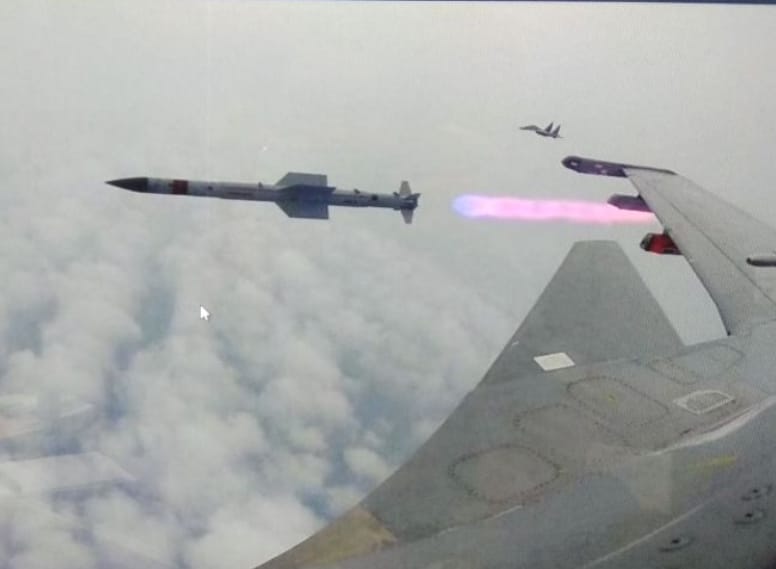
India took a giant leap forward in its indigenous defence capabilities as the Defence Research and Development Organisation (DRDO) and the Indian Air Force (IAF) successfully conducted flight-tests of the Astra Beyond Visual Range Air-to-Air Missile (BVRAAM), now equipped with an indigenous Radio Frequency (RF) seeker. The tests were carried out from a Su-30 MKI fighter jet off the coast of Odisha.
Pinpoint Accuracy
Two Astra missiles were launched at high-speed unmanned aerial targets under varying combat conditions and ranges. Both missiles scored direct hits, demonstrating exceptional precision and confirming the missile’s operational effectiveness across diverse engagement scenarios.
According to the Ministry of Defence, all subsystems performed flawlessly, especially the newly integrated RF seeker, which played a crucial role in target guidance and detection. The seeker’s performance was tracked and verified by advanced instrumentation deployed at the Integrated Test Range (ITR) in Chandipur.
Indigenous RF Seeker
The RF seeker is a vital component in modern air-to-air missile systems, enabling the missile to autonomously track and lock onto fast-moving airborne targets. Developed entirely in-house by DRDO laboratories, its successful performance during the trials marks a major breakthrough for India’s military research and development ecosystem.
This indigenisation of such a complex subsystem significantly reduces dependence on foreign suppliers, bolstering the country’s strategic autonomy in critical defence technologies.
Astra: India’s Premier BVRAAM
With a strike range of over 100 kilometres, Astra is India’s first indigenously developed beyond visual range air-to-air missile. It is designed for high-speed aerial combat, capable of engaging enemy aircraft at standoff distances. The missile features state-of-the-art mid-course guidance, terminal active radar homing, and high maneuverability, making it a formidable addition to the Indian Air Force’s arsenal.
The Astra project is a product of close collaboration between DRDO, the IAF, and over 50 public and private sector entities, including Hindustan Aeronautics Limited (HAL). This reflects the strength of India’s integrated approach to defence manufacturing and innovation.
Leadership Applauds Indigenous Milestone
Defence Minister Rajnath Singh praised the DRDO, IAF, and industry partners for the successful demonstration, calling the integration of the indigenous RF seeker a ‘landmark achievement’ in India’s journey toward self-reliance in defence. He emphasized that advancements in homegrown technology are critical for securing the nation’s strategic interests.
Dr. Samir V Kamat, Secretary, Department of Defence R&D and Chairman of DRDO, also congratulated the teams involved, highlighting the commitment, synergy, and innovation that led to the successful outcome.
Strengthening Atmanirbhar Bharat in Defence
This test-firing marks a decisive step in India’s ongoing efforts to achieve full self-reliance in advanced weapon systems, a key pillar of the Atmanirbhar Bharat (self-reliant India) initiative. The Astra missile, now proven with an indigenous seeker, not only enhances the combat capabilities of the Indian Air Force but also signals India’s growing competence in cutting-edge defence technologies.
The success of Astra is expected to accelerate other indigenous missile development programs, reinforcing India’s position as a capable and self-sufficient defence producer on the global stage.