








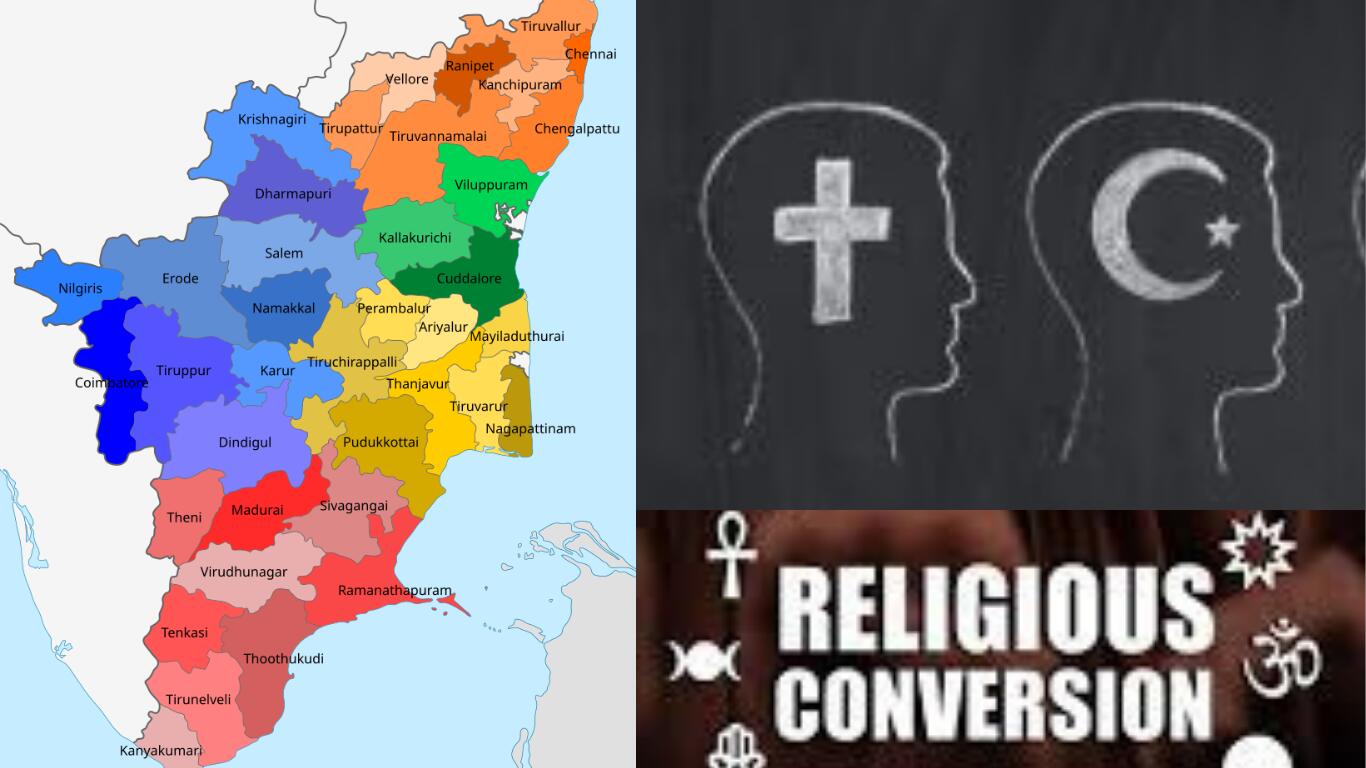
Mass conversions in Tamil Nadu have reached an alarming new peak under the DMK government, with reported coercion of Hindus from students to entire villages. Claims of “Christian and Islamic conversion mafias” working hand-in-glove with the Stalin-led administration are spreading like wildfire. From VCK’s open calls urging Dalits to embrace Christianity, to 17-year-old Lavanya’s heartbreaking suicide after forced conversion, each case is a symptom of a larger, systematic assault on Hindu identity.
Behind the façade of “secularism,” a disturbing alliance of Christian and Islamic conversion mafias allegedly backed by elements within the ruling party targets vulnerable Scheduled Castes (SC) and Scheduled Tribes (ST). What’s more alarming is that many of those who convert do not relinquish their caste-based reservations. They continue to benefit from quotas meant for marginalized Hindu communities, thus cheating the truly deserving and distorting the spirit of social justice. This is not just religious subversion, it’s systemic exploitation.
Once, Tamil Nadu prided itself on preserving its temples and traditions; today, no temple is safe, no child immune. Look how under the banner of secularism lies a campaign to dilute our faith, our culture, and our nation. This isn’t just political opportunism, it’s cultural subversion.
A Surge in Mass Conversions Since 2014
During Jayalalithaa’s tenure, Tamil Nadu resisted aggressive conversion drives. Under the AIADMK rule in 2002, anti-conversion laws were introduced to curb forced religious changes. The legislation recognized the need to protect vulnerable Hindus. However, the moment DMK returned, that legal shield was quietly dismantled. What followed was a wave of conversions often under duress targeting Hindu labourers, women, and children across the state.
Prominent examples include Lavanya, a 17-year-old farm labourer’s daughter, who allegedly took her own life after enduring two years of conversion torment at a missionary-run school in Thanjavur. The school lacked a hostel license and was government-aided yet unchecked by authorities. And this is no outlier: reports of mass Dalit conversions, especially in Southern regions of Tamil Nadu have resurfaced. Christian religious outfits operate “ecosystems” encompassing schools, hospitals, burial grounds, and churches, using taxpayer money to push conversion through social influence.
DMK’s Political Alliances Fuel the Crisis
The DMK’s alliances with parties like the Viduthalai Chiruthaigal Katchi (VCK) and MPs like Thirumavalavan have doused gasoline on this fire. VCK leaders have openly urged people to embrace Christianity, framing it as liberation from Hindu caste oppression. Meanwhile, DMK MLAs often demean Hindu symbols in public speeches, with zero pushback from the current government.
TN Chief Minister Stalin’s remark during the Church of South India’s 75th anniversary, “This government was formed by you” appears less a courtesy than a confession of allegiance. Temples are demolished under the guise of clearing water-bodies, yet illegal churches on hills rich with thorium remain untouched.
In 2023, Tamil Nadu Minister and current Deputy CM Udhayanidhi Stalin’s controversial remarks equating Sanatan Dharma with diseases like dengue and malaria have sparked widespread outrage across the country. By likening one of India’s oldest spiritual traditions to deadly epidemics, he not only insulted millions of believers but also exposed the deep-rooted anti-Hindu sentiment within the DMK. This is not an isolated incident year after year, the DMK leadership conveniently avoids extending wishes for major Hindu festivals like Deepavali and Vijayadashami, while being vocal and celebratory about festivals of other communities. Such selective silence and open disregard reflect the party’s long-standing bias against Hindu traditions and cultural values.
Religious Conversion and Reservation Fraud: A Silent Injustice
A deeply troubling consequence of religious conversion in Tamil Nadu is the misuse of caste-based reservations by those who convert but do not officially declare their new religion. Many SC and ST individuals, after embracing Christianity or Islam often under pressure or brainwashing continue to claim quotas in education and government jobs that are constitutionally reserved for marginalized Hindu communities.
Speaking to TFI, Balamurugan, a senior functionary of Hindu Munnani, said: “Most of the people who attempt to convert others usually target those going through financial difficulties or family problems. They slowly brainwash them by spreading venom against the gods worshipped by the victim’s family. They invite them to church and gradually influence them by introducing their own methods of worship and belief.”
As per constitutional provisions, SC reservations apply only to Hindus, Sikhs, and Buddhists. Yet in practice, these benefits are being unfairly claimed by converts who deliberately conceal their religious change.
Balamurugan further said, “In some cases, money is offered and educational expenses are taken care of to convince individuals to convert.”
This erodes opportunities for genuinely deserving candidates from economically and socially backward backgrounds within the Hindu fold. The result is a two-fold injustice: an assault on Hindu cultural roots and a betrayal of the constitutional safeguards meant to uplift the truly underprivileged. This calls for urgent legal reforms and strict enforcement to plug this loophole, ensuring justice for all.
Striking Parallels with Global Patterns of Religious Subjugation
From Europe’s pagan temple demolitions to the church-led colonization of indigenous cultures in the Americas, history reveals a familiar pattern. Author Catherine Nixey has written about this in her book titled ‘The Darkening Age documents Christianity’s systematic destruction of pagan beliefs’ now, the same playbook is being played out in Tamil Nadu, where old temples are razed, sacred Tamil scriptures are being rebranded in church garb, and attempts are made to replace traditional Tamil festivals like Jallikattu with Christmas-style celebrations.
Temples serve as community anchors, preserving unity and culture. Once dismantled, they leave spiritual voids that are swiftly filled with foreign religious symbols disguised as benevolence. From Constantinople to South America, we’ve seen how Christian missionaries capitalized on these gaps successfully converting entire civilizations. Tamil Nadu is heading down that perilous path.
Murder in Broad daylight for opposing Conversion
Ramalingam, a Pattali Makkal Katchi (PMK) functionary in Thanjavur, Tamil Nadu, was murdered on February 5, 2019. He was attacked with lethal weapons by a gang in Thirubhuvanam, Thanjavur. The National Investigation Agency (NIA) took over the case from the state police and filed a chargesheet against 18 accused, including five absconders, in August 2019. The NIA investigation revealed the murder was allegedly linked to Ramalingam’s opposition to forced religious conversions by the now banned extremist outfit Popular Front of India (PFI).
The arrested accused have been identified as Abdul Majeeth and Shahul Hameed, both hailing from Thanjavur district of Tamil Nadu. NIA investigations have revealed that the duo were involved in the murder and are members of the PFI. Majeeth and Hameed had conspired with other accused near the Periyapalli mosque in Thirubhuvanam on February 5, 2019, to sever the hands of Ramalingam with the intent of creating fear among the people who oppose conversion.
Schools as Conversion Fronts: The Lavanya Tragedy
Conversion is no longer confined to specific camps it has infiltrated classrooms. Christian schools, funded by public money under the minority institution clause, often fail to deliver secular education. In bright walls of respectability, they hide coercion. Students are punished for wearing kum-kum or silencing chants. Many poor Hindu families are forced to convert just to secure school admission with affordable fees.
The case of Lavanya, whose suicide note spoke of relentless religious pressure and corporal punishment by a Christian nun, is a case in point. The school reportedly had no legal hostel license and was exempt from RTE yet the state turned a blind eye. This appalling neglect signals state complicity or at least, indifference.
The Push for Nationwide Anti-Conversion Legislation
What’s needed is clear: India requires a robust central anti-conversion law that protects individuals while respecting religious freedom. Tamil Nadu’s lapse shows how easily state governments can be hijacked by conversion cartels in the absence of federal checks.
A national law would give teeth to state-level initiatives, deter predators, and hold political allies accountable for enabling conversion mafias whether Christian or Islamic. Without it, covert operations funded by foreign interests will continue unchallenged. Census 2011 showed minor shifts: Hinduism fell slightly from 88.11% (2001) to 87.58%, Christianity rose from 6.06% to 6.12%, and Islam from 5.56% to 5.86% in Kanyakumari district alone. In the same place Christian share has surged: from 30.7% in 1921 to ~46.9% by 2011, with Christian-majority taluks reaching 58.5%.
Stand Up for Dharma
Tamil Nadu stands at a dangerous precipice. The slow erasure of Hindu identity through forced conversions, politically-backed demolitions, and missionary infiltration isn’t just about religion it’s about national identity and survival. Only by reclaiming our temples, protecting our schools, and enacting strong federal safeguards can we halt this tide.