
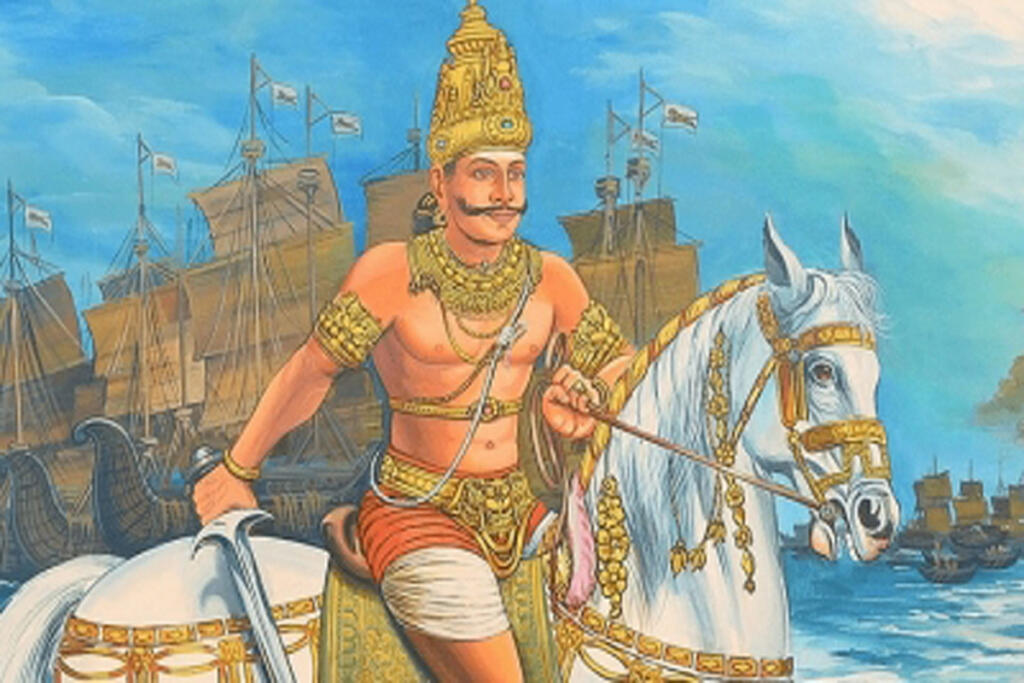
Over a thousand years ago, when much of the world was shrouded in darkness, a powerful emperor from the Tamil heartland was commanding the seas, asserting dharmic influence across Asia. Rajendra Chola, the illustrious son of Raja Raja Chola, wasn’t just a monarch; he was a maritime visionary. His naval expeditions reached as far as Sumatra, Malaysia, and Thailand, making him one of the earliest rulers in Indian and world history to deploy a true blue-water navy. As India today turns a new page with its last imported warship INS Tamal, Rajendra Chola’s legacy reminds us that this isn’t our first chapter in maritime dominance. We are simply returning to a civilizational tradition where the seas once bore the flag of Bharat.
The First Blue-Water Navy of Bharat
Rajendra Chola ruled from 1014 to 1044 AD, during which he built a naval force that projected power well beyond the Indian subcontinent. His navy wasn’t just for defense it was a bold tool of cultural assertion. From Sri Lanka to the distant shores of Southeast Asia, the Chola navy disrupted empires and established Bharat’s spiritual, commercial, and cultural presence.
In particular, his conquests of the Srivijaya Empire are legendary. Launching swift and strategic strikes at Kadaram (modern-day Kedah in Malaysia), Pegu in Myanmar, and the ports of Sumatra, Rajendra Chola sent a message to the world: Bharat could sail, strike, and succeed. His expeditions weren’t about plunder. They were about protecting trade routes, upholding dharma, and expanding the Indian worldview.
Why Rajendra’s Campaigns Still Matter
Unlike modern imperialism driven by greed, Rajendra’s overseas actions were driven by a dharmic ethos. Trade with Southeast Asia had long been part of Tamil society, and these regions were not strangers to Hindu temples, culture, and language. Rajendra’s expeditions were more of a civilizational reunion than colonization. Tamil merchant guilds like Manigramam and Ainnurruvar flourished under his reign, becoming the economic ambassadors of the Chola world. These were ancient equivalents of today’s multinationals but with a sacred mission to promote dharma through commerce.
Gangaikondacholapuram, Rajendra’s capital, wasn’t just a seat of power. It was a marvel of urban planning and temple architecture. The spiritual and economic life of the empire revolved around these temples, reinforcing India’s timeless model where faith and statecraft coexisted in harmony.
Echoes of the Cholas in Today’s Bharat
Fast forward to today. The Indian Navy has just commissioned INS Tamal, a Talwar-class frigate built in Russia. While this is the last of India’s foreign-made warships, its arrival signals a turning point: from now on, every Indian warship will be designed and constructed in India. This is not just strategic autonomy it’s a civilizational revival.
Like Rajendra’s navy of the past, today’s naval force is not just defending borders. It is projecting Bharat’s strength across the Indo-Pacific. With over 90% of our naval platforms now made in India, the doctrine of self-reliance echoes the spirit of the Cholas. The symbolism is clear: just as Rajendra took the dharmic torch to foreign lands, modern Bharat is reclaiming its rightful place in global maritime affairs.
India’s Rising Naval Power: A Chola-Inspired Doctrine
India is no longer just a regional power; it is fast becoming a maritime superpower. Indigenous shipyards like Mazagon Dock, Cochin Shipyard, and GRSE are building cutting-edge destroyers, frigates, and submarines. Our partnerships with ASEAN nations, naval exercises like Malabar and Milan, and defence cooperation with Australia and Japan are all part of a larger maritime vision.
And this vision isn’t borrowed from the West. It’s rooted in our own history. The Chola Empire proved that naval power could serve a higher purpose preserving civilizational values, protecting trade, and inspiring spiritual exchange. Rajendra didn’t ask permission to act. He acted with clarity, dharma, and decisiveness. That’s exactly what Bharat needs today.
Spiritual and Civilizational Renaissance at Sea
The Chola legacy isn’t just about weapons and warships. It’s about the soul of Bharat asserting itself. Today, as grand temples rise once again from the Ram Mandir in Ayodhya to the restoration of Kashi Vishwanath we are witnessing a dharmic resurgence. The rivers and oceans of India, once central to spiritual life, are again becoming channels of civilizational assertion.
The Ganga Vilas cruise, promoting temple tourism and spiritual heritage, is one example. Bharat is blending its ancient strengths with modern capabilities. Like the Cholas, we are again combining cultural pride with military strength.
A Much Awaited Civilizational Comeback
As our ancestors once ruled the eastern oceans, modern Bharat is ready to reclaim its seat at the maritime high table. Not as a follower, but as a civilizational leader.
So let us remember:
We are not a nation learning to build ships.
We are a civilization relearning how to command oceans.
The seas remember Rajendra…
And now they will remember India again.