
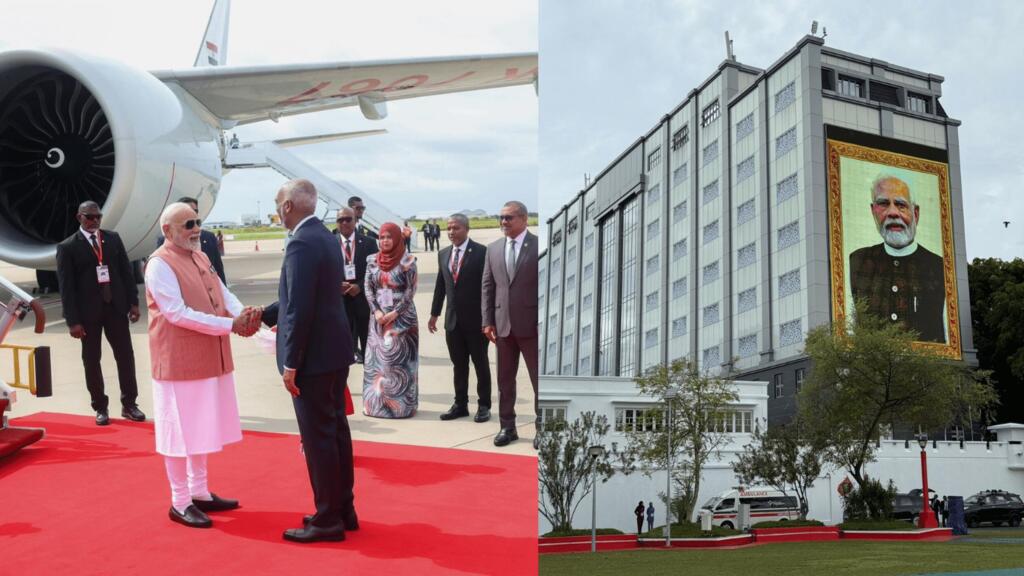
Beijing’s Indian Ocean ambitions have hit a wall of civilizational depth. It must be noted that for over a decade, China has pumped a vast amount of resources into the Maldives, eyeing the strategically located archipelago as a vital outpost as part of its Indian Ocean ambitions.
Through investments in infrastructure, political influence campaigns and digital disinformation, the Chinese government sought not just friendship, but dependency. The goal was to weaken India’s traditional ties with Male and establish a firm Chinese presence in India’s maritime backyard.
But two years after a hard-fought political victory for the “India Out” campaign, the narrative has flipped completely and dramatically so.
The Maldivian President, Mohamed Muizzu who rode to power on the back of anti-India rhetoric, which was amplified by Chinese-backed information networks and its ally Pakistan, is now greeting Indian Prime Minister Narendra Modi at the airport. Even more symbolic: India is now set to construct the very building that will house the Maldives’ Ministry of Defence, a potent signal of restored trust.
What went wrong for China? From “India Out” to “India In”
Beijing’s strategy in the Maldives mirrors its broader approach across South Asia. The Dragon wants to flood the zone with money, leverage local discontent, seed anti-India sentiment and use its state-sponsored infrastructure diplomacy to create strategic dependencies.
In the Maldives, China tried this by funding infrastructure projects with opaque loan terms under the Belt and Road Initiative. It supported political elements hostile to India’s presence and launched a virulent online hate campaign against India.
Though this strategy paid short-term dividends, culminating in the fall of the pro-India government and a regime that came to power promising to eject Indian influence. However, in less than two years, there has ben a complete turnaround.
While the Chinese loans came with heavy strings and most infrastructure projects faced backlash, it must be noted that Indian tourism remained the lifeline of the Maldivian economy. Beijing, despite its billions, could not replicate the civilizational depth and social trust that India has been sharing with its neighbors over the past several centuries.
A Broader Pattern: Déjà vu in South Asia
It is to be understood that what’s unfolding in the Maldives is not an isolated failure for China. Similar patterns can be observed across the region, as has become evident over the past few years.
Sri Lanka: China’s investments in ports like Hambantota led to a debt-for-equity swap. When crisis struck, it was India, and not China, that proved to be the first responder and provided emergency aid, fuel, and food.
Bhutan: Despite repeated Chinese pressure and attempts, Bhutan has kept India close, diplomatically, economically, and militarily.
Nepal: After years of China’s meddling in internal politics by propping up Marxist and Maoist ideologies and promises of economic deliverance, public skepticism is rising. Cultural and religious ties with India have proven more enduring than Beijing’s cash.
Pakistan: The flagship China-Pakistan Economic Corridor (CPEC) has sputtered for over a decade, especially the port at Gwadar. In fact, several Chinese nationals have been killed by the terror outfits that operate with impunity out of Pakistan. The situation turned so bad that the Pakistani government had to reassure Beijing regarding the safety of its citizens. In contrast, India’s Chabahar Port in Iran, is already operational and facilitating trade with Iran, Afghanistan and even Russia.
Why Beijing Keeps Losing
The short answer: civilizational depth vs. transactional diplomacy.
China’s strategic culture, rooted in a mix of authoritarian centralism and transactional global diplomacy, struggles to grasp the long arc of Indian civilizational influence, one that spans religion, language, education and values that have evolved over millenea. Unlike India, China lacks the soft power to build durable bonds with South Asian societies. Its vision for the region is often perceived as extractive and opaque.
Add to that a top-down, Han-centric worldview and it’s no surprise that regional populations and elites remain suspicious of Chinese intentions. India, by contrast, builds its influence not just through diplomacy or development, but through people-to-people connections and shared history and religions like Hinduism and Buddhism.
Beijing’s planners and military thinkers, shaped by propaganda that minimizes India’s global role, have failed to appreciate these nuances that have evolved naturally, unlike the artificial push that China is trying to create. As a result, they underestimate India’s staying power in its own backyard and overestimate what money alone can buy.
A confrontational posture has defined China’s South Asia policy. The result? Repeated failures, squandered goodwill and the strengthening of India’s strategic hand, not just diplomatically, but morally and culturally.
Time for China to Rethink Its Approach
China’s ambition to carve out influence in South Asia has met with limited success and long-term setbacks. Its attempts to engineer political change, manipulate public sentiment, and sideline India repeatedly amongst its neighbours have consistently faltered against the deep-rooted historical, religious and civilizational ties that India enjoys in the region.
Rather than continuing on a path of rivalry, China needs to shed its supremacist instincts and views. Beijing should stop viewing India as a threat. Unless the officials of the Communist Party understand this, the story of failed Chinese influence, from the Maldives to Gwadar, will keep repeating.