





















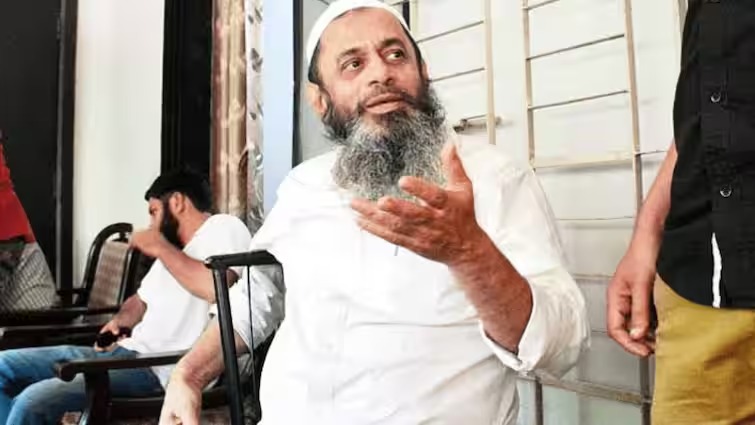
Saquib Nachan, the man accused of leading ISIS ’s operations in India and a former key figure in the banned group SIMI, died on Saturday at Safdarjung Hospital in Delhi after suffering a brain haemorrhage. He was 57 years old.
Nachan had been in Tihar Jail since 2023 after being arrested by the National Investigation Agency (NIA) for his suspected role in an ISIS-linked terror network that stretched across Delhi and parts of Maharashtra. Authorities moved him to the hospital earlier this week after his health deteriorated. Doctors diagnosed a brain haemorrhage shortly after his admission on Tuesday. Despite medical efforts, his condition worsened, and he was pronounced dead at 12:10 PM on Saturday.
Who Was Saquib Nachan?
Originally from Padgha, a small town in Maharashtra’s Thane district, Saquib Nachan—born Sadiq Abdul Hameed Nachan—was no stranger to controversy. He first made headlines in the early 2000s as a senior member of the Students Islamic Movement of India (SIMI), an organisation that was banned in 2001 for promoting extremist views and allegedly inciting anti-national activities.
In 2002 and 2003, Nachan’s name came up during investigations into a series of deadly bomb blasts in Mumbai, including attacks at Mumbai Central, Vile Parle, and Mulund station. The explosions killed 13 people and injured over 100. Nachan was arrested in connection with the case and served time, though he was acquitted in some charges.
From SIMI to ISIS
SIMI was originally founded as a student group in 1977 to promote Islamic values, but by the 1990s, its ideology had become more radical. The group called for the creation of an Islamic state in India and rejected the country’s secular constitution. The government banned it in 2001, citing national security concerns.
Years later, Saquib Nachan was accused of aligning with an even more dangerous outfit — the Islamic State (ISIS). While ISIS gained global infamy for its brutal reign in Iraq and Syria, its influence spread to South Asia through online propaganda and covert recruitment. In India, investigators say Nachan played a role in setting up a terror module inspired by ISIS ideology. He was believed to be helping recruit young people, sharing extremist content, and coordinating plans that could threaten public safety.
What His Death Means
Nachan’s death closes a significant chapter in India’s ongoing battle against homegrown extremism. His story reflects how local radical elements have evolved over the years—from groups like SIMI with domestic roots, to global jihadist movements like ISIS that operate across borders and online platforms.
Law enforcement agencies continue to keep a close watch on suspected terror networks and online radicalisation, especially among youth. Cases like Nachan’s serve as a reminder of how extremist ideologies can take root — and the importance of early intervention, education, and community engagement to counter them.