















TFIPOST हिन्दी
TFIPOST Global
Tfipost.com
Tfipost.com
No Result
View All Result
  • Premium
  • Politics
    • All
    • Analysis
    • Opinions
    • Trending
    Rajasthan Civic Polls 2026: BJP Extends Its Dominance Across Urban Rajasthan

    Rajasthan Civic Polls 2026: BJP Extends Its Dominance Across Urban Rajasthan

    Why Ladakh’s Statehood Movement Is Shifting Gears

    Why Ladakh’s Statehood Movement Is Shifting Gears

    Bhaskar Report: Bihar Coaching Hub Under Fire Over Alleged Student Brainwashing

    Bhaskar Report: Bihar Coaching Hub Under Fire Over Alleged Student Brainwashing

    UK Break-Up Fears Rise as Nations Seek Self-Determination

    UK Break-Up Fears Rise as Nations Seek Self-Determination

    • Analysis
    • Opinions
    • Trending
  • Economy
    • All
    • Business
    • Economy1
    • Finance
    Money Back Plan for Parents: A Smart Way to Plan for Your Child’s Future

    Money Back Plan for Parents: A Smart Way to Plan for Your Child’s Future

    Need a bank account today? Open one online in minutes

    Need a bank account today? Open one online in minutes

    Do You Still Need Term Insurance If You Have ₹50 Lakh Employer Cover?

    Do You Still Need Term Insurance If You Have ₹50 Lakh Employer Cover?

    What the UAE’s 2026 Corporate Tax Rules Actually Mean for a Free Zone Company

    What the UAE’s 2026 Corporate Tax Rules Actually Mean for a Free Zone Company

    • Business
    • Finance
  • Defense
    • All
    • Defence
    • Strategy
    • Weaponry
    CNS Adm Krishna Swaminathan Visits New Zealand to Deepen Maritime Ties with RNZN

    CNS Adm Krishna Swaminathan Visits New Zealand to Deepen Maritime Ties with RNZN

    Chinese Troop Levels at LAC Fall as MoD Report Details Operation Sindoor Strikes

    Chinese Troop Levels at LAC Fall as MoD Report Details Operation Sindoor Strikes

    INS Kulish Arrives at Cambodia’s Ream Naval Base Under Eastern Fleet Deployment

    INS Kulish Arrives at Cambodia’s Ream Naval Base Under Eastern Fleet Deployment

    The Missing Layer: How Russia’s Pantsir-S1M Would Plug India’s S-400 Gap

    The Missing Layer: How Russia’s Pantsir-S1M Would Plug India’s S-400 Gap

    • Defence
    • Strategy
    • Weaponry
  • Geopolitics
    • All
    • Africa
    • Americas
    • Asia Pacific
    • Europe
    • South Asia
    • West Asia
    CIA Files Declassified for 9/11 Anniversary Reveal Bin Laden Eyed India as Target Years Before 2001 Attacks

    CIA Files Declassified for 9/11 Anniversary Reveal Bin Laden Eyed India as Target Years Before 2001 Attacks

    World Leaders Head Home as BRICS Summit Wraps Up in Delhi

    World Leaders Head Home as BRICS Summit Wraps Up in Delhi

    Modi Calls for “Concrete Results” as BRICS Wraps Up in Delhi, Hands Chairship to China

    Modi Calls for “Concrete Results” as BRICS Wraps Up in Delhi, Hands Chairship to China

    Between the Sessions: Millets, Mithai and a Malaysian PM Who Loves His Bollywood

    Between the Sessions: Millets, Mithai and a Malaysian PM Who Loves His Bollywood

    • Africa
    • Americas
    • Asia Pacific
    • Europe
    • South Asia
    • West Asia
  • Knowledge
    • All
    • Culture
    • Education
    • History
    • Indology
    What Skills Will You Gain from a Strategic Leadership Course

    What Skills Will You Gain from a Strategic Leadership Course

    Young Indian Gen Z exploring Sanatan Dharma through smartphones, social media and the Bhagavad Gita

    Ancient Roots, Digital Minds: The Rise of Sanatani Gen Z

    Break into QA Jobs Faster with Automation Testing Course from StarAgile

    Break into QA Jobs Faster with Automation Testing Course from StarAgile

    Which JEE Online Coaching Is Best for JEE Mains 2027?

    Which JEE Online Coaching Is Best for JEE Mains 2027?

    • Culture
    • History
    • Indology
  • Law
  • Lounge
    • All
    • Books
    • Cinema
    • Entertainment
    • Food
    • Games
    • Health
    • Lifestyle
    • Satire
    • Sports
    • technology
    • Travel
    Champions With Principles: India’s Women Show the World How to Win With Dignity

    Champions With Principles: India’s Women Show the World How to Win With Dignity

    How Sports Betting Changed My Understanding of Risk in Indian Politics

    How Sports Betting Changed My Understanding of Risk in Indian Politics

    How Mobile Proxies Engine Global Media Monitoring and International OSINT Pipelines

    How Mobile Proxies Engine Global Media Monitoring and International OSINT Pipelines

    Digital Sovereignty and Telecommunications Privacy: Safeguarding Personal Identifiers in Modern Geopolitics

    Digital Sovereignty and Telecommunications Privacy: Safeguarding Personal Identifiers in Modern Geopolitics

    • Books
    • Cinema
    • Food
    • Health
    • Sports
    • technology
    • Travel
    • Satire
Tfipost.com
  • Premium
  • Politics
    • All
    • Analysis
    • Opinions
    • Trending
    Rajasthan Civic Polls 2026: BJP Extends Its Dominance Across Urban Rajasthan

    Rajasthan Civic Polls 2026: BJP Extends Its Dominance Across Urban Rajasthan

    Why Ladakh’s Statehood Movement Is Shifting Gears

    Why Ladakh’s Statehood Movement Is Shifting Gears

    Bhaskar Report: Bihar Coaching Hub Under Fire Over Alleged Student Brainwashing

    Bhaskar Report: Bihar Coaching Hub Under Fire Over Alleged Student Brainwashing

    UK Break-Up Fears Rise as Nations Seek Self-Determination

    UK Break-Up Fears Rise as Nations Seek Self-Determination

    • Analysis
    • Opinions
    • Trending
  • Economy
    • All
    • Business
    • Economy1
    • Finance
    Money Back Plan for Parents: A Smart Way to Plan for Your Child’s Future

    Money Back Plan for Parents: A Smart Way to Plan for Your Child’s Future

    Need a bank account today? Open one online in minutes

    Need a bank account today? Open one online in minutes

    Do You Still Need Term Insurance If You Have ₹50 Lakh Employer Cover?

    Do You Still Need Term Insurance If You Have ₹50 Lakh Employer Cover?

    What the UAE’s 2026 Corporate Tax Rules Actually Mean for a Free Zone Company

    What the UAE’s 2026 Corporate Tax Rules Actually Mean for a Free Zone Company

    • Business
    • Finance
  • Defense
    • All
    • Defence
    • Strategy
    • Weaponry
    CNS Adm Krishna Swaminathan Visits New Zealand to Deepen Maritime Ties with RNZN

    CNS Adm Krishna Swaminathan Visits New Zealand to Deepen Maritime Ties with RNZN

    Chinese Troop Levels at LAC Fall as MoD Report Details Operation Sindoor Strikes

    Chinese Troop Levels at LAC Fall as MoD Report Details Operation Sindoor Strikes

    INS Kulish Arrives at Cambodia’s Ream Naval Base Under Eastern Fleet Deployment

    INS Kulish Arrives at Cambodia’s Ream Naval Base Under Eastern Fleet Deployment

    The Missing Layer: How Russia’s Pantsir-S1M Would Plug India’s S-400 Gap

    The Missing Layer: How Russia’s Pantsir-S1M Would Plug India’s S-400 Gap

    • Defence
    • Strategy
    • Weaponry
  • Geopolitics
    • All
    • Africa
    • Americas
    • Asia Pacific
    • Europe
    • South Asia
    • West Asia
    CIA Files Declassified for 9/11 Anniversary Reveal Bin Laden Eyed India as Target Years Before 2001 Attacks

    CIA Files Declassified for 9/11 Anniversary Reveal Bin Laden Eyed India as Target Years Before 2001 Attacks

    World Leaders Head Home as BRICS Summit Wraps Up in Delhi

    World Leaders Head Home as BRICS Summit Wraps Up in Delhi

    Modi Calls for “Concrete Results” as BRICS Wraps Up in Delhi, Hands Chairship to China

    Modi Calls for “Concrete Results” as BRICS Wraps Up in Delhi, Hands Chairship to China

    Between the Sessions: Millets, Mithai and a Malaysian PM Who Loves His Bollywood

    Between the Sessions: Millets, Mithai and a Malaysian PM Who Loves His Bollywood

    • Africa
    • Americas
    • Asia Pacific
    • Europe
    • South Asia
    • West Asia
  • Knowledge
    • All
    • Culture
    • Education
    • History
    • Indology
    What Skills Will You Gain from a Strategic Leadership Course

    What Skills Will You Gain from a Strategic Leadership Course

    Young Indian Gen Z exploring Sanatan Dharma through smartphones, social media and the Bhagavad Gita

    Ancient Roots, Digital Minds: The Rise of Sanatani Gen Z

    Break into QA Jobs Faster with Automation Testing Course from StarAgile

    Break into QA Jobs Faster with Automation Testing Course from StarAgile

    Which JEE Online Coaching Is Best for JEE Mains 2027?

    Which JEE Online Coaching Is Best for JEE Mains 2027?

    • Culture
    • History
    • Indology
  • Law
  • Lounge
    • All
    • Books
    • Cinema
    • Entertainment
    • Food
    • Games
    • Health
    • Lifestyle
    • Satire
    • Sports
    • technology
    • Travel
    Champions With Principles: India’s Women Show the World How to Win With Dignity

    Champions With Principles: India’s Women Show the World How to Win With Dignity

    How Sports Betting Changed My Understanding of Risk in Indian Politics

    How Sports Betting Changed My Understanding of Risk in Indian Politics

    How Mobile Proxies Engine Global Media Monitoring and International OSINT Pipelines

    How Mobile Proxies Engine Global Media Monitoring and International OSINT Pipelines

    Digital Sovereignty and Telecommunications Privacy: Safeguarding Personal Identifiers in Modern Geopolitics

    Digital Sovereignty and Telecommunications Privacy: Safeguarding Personal Identifiers in Modern Geopolitics

    • Books
    • Cinema
    • Food
    • Health
    • Sports
    • technology
    • Travel
    • Satire
No Result
View All Result
Tfipost.com
Tfipost.com
No Result
View All Result
  • Premium
  • Politics
  • Economy
  • Defense
  • Geopolitics
  • Knowledge
  • Law
  • Lounge

NJAC and Collegium: The hidden truth

Shivam Jaiswal by Shivam Jaiswal
18 January 2023
in Law
Judges Case
Share on FacebookShare on X

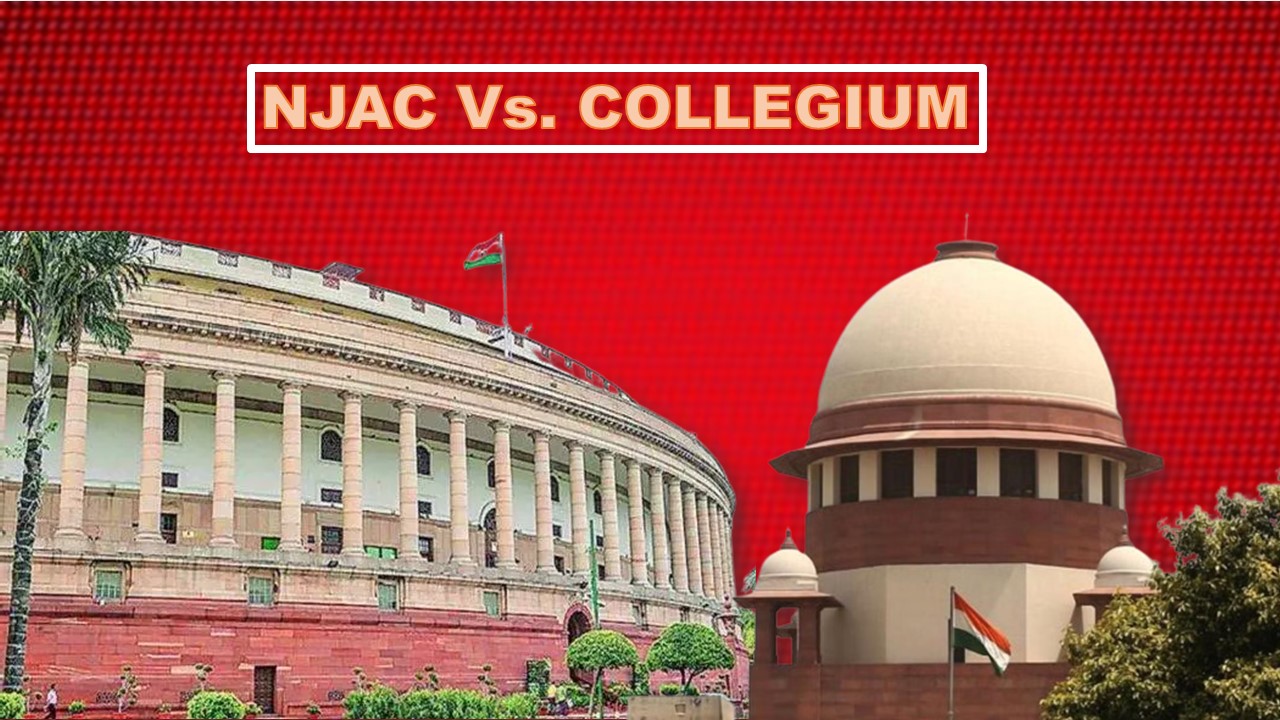
India being a participatory democracy provides a clear bifurcation between the judiciary and the legislature, to facilitate effective checks and balances on the people in authority. On the contrary, the two most powerful arms of democracy have, however, witnessed a fierce battle on various occasions. The most prominent and topical issue dealt with the appointment of Judges of High Courts and the Supreme Court.

Soon after the Modi government came to power in 2014, the legislature passed the NJAC Act, 2014, through the 99th Constitutional Amendment Act, 2014. The purported Act made it imperative on the government to incorporate a National Judicial Appointments Commission (NJAC) for the selection of judges. The move infuriated the judiciary which alleged that NJAC would undermine the independence of the judiciary and give the executive too much power.

RelatedPosts

Supreme Court: Bar Council of India Has No Power to Discipline Law Students, Only Enrolled Advocates

FSSAI moves to red-flag junk food, under pressure from the Supreme Court

Ram Mandir Donation Probe Faces Fresh Scrutiny

Load More

What followed was a tussle between the judiciary and legislature, with the Supreme Court ultimately declaring the NJAC Act and amendment as unconstitutional and void. Conversely to understand what formed the backdrop of this ferocious animosity, we have to devolve into the historical legal developments prior to the passing of NJAC.

Also read: There are strict guidelines about sale of acid that no one really follows

Brawl between the Judiciary and Legislature

The major brawl between the judiciary and the legislature came to public attention during the draconian regime of Prime Minister Indira Gandhi. At that time, the Constitution of India did not clearly define the role of the executive in the appointment of judges.

The government, led by the then Prime Minister Indira Gandhi, argued that the executive had the power to make appointments to the judiciary and that the Chief Justice of India’s (CJI) role in the appointment process was advisory.

However, the judiciary, led by the then Chief Justice of India Y. V. Chandrachud, argued that the judiciary had a “primacy” in the matter of appointments and that the executive should not have a veto power over appointments.

Also read: Courts are clear about the fate of Rohingyas, it’s the government that is not

First Judges Case (1981)

The diverse view on the legal position led to a longstanding legal and political scuffle between the judiciary and the executive. The initiation point of the dispute was marked with the filing of the writ petition in the Supreme Court, which ultimately resulted in the First Judges Case.

The First Judges Case (1981) was heard by a seven judge Bench of the Supreme Court, which provided the verdict by a 5:2 split. The Bench was concerned over the appointment of judges to the Supreme Court and High Courts in India.  The main issue was whether the executive had the power to make appointments to the judiciary without consulting the Chief Justice of India (CJI) and the judiciary.

The government had argued that the executive had the power to make appointments to the judiciary and that the CJI’s role in the appointment process was advisory. Consequently, the majority held that the CJI should have a “predominant” role in the appointment of judges and that the executive should consult the CJI before making appointments.

The court held that the judiciary has a “primacy in the matter of appointments” and that the executive should not have a veto power over appointments.

Further, the court also held that the CJI should consult the two senior-most judges of the Supreme Court and the chief justice of the high court concerned before making appointments to the higher judiciary. Evidently, the court laid down the principle of “consultation” in the appointment of judges, which means that the executive should consult with the judiciary before making appointments and that the judiciary should have a primacy in the matter of appointment of judges.

This principle forms the basis of the collegium system of appointment of judges that was established by the Second Judge case.

Also read: When a Nepalese immigrant killed one person thinking they were ghosts and Court let him go

Second Judges Case (1993)

The landmark verdict of the Second Judges Case (1993) expanded on the principles established in the First Judges Case (1981). The case was heard by a bench of 9 judges of the Supreme Court, and the judgment was delivered by a majority of 7:2.

The main issue pertained to the interpretation of the principles laid down in the First Judges Case regarding the role of the Chief Justice of India (CJI) in the appointment of judges. The government had argued that the CJI’s role in the appointment process was advisory and that the executive had the power to make appointments to the judiciary.

The majority in the Second Judge case was of the view that the CJI should have a “primacy” in the appointment of judges and that the executive should not have a veto power over appointments. The court held that the CJI should consult a collegium of senior judges before making appointments and that the executive should not have a veto power over appointments.

Also read: The SC Judgment about ‘politicians with the criminal record’ that politicians willfully ignore

Third Judges Case (1998)

The Third Judges Case (1998) further builds upon the principles established in the previous two cases (First and Second Judges Case) concerning the appointment of judges to the Supreme Court and High Courts in India and the role of the executive in the appointment process. The case was heard by a bench of 9 judges of the Supreme Court, and the judgment was delivered by a majority of 7:2.

The issue in the instant case pertained to the principles laid down in the Second Judges Case regarding the role of the Chief Justice of India (CJI) in the appointment of judges and the composition of the collegium system. The government had argued that the CJI’s role in the appointment process was advisory and that the executive had the power to make appointments to the judiciary.

Contrarily, the majority in the instant case held that the CJI should have a “primacy” in the appointment of judges and that the executive should not have a veto power over appointments. The court further held that the CJI should consult a collegium of five senior-most judges of the Supreme Court before making appointments and that the executive should not have a veto power over appointments.

Moreover, the Bench provided that the collegium system of appointment of judges, which was established in the Second Judges case, should be composed of the Chief Justice of India, the four senior-most judges of the Supreme Court, and the Chief Justice of the High Court concerned.

The verdict established that the executive should consult the judiciary before making appointments and that the judiciary should have a primacy in the matter of appointment of judges. It also reaffirmed the principle of “collegium system” of appointment of judges, which means that the CJI should consult with a collegium of senior judges before making appointments to the higher judiciary.

The well established principle subsequently led to concentration of power in the hands of privileged individuals and groups. Consequently, the Modi government brought the NJAC Act, 2014 to expand the selection process which was also thrown in the trash box by the judiciary. The repercussion of the NJAC verdict has resulted in a never-ending dispute between the judiciary and legislature which even persists today.

Support TFI:

Support us to strengthen the ‘Right’ ideology of cultural nationalism by purchasing the best quality garments from TFI-STORE.COM

Also Watch:

https://www.youtube.com/watch?v=VU2tz1rwhhA

Tags: Chief Justice of IndiaCollegiumIndian JudiciaryNJACSupreme Court
ShareTweetSend
Previous Post

Axis Bank Credit Card: A Perfect Credit Card Any Traveller Can Have

Next Post

How geopolitics became so prevalent among the Indian masses?

Related Posts

The Biggest Mistakes Injured Workers Make After a Workplace Accident
Law

The Biggest Mistakes Injured Workers Make After a Workplace Accident

20 August 2026

A workplace injury can change everything in a matter of seconds. One moment you are focused on your job,...

Reasons a Truck Accident Case May Go to Trial
Law

Reasons a Truck Accident Case May Go to Trial

19 July 2026

A truck accident case may go to trial when the parties cannot agree on liability, the value of the...

What Evidence is Used to Calculate Economic Damages?
Law

What Evidence is Used to Calculate Economic Damages?

1 July 2026

Economic damages are the actual financial losses a person suffers after an injury or wrongful act. They cover things...

Load More

Leave a Reply Cancel reply

Your email address will not be published. Required fields are marked *

I agree to the Terms of use and Privacy Policy.
This site is protected by reCAPTCHA and the Google Privacy Policy and Terms of Service apply.

Currently Playing

Beginning Of Saudi Arabia's End ? A Case Study...

Beginning Of Saudi Arabia's End ? A Case Study...

00:16:00

₹2 Crore Film, ₹143 Crore Hit: The ‘Hanuman Ansh’ Box Office Shock

00:02:46

Who Is Major Rishabh Sambhyal? The Army Officer Who Became a Social Media Sensation

00:03:34

The Missing 54: What Happened to India’s Soldiers After the 1965 & 1971 Wars | POW | Indo-Pak

00:04:43

J-20 vs India: How Super Sukhoi, Rafale & AMCA Could Counter China’s Stealth Fleet | IAF | HAL

00:03:32
Facebook Twitter Instagram Youtube
tfipostTfipost.com
Right Wing | News Analysis | Indian Opinion
  • About us
  • Contact Us
  • Careers
  • Brand Partnerships
  • Terms of use
  • Privacy Policy
  • Sitemap

©2026 TFI Media Private Limited

No Result
View All Result
  • Premium
  • Politics
    • Analysis
    • Opinions
    • Trending
  • Economy
    • Business
    • Finance
  • Defense
    • Defence
    • Strategy
    • Weaponry
  • Geopolitics
    • Africa
    • Americas
    • Asia Pacific
    • Europe
    • South Asia
    • West Asia
  • Knowledge
    • Culture
    • History
    • Indology
  • Law
  • Lounge
    • Books
    • Cinema
    • Food
    • Health
    • Sports
    • technology
    • Travel
    • Satire
TFIPOST हिन्दी
TFIPOST Global

©2026 TFI Media Private Limited