
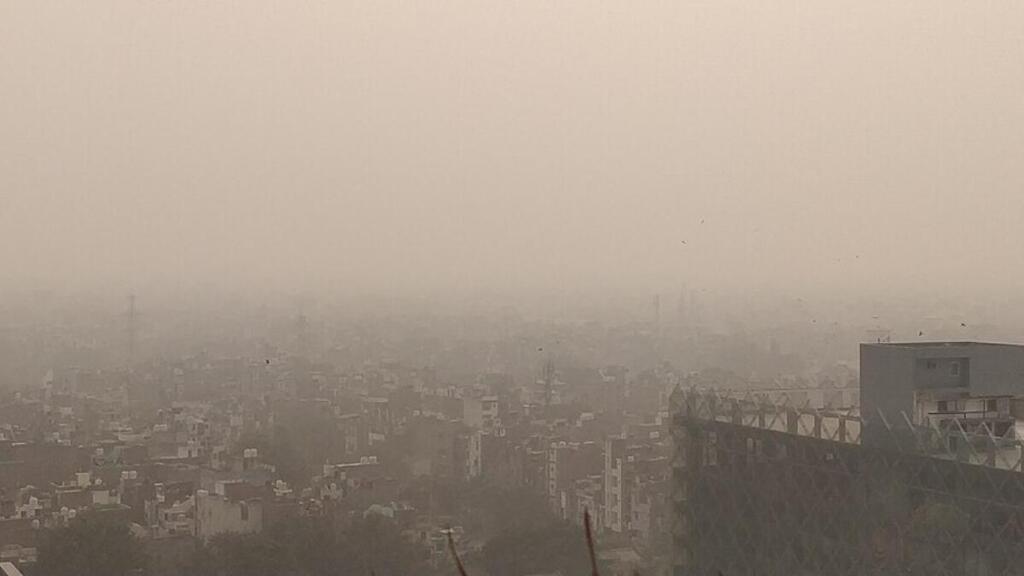
On Diwali night, air quality at 20 monitoring stations slipped into the “severe” category, while Delhi’s overall AQI stood at 371 at 10 pm. By Monday morning, several localities had reached the severe category, with Sonia Vihar close to 450. The smoke from crackers is easy to see and easy to blame. It is also the smallest part of the story.
Fireworks are a few hours of damage on top of a base that is already poor. The peaks are dramatic, but the air Delhi breathes through November and December is shaped by sources that run every day of the year.
The studies point in the same direction. A real-time source apportionment study led by IIT Kanpur found that secondary inorganic aerosols (32 percent) and biomass burning (24 percent) contributed most to winter PM2.5, followed by vehicles at 17 percent. A Centre for Science and Environment analysis of 10 to 20 November across 2023 to 2025 found that vehicles contribute roughly 51-53 per cent of Delhi’s local pollution, making transport the single largest local source. The methods and boundaries differ, but the conclusion holds. Crackers are the match, and the fuel is permanent.
The shield that is being dismantled
Delhi sits at the edge of the Thar desert’s dust-bearing winds. The Aravalli range, one of the oldest on earth, runs from Gujarat through Rajasthan and Haryana to the capital’s southern border. It works as a barrier against desert dust, a recharge zone for groundwater, and a green lung for the region. Decades of quarrying, stone crushing and real estate pressure have cut gaps into it.
The legal fight over what counts as “Aravalli” shows how contested the ground is. In November 2025, the Supreme Court adopted a “uniform” definition of the Aravallis across Gujarat, Haryana, Rajasthan and Delhi. Critics warned that the definition could exclude over 90 per cent of the Aravallis from mining restrictions. The court later stayed that verdict and declined to impose a complete ban on mining. A high-powered committee was then set up to review the definition. In September, the court gave it a final extension until November 30 to submit its report, rejecting a request for more time until February.
Whatever the committee decides, mining in the range is not the single cause of Delhi’s smog. Its larger effect is on the long-term resilience of the region: more dust, less groundwater, and a thinner natural buffer against the worst days. Protecting the range does not clear the air by itself, but losing it makes every other measure work harder.
A parliamentary standing committee flagged the significant contribution of road dust, construction and demolition activities, waste burning, and crop residue burning to air pollution. Construction in Delhi-NCR is relentless, and enforcement of dust-control norms such as covered sites, anti-smog guns, debris management and covered trucks remains uneven. Rules exist. Compliance at the site level is the weak link.
Industry beyond the city’s border
Delhi’s own factories are limited. The pressure comes from the industrial belt around it: brick kilns, power plants, steel and chemical units, and dense manufacturing clusters in neighbouring states. Pollution does not respect state lines, which is exactly the problem. The standing committee stressed that Delhi-NCR’s air pollution is a regional problem requiring coordinated action across Delhi, Haryana, Uttar Pradesh, and Rajasthan, and recommended planning and enforcement at the airshed level instead of the state level.
The data problem
Delhi has long acted on outdated information. Senior advocate Sanjay Upadhyay, as amicus curiae, told the National Green Tribunal that pollution measures in Delhi are based on source apportionment data from before 2018 and have not been updated despite newer studies. The Delhi government has since moved to a five-year collaboration with IIT Delhi for continuous, real-time source apportionment of PM2.5 and PM10. That is a step in the right direction, provided the findings drive action.
What needs to happen
The first requirement is to treat the airshed as a single unit. One empowered authority should set binding, enforceable targets across Delhi, Haryana, Uttar Pradesh, Rajasthan and Punjab, with penalties that fall on states as well as on individual polluters.
Vehicles come next, because they are the largest local source and offer the biggest gains. That means expanding electric and CNG public transport and last-mile connectivity, replacing blunt age-based bans with performance-based testing that targets high-emitting vehicles, enforcing emission norms against visibly polluting ones, and making congestion pricing and parking reform real rather than symbolic.
Construction must be made accountable. Mandatory site registration, real-time dust monitors at large projects, automatic stop-work penalties and public dashboards would turn dust rules from paperwork into practice. Builders who cannot control dust should not be allowed to build.
The Aravalli range needs to be protected as ecological infrastructure. The freeze on new mining leases should hold until the expert committee reports, the definition should rest on ecology rather than elevation alone, and illegal quarrying should be met with satellite monitoring and strict penalties. Restoration of degraded stretches should be funded, not merely announced.
Industry across the wider region has to be cleaned up. Emission standards for thermal plants, brick kilns and industrial clusters must be enforced, cleaner fuels adopted, and unit-level compliance data published.
The stubble and waste-burning cycle must end. Farmers need payment for alternatives, along with machinery and markets for crop residue, while bans on open waste burning in the city need real enforcement.
Firecracker rules must either be enforceable or be redesigned. Bans that are widely flouted lose credibility. Strict action against manufacturers and suppliers before the festival works better than policing neighbourhoods on the night, paired with community alternatives such as organised displays and laser shows.
Finally, measurement and transparency need to improve. Dense monitoring across the airshed, fresh source apportionment feeding directly into policy, and public accountability for every agency that misses its targets would close the gap between knowing the problem and acting on it.
The smog after Diwali is a symptom, not the disease. Delhi’s air is shaped by traffic, dust, biomass burning, industry and a weakened natural shield, all acting together across state lines. Crackers make the headlines for a few days. The structural causes, and the political will to confront them, decide whether the next November looks any different.