
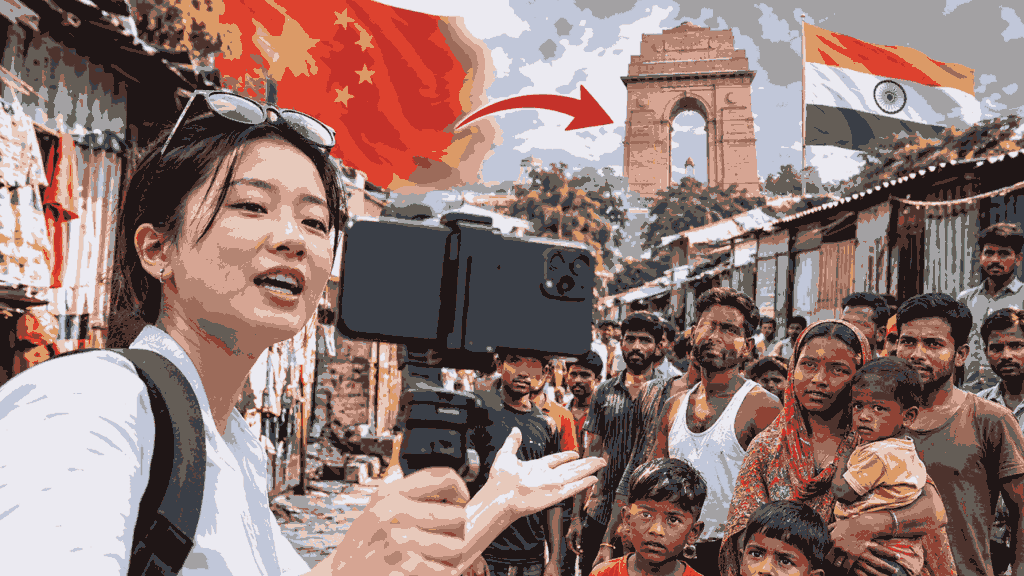
A disturbing digital propaganda operation has come under scrutiny after around 150 Chinese influencers were reportedly found filming impoverished neighbourhoods in Bangladesh and presenting them as locations in New Delhi. The revelations have raised questions about China’s information warfare tactics and the growing use of social media to undermine India’s international reputation. The controversy also brings renewed attention to the broader security concerns surrounding Jihadi Bangladesh, although the reported activities of these Chinese content creators do not establish any connection to Islamist extremist organisations.
An investigation published by Bangladesh’s leading newspaper, Prothom Alo, on November 6, revealed that Chinese nationals had been filming in the low-income neighbourhoods of Tekpara and Sector 12 in Uttara, Dhaka. Their videos were reportedly broadcast through Chinese social media platforms, including WeChat and Douyin, with the locations falsely identified as parts of India’s national capital.
According to the investigation, local residents estimated that approximately 150 Chinese nationals had been engaged in these activities over several months. The influencers reportedly concentrated on narrow streets, overcrowded residential areas, drainage channels and modest homes, presenting the footage to Chinese audiences as evidence of India’s poverty and poor living conditions.
One particularly revealing incident involved a Chinese woman identified as Mianmian, who reportedly livestreamed from beside a canal in Uttara’s Sector 12 on November 1. Although she was physically present in Bangladesh, she introduced the location as New Delhi and made derogatory remarks about the houses, sanitation and lifestyle of the residents.
Another Chinese streamer, identified as Wang Wei, reportedly filmed at tea stalls in Tekpara and made an outrageous claim that the tea consumed by local residents was prepared using cow urine. Such remarks appear designed to reinforce offensive stereotypes about Indian culture and religious practices among unsuspecting viewers.
The revelations have exposed how easily social media platforms can be exploited to manufacture misleading narratives. Instead of documenting genuine social conditions, these influencers allegedly used footage from one country to create a distorted picture of another. In the context of India’s complicated relationship with China, such activities deserve serious examination, particularly when concerns surrounding Jihadi Bangladesh and regional security already feature prominently in India’s strategic discussions.
The controversy is not entirely new. Earlier reports published by Bangladesh’s The Business Standard and Kaler Kantho had also highlighted the presence of Chinese content creators in Dhaka’s impoverished neighbourhoods. Their activities reportedly included recording residents, entering shops and filming inside private homes. Several residents complained that the repeated filming had become an intrusion into their everyday lives.
One local resident reportedly described how the Chinese nationals continued filming from early morning until late at night without adequately explaining the purpose of their activities. Other residents alleged that some content creators entered homes and even private spaces without permission, causing considerable discomfort.
There are also questions about the commercial explanations offered by some of the influencers. One Chinese national reportedly described the livestreams as part of product-promotion activities. However, this explanation does not adequately clarify why footage from Dhaka was repeatedly presented as material from Delhi or why the broadcasts contained inflammatory claims about Indian customs.
The allegations have attracted attention because China and India are competing for economic, technological and strategic influence across Asia. Public perception is an increasingly important component of this competition. Misleading videos, fabricated descriptions and deliberately manipulated geographical identities can influence audiences far beyond the locations where the footage is recorded.
India has its own challenges involving poverty, urban overcrowding, sanitation and infrastructure. These issues deserve honest reporting and constructive criticism. However, deliberately misidentifying another country’s neighbourhoods and presenting fabricated claims as Indian realities is fundamentally different from legitimate journalism.
The controversy also raises concerns about Bangladesh’s ability to regulate foreign content creators operating within its territory. The presence of large numbers of foreign nationals conducting repeated livestreaming activities, sometimes allegedly entering private properties, warrants appropriate scrutiny by local authorities. The debate surrounding Jihadi Bangladesh should not distract from the immediate questions of foreign influence, privacy violations and the potential misuse of Bangladeshi territory for propaganda activities.
At the same time, there is no conclusive public evidence establishing that the Chinese influencers were directed by the Chinese government or that their activities formed part of an officially coordinated intelligence operation. Some participants have cited commercial motives, and investigators must establish the facts before drawing definitive conclusions.
Nevertheless, the reported misrepresentation of Dhaka as Delhi demonstrates how digital platforms can become instruments of cross-border perception management. The concerns associated with Jihadi Bangladesh and regional security make transparency and accountability particularly important, but allegations must remain distinct from verified facts.
For India, the lesson is clear: defending its international image requires more than diplomatic statements. It demands timely fact-checking, credible communication and closer monitoring of organised disinformation campaigns. The wider debate over Jihadi Bangladesh must also be grounded in evidence rather than political labels.
As the investigation attracts further attention, the central question remains whether these Chinese influencers were independently exploiting poverty for online engagement or participating in a more organised effort to portray India negatively. Until that question is answered, the episode should serve as a warning about the growing power of digital propaganda and the vulnerability of public opinion to deliberately manufactured falsehoods. The controversy surrounding Jihadi Bangladesh and the alleged anti-India campaign ultimately underscores the importance of separating verified evidence from speculation.