
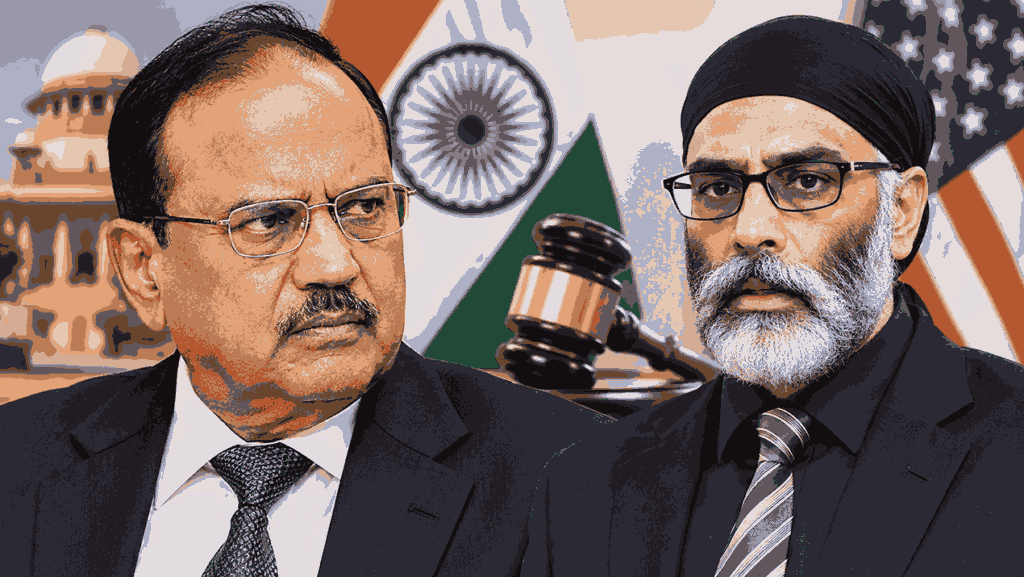
The government’s response came on Tuesday, November 10, after the US State Department confirmed that court-issued summonses had been transmitted to the Indian Embassy in Washington, DC, through diplomatic channels. The development has brought renewed attention to the legal confrontation between Pannun and the Indian government, particularly because the allegations directly name two senior figures associated with India’s intelligence and national security establishment.
Addressing the issue during a media briefing, MEA spokesperson Randhir Jaiswal delivered an unequivocal response. He stated, “We reject the fabricated and malicious attacks on our high officials. Also, we reject the frivolous lawsuits.” Jaiswal further clarified that requests for serving judicial documents in India must be routed through the country’s designated central authority, the Ministry of Law and Justice. His remarks underline India’s position that established legal procedures cannot be bypassed.
The diplomatic communication from Washington reportedly followed a note signed on September 30, 2026, with the relevant summonses and documents transmitted to the Indian Embassy on October 9. The communication invoked the Foreign Sovereign Immunities Act (FSIA), which governs the circumstances under which foreign governments and certain state-linked entities or officials can face legal proceedings in American courts. The US State Department stated that it had no discretion in carrying out the District Court’s request under the legislation.
The US lawsuit was initiated by Gurpatwant Singh Pannun, who serves as legal counsel for Sikhs for Justice (SFJ), an organisation banned by the Indian government. Pannun has sought damages over an alleged conspiracy to assassinate him on American soil. His complaint names several Indian officials, including Doval and Goel, whom he accuses of involvement in the purported operation. These allegations have been firmly rejected by New Delhi.
The controversy is particularly sensitive because Pannun has been designated a terrorist by India and is wanted by Indian investigative agencies in connection with terrorism-related charges. New Delhi has repeatedly opposed the activities of SFJ, which it considers a threat to India’s sovereignty and territorial integrity. The organisation has campaigned for the creation of an independent Khalistan through separatist activities.
The allegations in the US lawsuit are connected to a separate criminal investigation launched by American authorities in 2023. In November that year, US prosecutors charged Indian national Nikhil Gupta with allegedly participating in a conspiracy to murder Pannun in New York. According to the American indictment, Gupta allegedly worked with an individual described as an Indian government employee to arrange the killing through a purported hired assassin. The alleged operation was foiled before it could be carried out.
It is important to distinguish between the criminal proceedings and Pannun’s civil case. The criminal investigation concerns the alleged assassination conspiracy and the individuals accused of participating in it, whereas the civil complaint seeks monetary damages and directly names senior Indian officials. The allegations against Doval and Goel have not been established through a judicial finding in the civil proceedings.
The US lawsuit also raises questions about the procedural implications of serving legal documents on officials representing a foreign government. The transmission of summonses does not automatically establish the jurisdiction of an American court over the defendants, nor does it validate the accusations. The US government has clarified that its role in transmitting the documents does not represent an endorsement of the claims or their legal merits. Any objections concerning jurisdiction, sovereign immunity or other defences must be raised before the court concerned.
For India, the issue goes beyond an individual legal dispute. The government maintains that its national security institutions and senior officials should not be subjected to unsubstantiated allegations without proper legal scrutiny. At the same time, the proceedings demonstrate the complexities of handling cases involving alleged transnational conspiracies, diplomatic sensitivities and competing legal jurisdictions.
New Delhi’s response makes its position unmistakable: it rejects the accusations and intends to defend its institutional interests through established legal and diplomatic channels. As the proceedings continue, the distinction between allegations, procedural developments and proven facts will remain essential to understanding this increasingly sensitive India-US legal confrontation.