
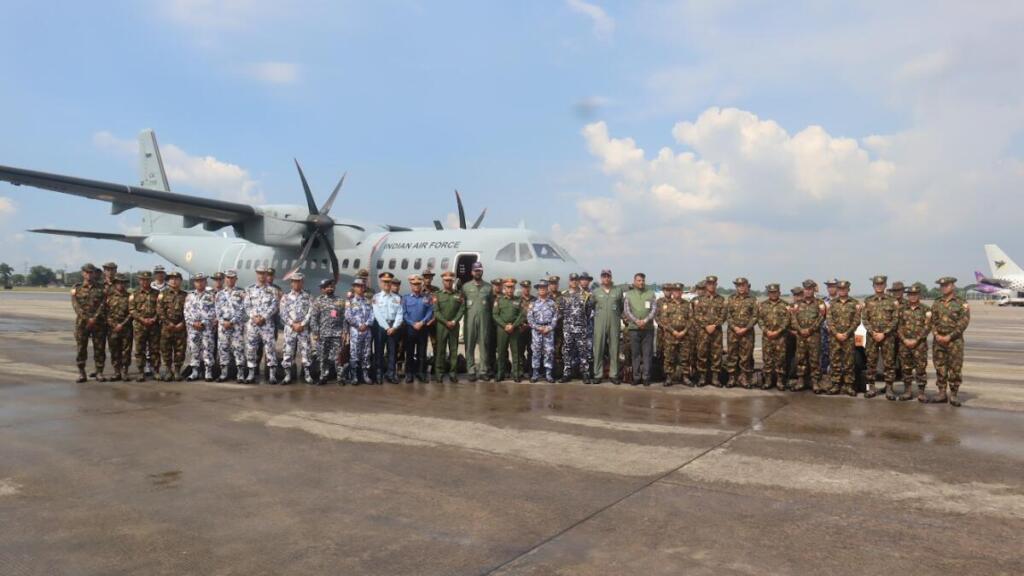
India and Myanmar have begun their first bilateral exercise in which the armed forces of both countries rehearse how to respond when disaster strikes. Titled ‘Rahat Mitra’, the Tri-Services Humanitarian Assistance and Disaster Relief (HADR) exercise opened in Chennai on 5 November 2026 and runs through 6 November.
It is a two-day drill built around relief work rather than combat. HADR operations cover the help that militaries provide after floods, cyclones, earthquakes and similar emergencies, such as rescue, medical aid and the delivery of essential supplies. The name Rahat Mitra can be read as “relief friend”, and the exercise carries the theme “Together for Humanity, Stronger through Partnership.”
This is the maiden edition, and it is described as the first bilateral Tri-Services HADR exercise between the two countries. Tri-Services means that the Army, Navy and Air Force of both nations are taking part.
More than 300 personnel from all three services of India and Myanmar are involved. The exercise is coordinated under the aegis of the Indian Navy.
What is it meant to achieve?
The stated aims are to strengthen bilateral cooperation, build mutual trust and improve coordination between the two countries’ armed forces. Personnel will engage in professional exchanges, share experiences and work on interoperability, which means being able to operate smoothly alongside one another when a real crisis demands a joint response. The exercise also reflects the shared commitment of both nations to humanitarian cooperation and regional disaster response.
Why does it matter beyond the drill?
The exercise is presented as a step towards deeper defence cooperation and the longstanding relationship between India and Myanmar. It is also linked to two of India’s policy frameworks. The first is the ‘Neighbourhood First’ policy, which prioritises ties with nearby countries. The second is MAHASAGAR, which stands for Mutual and Holistic Advancement for Security and Growth Across Regions.
Both nations, the release says, share a resolve to uphold peace and stability and to provide humanitarian assistance in times of crisis. Joint practice of this kind means that, when a disaster does occur, responders have already worked together.
Rahat Mitra is modest in scale, with two days and a little over 300 personnel, but it is a first. It sets a template for India and Myanmar to work side by side on relief, an area of cooperation that is easier to build trust around than most.