
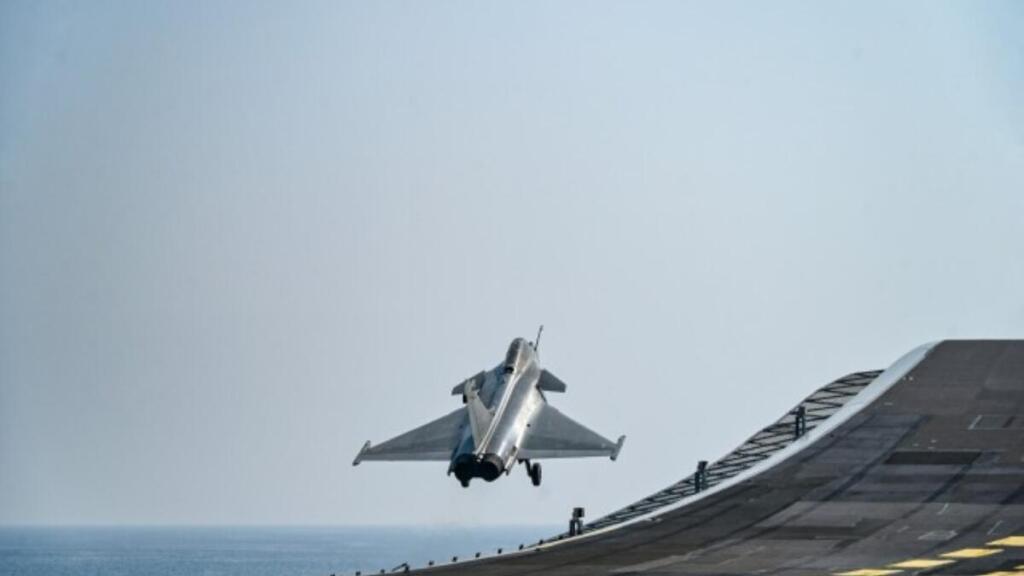
On 29 October, a Rafale Marine touched down on INS Vikrant on its first attempt. The Navy released the video a day later, with a measured caption: the ongoing trials mark the first steps towards operationalisation of the aircraft. The landing was carried out under Captain Ashok Rao, the carrier’s commanding officer. A first-attempt landing on a flight deck sounds like the end of a story, but it is closer to the opening chapter. The jet is flying from a ship it was never designed for.
Two ways to launch a fighter
An aircraft carrier has two jobs: throw jets into the air and catch them coming back. Navies solve the first problem in two basic ways.
In a CATOBAR carrier, the name stands for Catapult Assisted Take-Off But Arrested Recovery. A catapult hurls the aircraft down the deck, accelerating it to flying speed within about a hundred metres. The French Navy’s Charles de Gaulle works this way, as do US carriers. The Charles de Gaulle is a 42,500-tonne nuclear-powered ship with steam catapults. Catapults allow a greater maximum takeoff weight, and so more payload for fuel and ordnance.
In a STOBAR carrier, Short Take-Off But Arrested Recovery, there is no catapult. The aircraft uses its own engines to accelerate along the deck and leaves a curved ramp at the bow, the ski-jump, which angles it upward into flight. India’s INS Vikrant works this way. The Vikrant has a 14° ski-jump, two restraining gears for take-off and three arresting gears of steel cable for landing. STOBAR trades performance for simplicity: it is less expensive to develop, and a ski-jump has no moving parts, so it costs less to maintain than a catapult.
Both systems recover aircraft the same way. A tailhook drops from the jet’s belly and catches a wire, stopping a machine moving at well over a hundred knots in roughly a hundred metres. Landing is, in principle, the part the two systems share.
So why does the landing matter?
The Rafale M, Dassault’s carrier version of the fighter, was designed for CATOBAR operations, as used on the Charles de Gaulle. Its airframe is built for stress, with a strengthened structure to withstand ski-jump take-offs and arrested landings. Still, Indian carriers present conditions the French jet was not originally tested against. The landing confirms the aircraft’s approach handling, hook engagement and deck compatibility on Vikrant itself. It also confirms that the ship’s arresting gear, pilot cues and flight-deck routines work with a new type.
The harder test is the take-off. A catapult delivers energy from outside the aircraft, and a ski-jump relies entirely on the jet’s engines, runway length and ramp geometry. Some sources say aircraft may need to limit weapons and fuel to become airborne from a ski-jump, though others suggest heavy loads are possible. The question for the Rafale M is how much weapons load and fuel it can carry off Vikrant’s deck, since a fighter that must leave half-empty can fly shorter missions with fewer weapons. That sets the real range of the carrier’s air wing.
What the Goa trials are checking
The shore-based work comes first, at INS Hansa near Dabolim. The facility reproduces the ski-jump ramp and arrestor-wire set-up used on Indian carriers, letting the Navy test aircraft before risking a ship. The Rafale M was tested at the 283-metre-long facility, with multiple ski-jumps, roll-ins and fly-in arrestments in various configurations, including with air-to-air, air-to-ground and air-to-surface loads. The aircraft was seen with a telemetry pod fitted, a sign that performance data is being gathered to certify take-off and landing procedures.
The trials are validating several things at once. Structural loads on the undercarriage and airframe need to stay within limits during ski-jump launches and hard arrested landings. Take-off performance has to be established at different weights, so the Navy can fix safe fuel and weapon combinations. Deck handling matters too: how the jet fits in the hangar, moves on lifts and is parked on a crowded flight deck. One practical issue under review is the Rafale M’s fixed, non-folding wing, which takes more space than the folding wings of some carrier fighters. Reports suggest Indian carriers may need upgrading to accommodate the aircraft.
Where this fits in India’s naval plans
Vikrant, commissioned in 2022, displaces about 45,000 tonnes and cost roughly ₹23,000 crore. It currently operates MiG-29K fighters, which have had a mixed record. India signed an agreement on 28 April 2025 for 26 Rafale M jets, 22 single-seat and four twin-seat trainers, at about ₹63,000 crore, including weapons, simulators, training and support. Deliveries are expected by the end of 2028 or early 2029, although some references cite 2030. The aircraft will operate from both INS Vikrant and INS Vikramaditya. The purchase is an interim capability until the indigenous Twin-Engine Deck-Based Fighter, or TEDBF, becomes available, and it offers logistical commonality with the Indian Air Force’s existing Rafales.
A larger question follows. STOBAR sets a ceiling on aircraft weight, and it limits the sorties a carrier can generate. India’s planned third carrier, INS Vishal, has been discussed as a 65,000-tonne CATOBAR design with electromagnetic catapults, to support heavier fighters, airborne-early-warning aircraft and unmanned combat aircraft that cannot launch from ski-jumps. Whether it gets built is a separate decision, and for now the Navy is making STOBAR work.
What remains
A Rafale on Vikrant’s deck is not a Rafale in service. The maiden landing does not mean the Rafale-M has entered operational service. Carrier take-offs, night operations, loaded launches and sustained deck cycles remain to be shown. The first landing proved that two very different carrier traditions, a French catapult fighter and an Indian ski-jump ship, can be made to work together. Whether they can do so at full combat weight, day after day, is what the remaining trials will establish.