
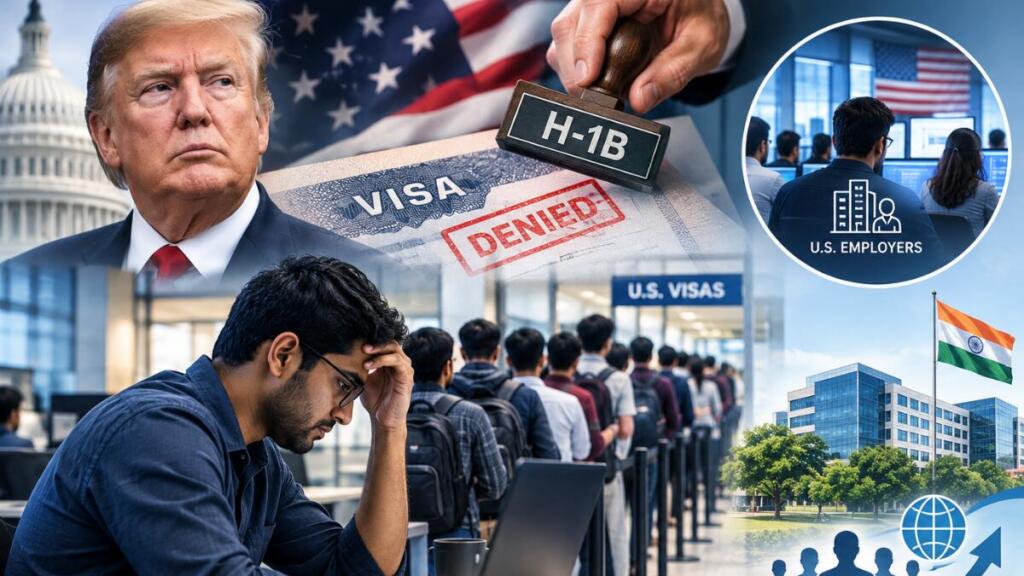
The Trump administration’s latest move against employer-sponsored permanent residency has been widely read as a blow to India’s IT services industry. The numbers suggest the sector’s direct exposure is smaller than the headlines imply. The people and companies that stand to lose most may be elsewhere: the individual workers stuck in the queue, and American employers that depend on global talent.
The first thing to get right is what has been suspended, because “H-1B,” “PERM” and “green card” are being used as if they were the same thing. They are not.
The H-1B is a temporary work visa. It lets an employer bring in a skilled foreign worker for up to six years. PERM, short for Program Electronic Review Management, is something else entirely. It is the labour certification process run by the Department of Labor. Before applying, a company generally has to show there are no qualified and available US workers for the job and that hiring a foreign worker will not hurt the wages or working conditions of American workers. A green card is the end product, and PERM is only the first of several gates on the way to it.
The sequence matters. For most employment-based applicants, an approved PERM allows the employer to file an immigrant petition with USCIS, and only after that does the worker apply for the green card itself. Suspending PERM filings for named employers therefore does not cancel anyone’s green card, and it does not revoke an H-1B. It stops those employers from starting, or advancing, one specific step. Existing employees can keep working in America on their current visas. What changes is their path to staying permanently.
The suspension is also tied to enforcement rather than to a general rule change. The Labor Department’s Inspector General said that “Threats to American workers will NOT be tolerated,” and the action followed a July investigation into alleged fraud involving the H-1B and PERM programmes. Reports have named Cognizant and the US software firm Cloudera among the affected employers, and later coverage points to a wider list of IT companies, so the scope is still evolving. Authorities have not said how many applications are affected or how long the suspension will last. Filing large numbers of applications does not, by itself, establish wrongdoing.
How exposed are Indian IT companies?
On the available figures, less than the framing suggests. The Labor Department received 117,849 PERM applications in fiscal 2025. According to Labor Department data reported for October 2024 to September 2025, fewer than 1,400 of those came from the major Indian IT companies, which is under 2 percent of the total. Infosys has reportedly filed no PERM cases since 2022, though at least one public dataset shows it with a small number of filings in fiscal 2024, so the precise figure is contested. In fiscal 2025, Wipro, TCS and HCLTech reportedly received 523, 513 and 393 PERM approvals respectively.
The comparison with American firms is striking. Microsoft alone had 3,161 PERM cases decided in the same period, more than Wipro, TCS and HCLTech combined. If the question is who is more exposed to a PERM suspension, the arithmetic points toward US companies as much as Indian ones.
The same pattern shows up in the H-1B data, which explains why. A National Foundation for American Policy analysis of USCIS figures found that the top seven Indian IT firms received just 4,573 approvals for new H-1B workers in FY2025, 37 percent fewer than the year before. The group’s executive director said the data suggests Indian IT firms are increasingly delivering services to US clients with fewer H-1B workers. Years of visa pressure have already pushed these companies toward local hiring, offshore delivery and smaller sponsored workforces. A policy aimed at the sponsorship pipeline hits a pipeline that has already narrowed.
Who pays the real price
The costs fall unevenly, and the heaviest falls on individuals. A worker whose employer is barred from filing PERM cannot start the clock on a green card, and for Indian nationals the clock is already punishing. Per the State Department’s visa bulletin figures cited in recent coverage, the India cut-off for final action is 15 October 2022 for EB-1, EB-2 is unavailable, and EB-3 stands at 1 January 2014. Workers approaching the six-year limit on their H-1B, who rely on a PERM filing to qualify for extensions, face the sharpest risk. For them, a pause of unknown length is not a delay but a possible end to their time in the country.
American employers pay in a different way. PERM reviews have been slow even without a suspension, averaging about 16.5 months for analyst review as of March 2026. Firms that use green card sponsorship to retain engineers, specialists and client-facing staff lose a retention tool at the point when those workers are hardest to replace. The inclusion of non-Indian firms such as Cloudera among those affected is a reminder that the policy does not respect the “Indian IT” label.
Indian IT companies pay the least directly. They face compliance costs, reputational uncertainty and some pressure on the retention of experienced staff in the US. But with so few PERM filings on the books, their near-term operating risk is modest. The larger exposure is indirect: if sponsored staff leave, delivery teams must be rebuilt, and projects in the US may shift toward offshore centres in India.
The retention problem
The deeper problem is uncertainty rather than the suspension itself. Skilled professionals plan around multi-year timelines, and a process that can be halted for named employers without warning or an end date is a poor basis for planning a career or a family. If the uncertainty continues, some experienced engineers will look to Canada, the UK, Germany or the Gulf, or choose to return home. Those are exactly the people American companies say they need to keep.
That does not make the administration’s position illegitimate. Its case is that visa and green card programmes have been abused, that some employers favour foreign hires over American ones, and that enforcement is overdue. Protecting wages and job opportunities for US workers is a legitimate aim, and fraud, where proven, should be punished. But enforcement against specific employers on the basis of investigations that have not reached findings is different from a policy that raises the cost of hiring and keeping global talent across the board.
Washington may believe it is applying pressure to Indian IT companies. On the evidence of filing volumes, those companies are among the least exposed participants in the system, and the cost lands first on the workers caught in the queue and second on the American employers that rely on them. The central question is whether the administration is protecting its workforce or narrowing the pool of talent that its most competitive industries draw from. That will depend on how long the suspension lasts, whether it ends in findings or in quiet withdrawal, and whether the chilling effect on skilled migration outlasts the action itself.